 Warble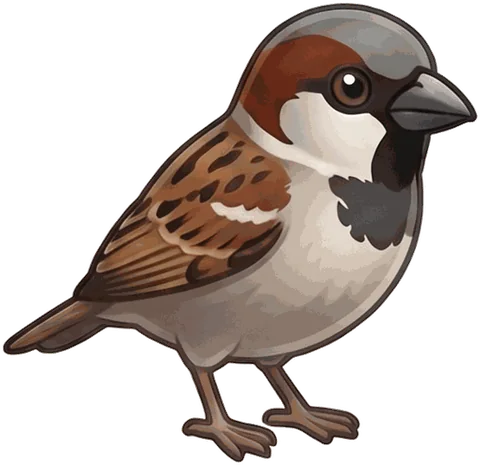
A House Sparrow sounds like a plain, unmusical cheep or chirrup, repeated over and over with no real tune. It is the background noise of parking lots, storefront awnings and suburban hedges in every town in the country. In spring a male stands beneath a hole in a wall or under an eave and fires off the same chirp faster and louder, and that is as close as this bird gets to a song. Groups keep up a shrill, monotonous chattering in shrubs, loudest around dusk when they gather to roost.
What the song sounds like
There is no melody to learn. The House Sparrow's entire repertoire is built from one short, slurred, flat note, written as chirrup, chireep or philip, and nearly everything it says is a variation on it. The song is simply that note delivered with emphasis and speed, again and again, for minutes at a time. Ornithologists sometimes call it an ecstatic call rather than a song, which is fair: it is more enthusiasm than music.
The performance matters more than the sound. In the breeding season the male perches right beside the nest hole he has claimed, drops his wings, puffs his chest so the black bib shows, and chirps at anything female that passes. Other males often gather and join in, so a single eave can turn into a shouting match. If you hear the same nonmusical chirp coming from a wall vent, a streetlight or the gap behind a shop sign, you have found a nest.
The calls: chirps, trills and the dusk chatter
Besides the chirp there is a fast, trilled chur-r-r-it-it-it when two birds squabble over food or a nest, a nasal quer as an alarm and a thin chree when a bird is grabbed. Fledglings out of the nest beg with a soft warble that sounds surprisingly like a finch. The most familiar sound of all, though, is the crowd: dozens of sparrows packed into a dense hedge, an ivy-covered wall or a shopping-center tree, all chirping at once in the last half hour of daylight. From the sidewalk it sounds like a single bush arguing with itself.
When and where you hear it
House Sparrows are permanent residents across almost all of North America, and they sing and chirp in every month, though the spring display is the loudest. The rule for finding them is simple: look for people. They live in cities, towns and farmyards and around isolated buildings even in desert or forest, and they are essentially absent from land that people have not altered. They reach their highest densities in city centers, feed by hopping on pavement and lawns for seeds, waste grain and crumbs, and nest in any enclosed cavity they can find, from a drainpipe to a bluebird box.
They are not from here. The species is native to Europe, Asia and North Africa, and birds from England were released in New York in the early 1850s, partly in the hope that they would eat insect pests. They did not eat many, but they spread across the continent within decades and now range from northern Canada to Panama. The eastern population peaked around 1900 and has been slowly declining since, and numbers have fallen in parts of the range, though the bird remains one of the most abundant on the continent.
The decline is small comfort to native cavity nesters. House Sparrows aggressively take over holes and boxes used by bluebirds, Tree Swallows, Purple Martins and woodpeckers, and they raise several broods a season, so they are the one bird most nest-box landlords learn to recognize by ear first.
What it looks like
A stocky, thick-billed sparrow about 6 inches long, heavier and rounder than most native sparrows. The male has a gray crown, chestnut on the nape and sides of the head, white cheeks and a black bib that grows larger as the bird ages. The female is plain: buffy below, streaked brown and black on the back, with a pale eyebrow stripe and a yellowish bill. Despite the name, it is not related to our native sparrows at all. It belongs to the Old World sparrow family, which is one reason it looks and sounds so different from a Song Sparrow or a Chipping Sparrow. The diet is roughly 90 percent seeds, topped up with insects in summer and whatever people drop.
Birds that sound similar
 House Finch
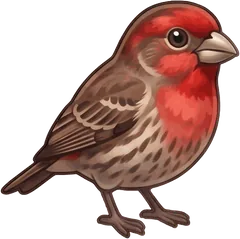
A House Finch's call is a chirp much like a young House Sparrow's, but the finch also sings a long, bouncy warble that ends in a slurred cheer. A House Sparrow never sings a melody of any kind.
- ?Eurasian Tree Sparrow
Its chirping is higher and more metallic, with a hard tik tik in flight, and it lives only around St. Louis and nearby parts of Illinois and Iowa. Look for the chocolate-brown crown and a black spot on the white cheek.
Where the House Sparrow card lives
In Warble the same bird can be an easy card in one state and a prized one in another, because each album ranks its birds by how often people really report them there. The House Sparrow appears in 50 state albums:
 Heard one? Open Warble, tap the green button while it sings, and the House Sparrow card flips into your album. Get the app free.
Questions people ask
Do house sparrows actually sing?
Not in the way a robin or a finch does. The male's song is his ordinary chirrup repeated fast and loud beside a nest hole, sometimes for minutes. There is no melody, which is the easiest way to tell it from any native songbird.
Why are there so many sparrows chirping in my hedge at dusk?
They are settling in to roost. House Sparrows sleep communally in dense shrubs, vines and evergreens, and the whole flock chatters as it gathers in the last light. The noise usually stops soon after dark and starts again at dawn.
Are house sparrows native to the United States?
No. They are native to Europe, Asia and North Africa and were released in New York in the early 1850s. They spread across the continent within a few decades and are now among its most numerous birds, always close to buildings.
Are house sparrows a problem for bluebirds?
Yes. They compete for the same nest cavities and boxes and will evict bluebirds, Tree Swallows and Purple Martins, which has contributed to declines of those native birds. Learning the flat chirp helps you notice when sparrows have moved into a box.
Sources
- National Audubon Society, Guide to North American Birds: House Sparrow. www.audubon.org/field-guide/bird/house-sparrow
- Wikipedia: House sparrow (vocalizations, introduction, nesting, diet). en.wikipedia.org/wiki/House_sparrow
- Missouri Department of Conservation, Field Guide: House Sparrow. mdc.mo.gov/discover-nature/field-guide/house-sparrow
- Missouri Department of Conservation, Field Guide: Eurasian Tree Sparrow. mdc.mo.gov/discover-nature/field-guide/eurasian-tree-sparrow