 Warble
A Blue Jay sounds like a loud, harsh jay! jay! jay!, a raucous, almost gull-like scream that speeds up as the bird gets more worked up. That is only its best-known voice. Jays also give a clear, bell-like queedle-queedle, a squeaky note like an old hand pump, soft murmurs and whistles, and a near-perfect copy of a Red-shouldered Hawk scream. If a hawk seems to be screaming from inside a leafy oak in the suburbs, it is probably a jay.
The birder's mnemonic
“jay! jay! jay!” The bird more or less shouts its own name, usually two or three times in a row and louder than seems necessary.
What it sounds like: the jeer
Blue Jays do not sing the way a robin or a cardinal sings. The sound everyone knows is the jeer: a harsh, ringing jay, jay or jayer, jayer that carries across a neighborhood. It is an alarm and a rallying cry at once, and the faster it comes the more agitated the bird is. When a jay spots a hawk, an owl or a cat, the jeering pulls in other jays and they mob the intruder together until it leaves.
The rest of the repertoire surprises people. There is a musical two-note queedle-queedle with a bell-like tone, clear chime-like whistles, and a quiet creaky call that birders name the rusty pump because it sounds exactly like an old hand-operated water pump. Up close, jays also mutter softly, and they can imitate a meowing cat.
The calls: loud in the open, silent at the nest
The loud calls are for the open: feeders, roadsides, the edge of the woods, and especially fall, when jays move in noisy groups through the oaks collecting acorns. Around the nest the bird changes personality. Nesting jays become quiet and inconspicuous, slipping in and out of a dense tree with barely a sound, until a crow or a cat gets too close and both adults erupt in a screaming attack. That is why people think the jays have vanished in May and June. They have only stopped announcing themselves.
When and where you hear it
Blue Jays live from southern Canada across the eastern and central United States, south to Florida and northeastern Texas, and their range stops roughly at the eastern foothills of the Rockies, where the Steller's Jay takes over. They like oak and pine woods, groves, well-wooded suburbs and city parks, anywhere with oaks or beeches, and they are thinner in deep unbroken forest. In recent decades the range has been creeping northwest.
Most jays are present all year, but every fall a variable number head south, and in some years the flights are enormous, with thousands passing along the Great Lakes and the Atlantic coast in loose daytime flocks. They do not leave the United States, and much about which birds go and why is still a mystery. In the eastern states the jay is a common card, and its calls carry far enough that it is often the first bird a Warble player catches without ever seeing it.
The hawk impression
Jays are expert mimics, and their specialty is the shrill, down-slurred kee-yeeear of the Red-shouldered Hawk, along with the calls of other hawks. The copy is close enough that field guides warn it can be very hard to tell apart by ear. The practical clue is context: a hawk scream from inside foliage or from right beside the feeder is almost always a jay, and the bird often drops the disguise a moment later with an ordinary jay, jay.
What it looks like
A big, flashy songbird, 9 to 12 inches long with a 13 to 17 inch wingspan, weighing 2.5 to 3.5 ounces. The back is dull blue-gray, the wings and tail are bright blue barred with black, with white wing bars and white tail corners. The face is white and nearly ringed by a black necklace, and the tall crest goes up and down with the bird's mood. Males and females look alike.
The blue is a trick of light. There is no blue pigment in the feathers, only brown melanin; the color comes from the feather's internal structure scattering light, which is why a crushed jay feather loses its blue.
Birds that sound similar
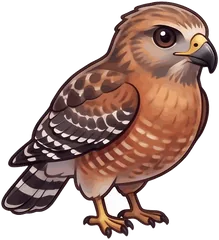 Red-shouldered Hawk
The Red-shouldered Hawk's shrill, falling kee-yeeear is the model for the jay's best impression. A scream from inside a tree or near a feeder is the jay, and it usually gives itself away with a jeer soon after.
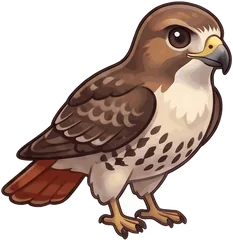 Red-tailed Hawk
The Red-tailed Hawk's hoarse, descending keeeeer is also copied by jays. The real thing is rougher and longer; a hawk scream from a bird at your feeder is a jay.
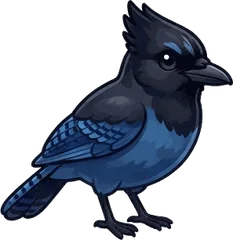 Steller's Jay
West of the Rockies the Steller's Jay gives a harsh shack-shack-shack or chook-chook-chook, deeper and more rattling than the Blue Jay's ringing jay. It mimics hawks too. The two barely overlap, so geography decides.
Where the Blue Jay card lives
In Warble the same bird can be an easy card in one state and a prized one in another, because each album ranks its birds by how often people really report them there. The Blue Jay appears in 41 state albums:
 Heard one? Open Warble, tap the green button while it sings, and the Blue Jay card flips into your album. Get the app free.
Questions people ask
Why does a blue jay sound like a hawk?
Blue Jays are skilled mimics and give a near-perfect copy of the Red-shouldered Hawk's scream, plus calls of other hawks. The imitation is so close that guides say it is often hard to tell which bird you are hearing. If the scream comes from inside a leafy tree or near a feeder, bet on the jay.
Do blue jays migrate?
Partly, and nobody fully understands it. Most jays stay all year, but each fall some head south, sometimes in huge daytime flights of thousands along the Great Lakes and the Atlantic coast. They stay within the United States, and the same individual may migrate one year and stay put the next.
Why do blue jays scream so much?
The loud jay, jay is an alarm and a call to arms. It warns other jays of a hawk, owl or cat and gathers them to mob the intruder. The call speeds up as the bird gets more agitated, so a fast, relentless jeer usually means a predator is sitting nearby.
Are blue jays actually blue?
Not by pigment. The only pigment in a jay's feathers is melanin, which is brown. The blue comes from the microscopic structure of the feather scattering light, and if you crush a feather the blue disappears.
Sources
- National Audubon Society, Guide to North American Birds: Blue Jay. www.audubon.org/field-guide/bird/blue-jay
- Wikipedia: Blue jay (vocalizations, migration, structural color). en.wikipedia.org/wiki/Blue_jay
- Missouri Department of Conservation, Field Guide: Blue Jay. mdc.mo.gov/discover-nature/field-guide/blue-jay
- National Audubon Society, Guide to North American Birds: Red-shouldered Hawk (the call jays imitate). www.audubon.org/field-guide/bird/red-shouldered-hawk