 Warble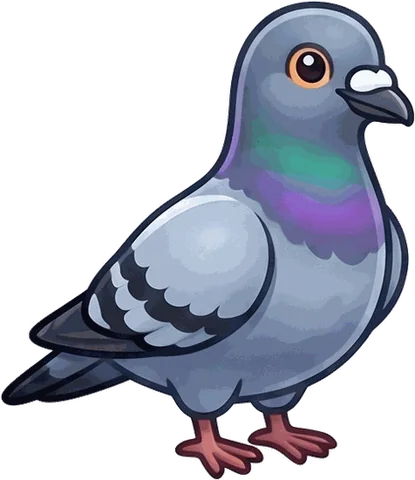
A Rock Pigeon sounds like a soft, throaty, rolling coo, crruoo-u, crruoo-u, a low, slightly wavering gurgle that never quite turns into a whistle. Males give a louder, more insistent version while strutting in circles with the tail spread and the chest puffed, bowing at a female. The other sound is mechanical: when a flock bursts off a ledge the wings clap loudly, and a displaying male claps his wings together above his back as he takes off. In a city you will hear the wings more often than the voice.
What the song sounds like
The pigeon's coo is guttural and continuous, more of a purr than a note. Where a Mourning Dove shapes its cooing into a clear, sad phrase, the pigeon rolls the sound around in its throat: crruoo-u, crruoo-u, soft, low and slightly wavering, repeated as long as the bird is in the mood.
The display coo is the loud one. A courting male inflates his throat, fans his tail, drops his head and struts in tight circles around a female, bowing and cooing with each step. The same performance, with the same sound, is used to threaten a rival, so a lot of pigeon cooing is one bird telling another to move along. Because pigeons can breed in any month, thanks to the crop milk both parents produce for their squabs, the display and its cooing go on all year, peaking in spring and summer.
The calls: wing claps, grunts and hisses
Most pigeon sounds are not vocal. Takeoff is a loud, clattering flap, and in display flights a male claps his wings together above his back as he flies. A flock exploding off a plaza when a dog runs through it is one of the loudest bird sounds in a city. The voice does have an alarm, a short grunt-like oorhh given at the sight of a hawk or a cat, and at the nest pigeons hiss, snap the bill and stamp their feet at an intruder.
When and where you hear it
The wild Rock Pigeon is a cliff bird of southern Europe, North Africa and western and southern Asia. People domesticated it at least 5,000 years ago for food and for carrying messages, and it traveled the world aboard European ships from the early 1600s onward. Colonists brought domestic pigeons to North America in the early seventeenth century, and the city pigeons of every American downtown are the descendants of birds that escaped or were let go, many of them homing pigeons that never made it home.
To a pigeon a skyline is a cliff: window ledges, bridge girders, grain elevators and highway overpasses stand in for the rock faces it evolved on. Pigeons do best where there are tall buildings, green spaces, plenty of dropped food and schools, and worst in far-flung suburbs. They feed by walking on the ground on seeds, waste grain, bread and popcorn, and they are present and cooing on every day of the year across most of North America. Farm country has its own flocks around barns and silos.
In Warble the pigeon counts like any other bird, and catching it from a park bench feels a little like cheating. The homing ability that made it useful is real: trained birds released hundreds of miles from home, in places they have never seen, find their way back to the loft.
What it looks like
A stout bird 12 to 14 inches long with a two-foot wingspan, weighing 8 to 13 ounces, with a small head, short legs and a short, squared tail. The ancestral pattern, still the most common, is pale gray with a darker gray head and neck, a green and purple shimmer on the neck, two black bars across each wing, a white rump and a black band at the tip of the tail. Centuries of domestic breeding have added every other combination: checkered wings, solid dark gray, rusty red, brown, pure white and pied birds with random white patches, all in the same flock. Females show a bit less iridescence than males.
Birds that sound similar
 Mourning Dove
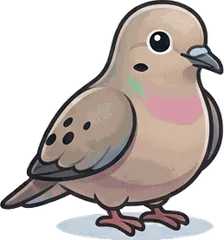
The Mourning Dove's coo is a clear, mournful phrase with a rising accented second note and a fading tail. The pigeon's is a rolling throaty gurgle. On takeoff the dove's wings whistle; the pigeon's clap.
 Eurasian Collared-Dove
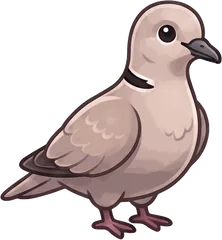
The collared-dove chants a deep, three-part kuk-kooooo-kuk with the stress in the middle, over and over, and gives a harsh nasal mew. Nothing in a pigeon's voice has that clear three-beat rhythm.
- ?Band-tailed Pigeon
The West's native pigeon gives a deep, owl-like whoo-hoo from oak canyons, foothills and mountain conifer forests along the Pacific coast and in the Southwest, not from sidewalks. It is larger, with a white band on the nape and a yellow bill.
Where the Rock Pigeon card lives
In Warble the same bird can be an easy card in one state and a prized one in another, because each album ranks its birds by how often people really report them there. The Rock Pigeon appears in 51 state albums:
 Heard one? Open Warble, tap the green button while it sings, and the Rock Pigeon card flips into your album. Get the app free.
Questions people ask
Why do pigeons coo?
Mostly for courtship and for arguing. A male coos while bowing and strutting in circles around a female, and he uses the same puffed-up display to warn off rivals. Pigeons can breed year-round, so the cooing never really stops, though it is loudest in spring and summer.
Why do a pigeon's wings clap when it takes off?
A pigeon's takeoff is a loud flap on its own, and in display flights males deliberately clap the wings together above the back, often after mating or during a dispute, before gliding with the wings raised. A whole flock flushing at once turns that into a clatter.
Are pigeons native to North America?
No. The Rock Pigeon is native to Europe, North Africa and Asia and was domesticated thousands of years ago. Colonists brought domestic pigeons to North America in the early 1600s, and today's city flocks descend from birds that escaped or were released.
Why are city pigeons so many different colors?
Because they are feral descendants of domestic birds. The wild pattern is gray with two black wing bars, but centuries of breeding produced checkered, solid, red, brown, white and pied forms, and all of them now mix freely in the same flocks.
Sources
- National Audubon Society, Guide to North American Birds: Rock Pigeon. www.audubon.org/field-guide/bird/rock-pigeon
- Wikipedia: Rock dove (voice, wing clapping, domestication, size, plumage, breeding). en.wikipedia.org/wiki/Rock_dove
- Wikipedia: Domestic pigeon (introduction to North America, homing, origin of feral pigeons). en.wikipedia.org/wiki/Domestic_pigeon
- Animal Diversity Web (University of Michigan): Columba livia. animaldiversity.org/accounts/Columba_livia/