 Warble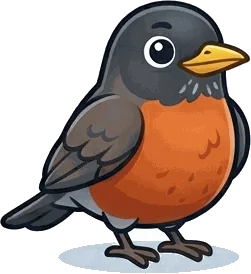
An American Robin sounds like a long, cheerful whistled speech: short two- and three-note phrases, each rising or falling, strung together with tiny pauses and repeated for minutes at a time. Birders write it as cheerily, cheer up, cheer up, cheerily. It is one of the first voices of the day, often starting before first light in spring, and among the last at dusk. Away from the song, robins give a sharp pick followed by a low tut-tut-tut, and a thin see-lip in flight.
The birder's mnemonic
“cheerily, cheer up, cheer up, cheerily, cheer up” Say it in a sing-song voice with a pause after every second or third word and you have the rhythm; the real bird keeps going far longer than you will.
What the song sounds like
The robin's song is a carol: rich, liquid whistles that rise and fall in pitch, delivered in short phrases of two or three notes. The bird repeats and shuffles those phrases into a long string with a brief breath between each one, and it can go on almost without stopping. A spring morning can seem to have several robins when it is one bird singing for half an hour.
The tone is clear and a little rounded, less pure than a Northern Cardinal and less hurried than a House Finch. If a robin-like song sounds hoarse or buzzy, check the lookalikes below. Males sing from a high perch, a treetop, a power line or a rooftop, and the song carries across a whole block of yards.
The calls: pick, tut-tut-tut and see-lip
Robins talk far more than they sing. The everyday alarm is a sharp pick or puck, usually followed by a low clucking tut-tut-tut or kuk-kuk-kuk, given with emphatic jerks of the tail. Speed and volume rise with the bird's worry: a cat on the lawn or a person too close to a nest gets the loud, fast version.
There is also a thin, high see-lip given in flight that you can hear in any month, including midwinter when flocks pass overhead. Once you know it, robins in a bare December sky stop being a mystery.
When and where you hear it
Robins are among the earliest songbirds in the dawn chorus, often starting before there is any light, and they keep going in the evening after most other birds have gone quiet. The singing season runs from late February or early March to late July or early August. In the Northeast the first warm mornings of late March bring the first songs, the dawn and dusk choruses peak in late April, and the volume tapers off by mid-July.
The species breeds across most of North America, from Alaska and Canada south to northern Florida and Mexico, in cities, towns, lawns, farmland and forests. In the dry Southwest it is a bird of mountain conifer forests more than of watered suburbs. Most robins leave Canada for the winter, heading south by the end of August and returning in February and March, roughly tracking the line where the average temperature reaches 37 degrees Fahrenheit. That is why the bird stands for spring even though plenty of robins never leave.
The ones that stay turn nomadic in winter: they give up the lawn, gather in flocks and roam for berries such as red cedar, holly, hawthorn and crabapple. The robin is the state bird of Connecticut, Michigan and Wisconsin, and because it sings so early and so often it is usually one of the first cards a new Warble player catches in spring.
What it looks like
A robin is a big thrush, 8 to 11 inches long and about 3 ounces, with a gray-brown back, a brick-red to peach-orange breast, a white throat streaked with black, white arcs around the eye and a yellow bill with a dark tip. Males have blacker heads and richer color; females are duller with a brownish head. Juveniles are heavily spotted below but already show a reddish wash on the chest.
The other field mark is behavior. A robin on a lawn runs a few steps, stops dead, cocks its head and yanks up an earthworm it found by sight. About 40 percent of the diet is small invertebrates and 60 percent is fruit, so the summer lawn bird and the winter berry bird are the same species.
Birds that sound similar
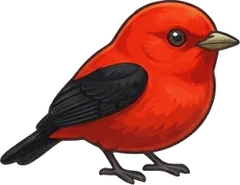 Scarlet Tanager
A Scarlet Tanager sings a hurried, burry, repetitive warble that birders call a robin with a sore throat. The phrases are robin-shaped but the voice is hoarse, and the call is a nasal chip-bang.
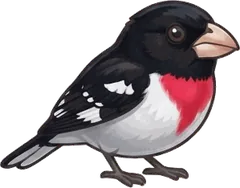 Rose-breasted Grosbeak
The Rose-breasted Grosbeak sounds like a robin that took singing lessons: the same rich whistled phrases, but softer and more fluid, usually from inside the treetops. Its call is a sharp metallic eek.
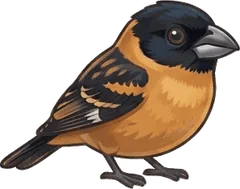 Black-headed Grosbeak
In the West, the Black-headed Grosbeak sings a robin-like warble that is softer, sweeter and faster than the real thing, with a sharp tick for a call, usually from oak woods or streamside cottonwoods.
Where the American Robin card lives
In Warble the same bird can be an easy card in one state and a prized one in another, because each album ranks its birds by how often people really report them there. The American Robin appears in 50 state albums:
 Heard one? Open Warble, tap the green button while it sings, and the American Robin card flips into your album. Get the app free.
Questions people ask
Do robins sing at night?
Robins are not true night singers, but in spring they start well before sunrise and are often the very first bird of the dawn chorus, so a robin caroling in the dark at 4 a.m. is normal. They are also among the last voices at dusk.
Why is a robin chirping loudly at me?
The sharp pick, tut-tut-tut with tail flicks is an alarm. You are probably near a nest or a fledgling on the ground. The faster and louder it gets, the more worried the bird is. Step away and it usually stops.
Do robins leave for the winter?
Most robins that breed in Canada and the northern states move south, leaving by the end of August and returning in February or March. Many others stay, but they abandon lawns for berry trees and travel in roaming flocks, so they are easy to miss.
Which states have the American Robin as their state bird?
Three: Connecticut, Michigan and Wisconsin. With a population of roughly 370 million, the robin is also considered the most abundant land bird in North America.
Sources
- National Audubon Society, Guide to North American Birds: American Robin. www.audubon.org/field-guide/bird/american-robin
- Wikipedia: American robin (song, migration, state bird status). en.wikipedia.org/wiki/American_robin
- Mass Audubon: American Robins (calls, singing season, winter flocks). www.massaudubon.org/nature-wildlife/birds/american-robins
- Missouri Department of Conservation, Field Guide: American Robin. mdc.mo.gov/discover-nature/field-guide/american-robin