 Warble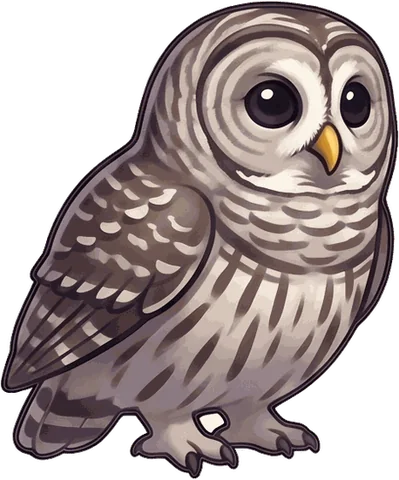
A Barred Owl sounds like someone asking, in a deep barking voice, who cooks for you, who cooks for you-all: about eight loud hoots in two groups, with the last note sliding downward into a throaty aw. It is the loudest owl in most eastern woods and carries more than half a mile. Pairs also break into a racket of cackles, gurgles and cat-like screams that sounds nothing like an owl. You hear it mostly between dusk and dawn, in every month, with the biggest chorus in late winter and early spring.
The birder's mnemonic
“who cooks for you, who cooks for you-all” Put the stress on cooks and you, and let the final all drop and fade, since that downward slur is the part no other owl copies.
What the hoot sounds like
The classic phrase is a run of eight or so hoots split into two halves, hoo, hoo, hoo-hoo; hoo, hoo, hoo-hooaw, which is exactly the rhythm of who cooks for you, who cooks for you-all. The delivery is loud and emphatic, more of a bark than the smooth, rounded hoot people expect from an owl, and the whole thing falls and wobbles in pitch. The final note is the giveaway: it drops and trails off in a hoarse aw. On a still night the phrase carries more than half a mile, so you rarely have to be close to hear it.
There are shorter versions. A single bird often gives a rising phrase that ends in a drawn-out hoo-aah, and a lone hoo-aw is used as a kind of check-in call, especially in the Southeast. Then there is the caterwauling. When a pair or a family gets going, the hoots dissolve into cackles, gurgles and screams tumbling over one another, a sound that has been compared to monkeys and to demonic laughter. It is startling the first time. Like the hoots, it peaks when pairs are courting in late winter and spring.
The voice is hard to pin to a direction, a ventriloquial quality that sends people the wrong way through the trees. Barred Owls also answer imitations readily, even in daylight, which is why a whistled who cooks for you at noon sometimes gets a reply from a bird you would never have found otherwise.
The other calls: hisses, bill snaps and screeches
A Barred Owl that feels crowded, by a person under its roost or a hawk too near the nest, gives a buzzy, rasping hiss every ten to thirty seconds and snaps its bill with a hard click. Females and young birds add a high, scratchy skreeech, and in early summer that scratchy screech from a dark tree at the edge of the yard is often a fledgling begging to be fed. Between the loud calls there are quieter grumbles and mumbles and a high twitter that only carry a few yards.
When and where you hear it
Barred Owls call most between six in the evening and six in the morning and go quietest in mid-afternoon, and they hoot more on overcast nights than on clear ones. They are also active at dawn and dusk and will hunt in daylight, so a hoot at breakfast is nothing unusual. There are two calling seasons. The big one runs ahead of nesting, from late January in Florida to early April in Canada, and a second, smaller round comes after the young leave home in late summer and fall. Since the birds do not migrate, a January cold snap or an August heat wave is still a fine night to listen. Pairs nest in February and March in the middle of the country, in a tree hollow twenty to forty feet up or in an old hawk or crow nest, and lay two or three white eggs that hatch after about four weeks; the young fly at around six weeks.
The place to listen is wet woods: wooded river bottoms, swamps, lake shores and mature forest with big old trees, across the eastern half of the United States. Barred Owls have also settled into leafy suburbs, and a study in Charlotte, North Carolina, found the neighborhood population growing faster than the one in old-growth forest. Over the last century they spread west along wooded river corridors across the northern plains and southern Canada, reaching Washington in 1965, Oregon in 1972 and California in 1976, where they now crowd out the smaller Spotted Owl. Because the bird is loud and often close to houses, its hoot is one of the owl sounds Warble can pick out from a porch recording at dusk.
What it looks like
A big, round-headed, gray-brown owl, 17 to 20 inches long with a wingspan of 39 to 43 inches, weighing one to a little over two pounds; females run noticeably heavier than males. There are no ear tufts, and the eyes are dark brown, nearly black in the field, which sets it apart from every other large owl in the East. The name comes from the pattern: horizontal bars across the throat and upper chest, then bold vertical streaks down the belly. The bill is pale yellow. A Barred Owl flushed from a daytime roost flies off with soft, buoyant wingbeats. It hunts from a perch for mice, voles, squirrels and rabbits, and it takes more frogs, crayfish and fish than most owls, sometimes wading into shallow water to do it. Its own main predator is the Great Horned Owl, which it avoids.
Birds that sound similar
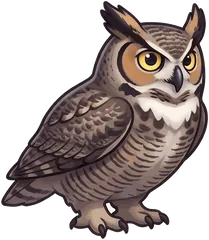 Great Horned Owl
The Great Horned Owl hoots lower, slower and smoother, in a pattern like hoo, hoo-hoo, hoo, hoo, with no barking rhythm and no drawn-out final slur. The Barred Owl's phrase is longer, faster and ends in that falling aw.
- ?Spotted Owl
A close relative of the Pacific Northwest, California and the Southwest mountains. It gives two or three short barking hoots and then a longer hooo-ah, a shorter phrase than the Barred Owl's eight notes, and its underside is spotted, not barred.
Where the Barred Owl card lives
In Warble the same bird can be an easy card in one state and a prized one in another, because each album ranks its birds by how often people really report them there. The Barred Owl appears in 11 state albums:
 Heard one? Open Warble, tap the green button while it sings, and the Barred Owl card flips into your album. Get the app free.
Questions people ask
What owl says "who cooks for you"?
The Barred Owl. Its main call is about eight loud, barking hoots in two groups that match the rhythm of who cooks for you, who cooks for you-all, with the last note sliding downward. It is the commonest big owl voice in eastern woods and swamps.
Do Barred Owls call during the day?
Sometimes. They call most between six in the evening and six in the morning and least in mid-afternoon, but they hunt at dawn and dusk and even in daylight, and they will answer an imitation or a recording at any hour, which is why hikers hear them at noon.
What is the screaming, laughing sound in the woods at night?
Very often a pair or family of Barred Owls caterwauling: hoots, cackles, gurgles and cat-like screams all at once, loudest in late winter and spring. A single high, scratchy screech in summer is usually a young Barred Owl begging for food.
What time of year are Barred Owls loudest?
Late winter and early spring, before nesting: from late January in Florida to early April in Canada. A second, quieter round of calling comes in late summer and fall when the year's young disperse. The birds stay all year, so you can hear one in any month.
Sources
- National Audubon Society, Guide to North American Birds: Barred Owl. www.audubon.org/field-guide/bird/barred-owl
- Wikipedia: Barred owl (vocalizations, calling hours and seasons, range expansion, diet). en.wikipedia.org/wiki/Barred_owl
- Missouri Department of Conservation, Field Guide: Barred Owl. mdc.mo.gov/discover-nature/field-guide/barred-owl
- National Audubon Society, Guide to North American Birds: Spotted Owl. www.audubon.org/field-guide/bird/spotted-owl