 Warble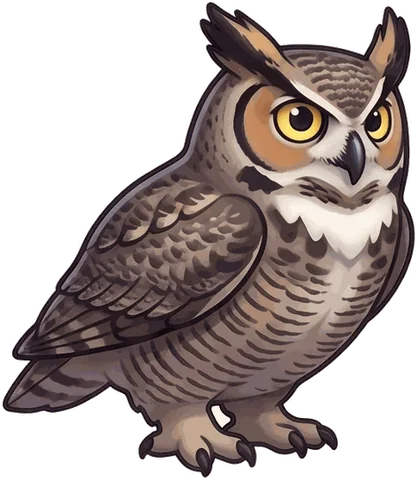
A Great Horned Owl sounds like the owl in every movie: a series of deep, soft, far-carrying hoots, usually four or five, in a rhythm like hoo, hoo-hoo, hoo, hoo, with the middle notes shorter than the rest. The voice is low and smooth, with none of the barking rhythm of a Barred Owl, and a mated pair often answers back and forth, the female noticeably higher-pitched than the male. You hear it mostly after dark, most of all in late fall and winter, when pairs are courting and other birds have gone quiet.
What the hoot sounds like
The territorial call is a run of low, resonant hoots that carries a long way through still winter air. Audubon writes it as hoo, hoo-hoo, hoo, hoo, five notes with the second and third shorter and run together; the Missouri Department of Conservation counts three to eight in a pattern such as hoo h'HOO, HOO, HOO. The quality is what matters: soft-edged, rounded and even, more like someone blowing across a bottle than anything shouted. A phrase carries a mile or more on a quiet night.
Pairs duet, and that is the easiest way to be sure. The female is the bigger bird but has a smaller voice box, so her hoots come out higher and rise in pitch at the end, while the male's stay low and level. The male hoots in every month; the female mostly joins in during the courting season, and the exchanges get more intense as nesting approaches.
The other calls: screeches, barks and hissing young
Beyond the hoot there is a catalog of noises that do not sound like an owl at all: chuckles, screeches and squawks, a growl, a laugh-like series, a high ank, cat-like meows and calls that mimic a hawk. A bird attacking prey gives a loud screech. The sound that fools the most people comes from the young: fledglings still being fed by their parents make a loud, persistent hiss or a piercing, raspy screech, over and over, from a dark tree in early summer. A yard that hears shrieking in June and July usually has an owl family, not something in trouble.
When and where you hear it
This is a bird of the deep night. Calling is heaviest after midnight rather than before it, though you will hear hoots at dusk and again toward dawn. Great Horned Owls are among the earliest nesting birds in North America, laying eggs weeks or months ahead of other raptors, so the hooting builds through late fall and peaks in mid-winter. In Missouri pairs begin nesting in late January or early February after a few months of calling, and once eggs are laid, in February or March, the territorial hooting drops off. The female sits on two or three dull white eggs for about a month, and the young are fed for months after leaving the nest, which is why the begging screeches last into summer.
Range is not the problem with this owl: it is the most widely distributed true owl in the Americas, from the Arctic tree line in Alaska to the tip of South America, in forest, prairie, desert, mangrove and city park alike. It likes woodland broken up by open ground best: a woodlot next to a pasture, a leafy suburb. The birds do not migrate, so a February night in Minnesota is as good as a July night in Arizona. The hoot is low enough to hide under a refrigerator hum indoors, which is why so many people have one in the yard and have never heard it; a short porch recording with Warble will often pick it out.
What it looks like
A very large, bulky owl, 18 to 25 inches long with a wingspan of three to five feet and a weight of roughly two to five pounds, females heavier than males. The wide-set feather tufts on the head, which are neither ears nor horns, are the field mark, along with a white throat patch, big yellow eyes and fine horizontal barring across the belly. It hunts from a perch, mostly at night and sometimes at dusk, dropping on anything from mice, voles and rabbits to skunks, geese, hawks and smaller owls; no other raptor in the Americas eats such a wide range of prey.
Birds that sound similar
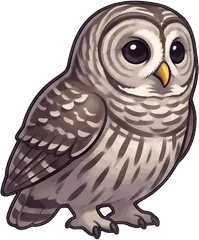 Barred Owl
A Barred Owl hoots louder and faster in a barking eight-note phrase, who cooks for you, who cooks for you-all, ending in a downward slur. The Great Horned Owl is slower, lower and smoother, with no rhythm you could speak.
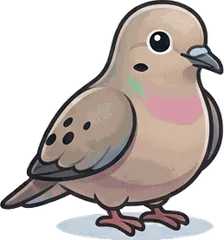 Mourning Dove
A Mourning Dove cooing in daylight is mistaken for an owl constantly. The dove's coo-OO, coo, coo, coo is thinner and more whistled, comes from a wire in the morning, and rises on the second note. The owl is deeper, rounder and mostly a sound of the dark.
Where the Great Horned Owl card lives
In Warble the same bird can be an easy card in one state and a prized one in another, because each album ranks its birds by how often people really report them there. The Great Horned Owl appears in 2 state albums:
 Heard one? Open Warble, tap the green button while it sings, and the Great Horned Owl card flips into your album. Get the app free.
Questions people ask
What time of night do Great Horned Owls hoot?
Mostly in full darkness, with calling peaking after midnight rather than in the evening. You will still hear hoots at dusk and before dawn, but the longest sessions come on winter nights after most people are asleep.
Why is the owl hooting in December and January?
Because that is courting season. Great Horned Owls nest earlier than almost any other North American bird, laying eggs in late January or February in the middle of the country, so pairs call most through late fall and mid-winter and go quieter once incubation starts.
What is the screeching sound in the trees at night in summer?
Often a young Great Horned Owl begging. Fledglings stay with their parents for months and make loud, persistent hisses and piercing screeches while they wait to be fed, usually from June into late summer. It sounds distressed, but it is normal.
Do male and female Great Horned Owls sound different?
Yes. The female is the larger bird but has a smaller voice box, so her hoots are higher and rise at the end, while the male's are lower and level. Two owls answering each other at different pitches are usually a pair.
Sources
- National Audubon Society, Guide to North American Birds: Great Horned Owl. www.audubon.org/field-guide/bird/great-horned-owl
- Wikipedia: Great horned owl (vocalizations, size, range, diet, nesting). en.wikipedia.org/wiki/Great_horned_owl
- Missouri Department of Conservation, Field Guide: Great Horned Owl. mdc.mo.gov/discover-nature/field-guide/great-horned-owl
- Animal Diversity Web: Bubo virginianus. animaldiversity.org/accounts/Bubo_virginianus/