 Warble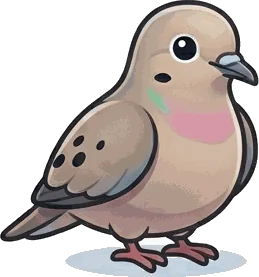
A Mourning Dove sounds like a soft, low, sorrowful cooing: coo-AH-oo, oo, oo, oo, one longer note that swells in the middle, then three or four shorter notes that trail off. It is the sound many people take for an owl in broad daylight. The singer is a male on a wire, a rooftop or a bare branch, mostly in the warm months. The other giveaway is not a voice at all. When a dove takes off, its wings make a sharp, twittering whistle that fades as it flies away.
The birder's mnemonic
“coo-AH-oo, oo, oo, oo” Put the weight on the second syllable and let the last notes fall away; the whole phrase is slower and sadder than you expect.
What the song sounds like
The dove's song is a coo, but a shaped one. It opens with a longer note that rises in the middle, written as coo-AH-oo or cooOOoo, and then settles into a short run of even, lower oo notes that fade out. Field guides call it mournful, and the bird is named for it: the mourning in Mourning Dove refers to the doleful sound, not to the time of day.
The singer is almost always a male trying to attract a mate. He picks an exposed perch, a power line, a rooftop, a dead branch, puffs his throat with each phrase and repeats the whole thing at a slow, steady pace, sometimes with a faint grating sound just before the first coo. Males also have a shorter version of the call, given at a possible nest site to bring the female over.
The call: whistling wings
The sound you hear most often is made by feathers, not the throat. A dove's wings produce a fluttery whistle in flight that is faint while it cruises and suddenly loud on takeoff and landing, so a dove flushing from a hedge or a feeder announces itself with a burst of high twittering. Sometimes the wings also clap audibly as the bird leaves. Nobody is sure what the sound is for, though it certainly works as an alarm for every other bird in the yard. Both sexes also give a short alarm call when threatened, but it is quiet and easy to miss.
When and where you hear it
Mourning Doves live from southern Canada through the whole of the United States to central Mexico, and they are birds of the open and the edge: farms, towns, suburbs, roadsides, prairie, desert and clearings in the woods. The one place you will not find them is deep, unbroken forest. Across most of that range they are present all year, and the cooing runs from early spring through the warm months. In Missouri pairs may attempt as many as seven nests between late March and early September, and in the southern states five or six broods a year is normal, more than any other native bird.
Northern birds do migrate, by day and in flocks. Spring movement runs from March to May and the fall flight from September to November, with young birds leaving first, then females, then males. Canadian doves travel farthest, likely to Mexico and beyond, while southern doves barely move. The species is also a popular game bird, with more than 20 million taken by hunters in a typical year, yet it remains one of the most abundant birds on the continent.
Because it coos from open perches and flushes noisily, the dove is an easy early card in nearly every state album in Warble.
What it looks like
A slim, small-headed bird about the size of a robin, 9 to 13 inches long with a 17 inch wingspan and a weight of 4 to 6 ounces. The plumage is plain gray-brown with a few black spots on the wings, a dark crescent below the eye and a long, pointed tail edged with white spots that flash when it flies. Males show a pinkish chest, a blue-gray crown and a purple-pink sheen on the neck; females are duller and browner; juveniles look scaly. Doves are strong, fast fliers, clocked at up to 55 miles an hour, and their diet is more than 99 percent seeds, which they gather from the ground and pack into the crop to digest later from a safe perch.
Birds that sound similar
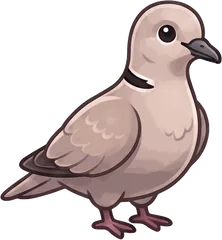 Eurasian Collared-Dove
The collared-dove's call is a deep, three-part kuk-kooooo-kuk with the accent in the middle, repeated like a chant, plus a harsh nasal mew. The Mourning Dove's phrase is longer, softer and trails off at the end.
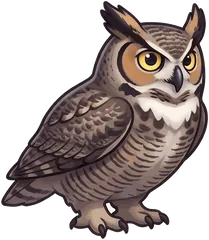 Great Horned Owl
The Great Horned Owl's hoo, hoo-hoo, hoo, hoo is deeper and flatter, with no rising accented note, and it comes mostly at night and in winter. A coo from a wire at noon in June is a dove.
- ?White-winged Dove
In Texas and the Southwest the White-winged Dove says who-cooks-for-you in a rhythmic, drawn-out phrase with clearer syllables. The Mourning Dove's cooing is smoother and sadder, without that spoken cadence.
Where the Mourning Dove card lives
In Warble the same bird can be an easy card in one state and a prized one in another, because each album ranks its birds by how often people really report them there. The Mourning Dove appears in 50 state albums:
 Heard one? Open Warble, tap the green button while it sings, and the Mourning Dove card flips into your album. Get the app free.
Questions people ask
Is the cooing I hear an owl or a dove?
If it is daytime and the sound comes from a wire, a roof or a tree in the open, it is almost certainly a Mourning Dove. Owls call mostly at night. The dove's phrase also has a shape, one rising accented note and then a falling run, while a Great Horned Owl's hoots are even and flat.
Why do a mourning dove's wings whistle?
The feathers make a fluttery whistling sound in flight that becomes loud on takeoff and landing. Its purpose is not settled, but the effect is a sharp alarm that startles every bird nearby, which is why a flushed dove often empties the feeder.
Do mourning doves migrate?
Northern ones do, by day in flocks, from September to November and back in March to May, with young birds leaving first. Across most of the United States doves stay all year, and southern populations barely move at all.
Why is it called a mourning dove?
For the sound. The low, doleful cooing struck early listeners as grieving, so the bird is named for mourning, not for the morning, even though it does coo early in the day.
Sources
- National Audubon Society, Guide to North American Birds: Mourning Dove. www.audubon.org/field-guide/bird/mourning-dove
- Wikipedia: Mourning dove (voice, wing whistle, migration, hunting, size). en.wikipedia.org/wiki/Mourning_dove
- Missouri Department of Conservation, Field Guide: Mourning Dove. mdc.mo.gov/discover-nature/field-guide/mourning-dove
- Animal Diversity Web (University of Michigan): Zenaida macroura. animaldiversity.org/accounts/Zenaida_macroura/