 Warble
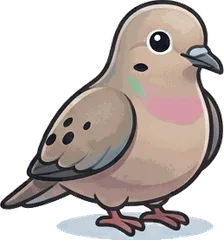
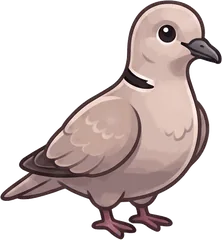
Count the syllables. A Eurasian Collared-Dove repeats a deep, three-part kuk-kooooo-kuk, stressed in the middle, often with no pause between phrases, and it also gives a harsh, nasal call like a loud catbird. A Mourning Dove's coo is softer and sadder: one inflected coo-AH-oo followed by three plain oo notes. By eye, the collared-dove is the bigger, paler, stouter bird, with a black half-collar on the back of the neck and a square tail; the Mourning Dove is slim and gray-brown, with black wing spots and a long, pointed tail.
Side by side
| Mourning Dove | Eurasian Collared-Dove | |
|---|---|---|
| Song | A soft, mournful coo-AH-oo, oo, oo, oo: one inflected note, then three plain ones | A deep, three-part kuk-kooooo-kuk, stressed in the middle, often repeated without pause |
| Second sound | Noisy wingbeats when a courting male flies up | A harsh, raspy, nasal, falling note, like a loud Gray Catbird |
| Build and color | Slender, rounded head, gray-brown; male with a pinkish chest | Larger and stouter, chalky grayish tan |
| Neck | No collar | Narrow black half-collar on the back of the neck |
| Wings | Black spots | No spots; dark wingtips against a paler wing |
| Tail | Long and pointed, edged with white spots | Square-tipped, with large white patches in the outer feathers |
| Where and when | Farms, towns, roadsides and fields; many northern birds leave in fall | Suburbs, small towns and farms, on poles and wires; resident all year in Missouri |
By ear: a lament or a chant
The Mourning Dove's song is where the bird gets its name: a low, mournful coo with a shape to it. It opens with an inflected note that swells in the middle, written coo-AH-oo by the Missouri Department of Conservation and coo-ah by Audubon, then settles into three soft, plain oo notes. Five beats, more or less, with all the feeling packed into the first one. It sounds unhurried and a little sad.
The Eurasian Collared-Dove counts to three instead. Its song is a deep kuk-kooooo-kuk, a short note, a long stressed one and a short one to finish, and the bird repeats it again and again, often with no gap between phrases. Where the Mourning Dove delivers one long lament, the collared-dove keeps a steady three-beat rhythm like a metronome, and once you notice it you will hear it from high trees, telephone poles and power lines all over town.
The collared-dove also has a sound no one would call a coo: a harsh, mewing, nasal note, raspy and falling in pitch, which many listeners compare to a loud Gray Catbird. Hear that from a pale dove on a wire and the question is settled.
By sight: collar, spots and tail
Missouri's field guide says a collared-dove can pass at first for a stocky, pale Mourning Dove, so look past the general shape. The collared-dove is larger and stouter, chalky grayish tan rather than gray-brown, and it wears a narrow black crescent on the back of the neck that does not close into a full ring. The Mourning Dove is slender, with a rounded head, and the male has a pinkish chest and a blue-gray crown.
Then check the wings and the tail. A Mourning Dove has black spots on its wings and a long, pointed tail edged with white spots that show in flight. A collared-dove has no black wing spots; instead its dark wingtips stand out against the paler wing, even on a perched bird. Its tail is square at the tip, gray underneath, with large white patches in the outer feathers.
Where you will meet each one
The Mourning Dove is the native, found from southern Canada to central Mexico on farms, in towns, open woods, roadsides and grasslands, especially along edges where trees meet open ground. It avoids unbroken forest. Some stay through winter over most of the breeding range, but many northern birds move south in fall, by day and in flocks. In Missouri it is a common summer resident, and most leave by mid-October, except in the southeast and in spots with plenty of food and roosting cover.
The Eurasian Collared-Dove is a newcomer from the Old World. It was introduced by accident in the Bahamas in 1974, soon reached the Florida mainland, and since the 1980s has spread west and north across much of North America, to Oregon and Washington and, Missouri adds, as far as California and Alaska. The Northeast is the exception, with only a few stray records. It is most common around homes and farmland with a mix of trees and open ground, and it does better in small towns than in big cities. In Missouri it is a permanent resident that can raise three to six broods a year.
That gives you a seasonal clue in places like Missouri: a dove cooing from a power line in January, away from the southeast, is more likely the collared-dove. In summer you can hear both, often from the same street.
 Still not sure which one is outside? Warble listens while it sings and tells you, then adds the card to your album. Get the app free.
Questions people ask
How can you tell a mourning dove from a collared dove by sound?
Count the notes. A Eurasian Collared-Dove repeats a deep three-part kuk-kooooo-kuk, stressed in the middle, and has a harsh, nasal, catbird-like call. A Mourning Dove gives a soft, mournful coo-AH-oo followed by three plain oo notes.
Is a Eurasian Collared-Dove bigger than a Mourning Dove?
Yes. It is larger and stouter, and Audubon puts its weight at 5.3 to 7.1 ounces against 3 to 6 for the Mourning Dove. It is also paler, with a black half-collar and a square tail instead of a long, pointed one.
Are Eurasian Collared-Doves native to the US?
No. The species comes from Eurasia. North American birds trace to an accidental introduction in the Bahamas in 1974, and since the 1980s they have spread across much of the continent. As an introduced species, they have no hunting protection in Missouri.
Sources
- National Audubon Society, Guide to North American Birds: Mourning Dove. www.audubon.org/field-guide/bird/mourning-dove
- National Audubon Society, Guide to North American Birds: Eurasian Collared-Dove. www.audubon.org/field-guide/bird/eurasian-collared-dove
- Missouri Department of Conservation, Field Guide: Mourning Dove. mdc.mo.gov/discover-nature/field-guide/mourning-dove
- Missouri Department of Conservation, Field Guide: Eurasian Collared-Dove. mdc.mo.gov/discover-nature/field-guide/eurasian-collared-dove