 Warble

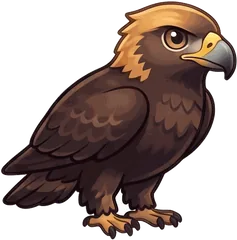
The real puzzle is a young Bald Eagle against a Golden Eagle, because an adult Bald's white head and tail end the debate. Sound helps a little: a Bald Eagle gives weak, squeaky, chirping whistles, kleek kik ik ik ik, while a Golden Eagle is usually silent. Then look at the legs and the head. A Golden's legs are feathered to the toes and the back of its head glows gold. A young Bald has bare lower legs, a bigger head and bill, and messy white blotches.
Side by side
| Bald Eagle | Golden Eagle | |
|---|---|---|
| Voice | Weak, staccato, chirping whistles, kleek kik ik ik ik, a little gull-like | Usually silent; when it calls, a weak, high kee-kee-kee or sharp yelps |
| Size | 28 to 40 inches; wings about 6 to 7.5 feet | About the same; wings 6 to over 7 feet |
| Adult | Dark brown, white head and tail, yellow bill | Dark brown, gold feathers on the back of the head and neck |
| Young birds | Messy white blotches, often on the body and wing linings | Darker, with neat white: a wing patch and a white tail base with a black band |
| Legs | Bare lower legs | Feathered to the toes |
| Shape in flight | Big head and heavy bill jut forward; broad, plank-like wings | Smaller head, longer tail, slimmer wings |
| Where and when | Coasts, rivers and big lakes; all year in much of the US | Open country in the West; in the East, fall and winter on Appalachian ridges |
By ear: chatter or silence
First, forget the scream. Wikipedia notes that the cry of a Red-tailed Hawk is often substituted for the Bald Eagle's voice on screen, because the hawk's is much louder and more powerful. Neither eagle sounds like that, and the Pennsylvania Game Commission adds that neither calls as often as a red-tail.
The Bald Eagle's real call is a string of weak, staccato, chirping whistles, written kleek kik ik ik ik, with something of a gull in it; young birds sound harsher and shriller. From a bird that size it sounds oddly small, more squeaky hinge than battle cry.
The Golden Eagle is quieter still. Audubon writes its call as a high-pitched kee-kee-kee, with an occasional high scream or squeal, and says it is usually silent. Wikipedia calls the voice weak, high and shrill and notes that Goldens often stay silent even while breeding. Pennsylvania describes rapid, sharp chirps or yelps.
So the ear gives you odds, not proof. A chattering eagle is more likely a Bald, because Goldens so rarely call. A silent one could be either, and that is when the eyes take over.
By sight: legs, head and the white
Adults are easy. A grown Bald Eagle has a dark brown body, a white head and tail, and a yellow bill, feet and eyes. A grown Golden is dark brown all over, with gold-tipped feathers on the back of the head and neck that catch the light. Goldens are booted eagles, feathered right down to the toes; a Bald Eagle's lower legs are bare.
Young birds are where people go wrong. A Bald Eagle wears dark brown overlaid with messy white streaking until about its fifth year. The Pennsylvania Game Commission points out that an adult Golden resembles a young Bald but is darker, with fewer white splotches, and Audubon adds that a young Bald shows at least a little white mottling on the body or wing linings. A young Golden has white too, but it is tidy: a patch in the middle of the wing, which varies a lot in size, and a white tail base ending in a broad black band. Wikipedia describes those patches as more sharply defined than the blotchy white of a young Bald.
Shape settles the rest. Wikipedia names head size, bill size, wing shape and leg feathering as the marks that separate a young Bald from a Golden. In flight a Bald Eagle's big head and heavy bill stick well out in front of broad, plank-like wings. A Golden looks smaller-headed and longer-tailed, the tail two to three times the length of the head as it soars, with slimmer, more hawk-like wings.
Where you will meet each one
The Bald Eagle is a fishing bird. It nests along coasts, rivers, large lakes and marshes, usually in a big tree close to open water, and fish made up 56 percent of the diet in a review of 20 nesting studies. As of 2018 it nested in every mainland state. Southern birds stay all year; northern birds whose water freezes move south or to the coast, gathering at open lakes and rivers in winter.
The Golden Eagle wants open terrain: mountains, foothills, plains, prairie and tundra, where it hunts rabbits, hares, ground squirrels, prairie dogs and marmots. In North America it breeds across most of Alaska, western Canada, the western states and Mexico, but not east of a line running from North Dakota through western Nebraska and Oklahoma to West Texas.
The East has Goldens too, just not many and not in summer. They nest in the northern forests of Quebec, Labrador and Ontario and winter on the wooded ridges of the central and southern Appalachians, mainly in Virginia and West Virginia, passing Pennsylvania's ridges from mid-October to early December and again in March and April. So in the East, a big brown eagle at a reservoir in January is most likely a young Bald, while a dark eagle sailing past a ridgetop hawk watch in November deserves a long look at its legs.
 Still not sure which one is outside? Warble listens while it sings and tells you, then adds the card to your album. Get the app free.
Questions people ask
Do golden eagles live in the eastern United States?
Yes, in small numbers and mostly in fall and winter. The eastern population nests in Quebec, Labrador and northern Ontario and winters on forested Appalachian ridges, mainly in Virginia and West Virginia.
Is a golden eagle bigger than a bald eagle?
Not in any way you could see. Audubon calls them about the same size, and Wikipedia describes the two as roughly equal in size, aggressiveness and strength.
How do you tell a juvenile bald eagle from a golden eagle?
Check the legs, the head and the white. A Golden is feathered to the toes, has a golden nape and shows neat white patches. A young Bald has bare lower legs, a bigger head and bill, and messy white blotches.
Sources
- National Audubon Society, Guide to North American Birds: Golden Eagle. www.audubon.org/field-guide/bird/golden-eagle
- Pennsylvania Game Commission: Golden Eagle species profile (eastern population, migration, identification). www.pa.gov/agencies/pgc/wildlife/discover-pa-wildlife/golden-eagle
- Wikipedia: Bald eagle (call, legs, plumage, comparison with the golden eagle, range, diet). en.wikipedia.org/wiki/Bald_eagle
- Wikipedia: Golden eagle (voice, juvenile plumage, flight shape, North American range). en.wikipedia.org/wiki/Golden_eagle