 Warble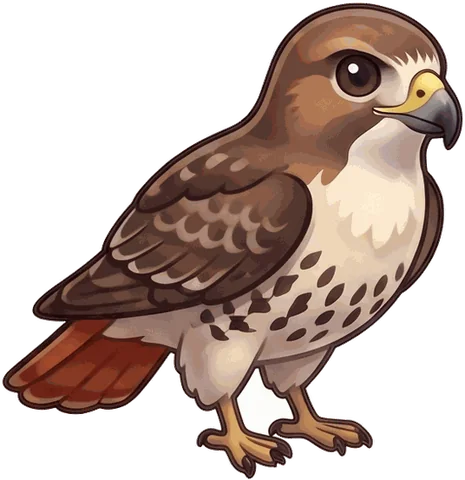
A Red-tailed Hawk sounds like a steam whistle losing pressure: a hoarse, rasping scream of two or three seconds that starts high and slides downward, written as kree-eee-ar or keeeeer. It usually comes from a soaring bird or a high perch. If you think you have heard it in a movie, you have: this scream is the stock sound effect for nearly every eagle and hawk on screen. Close up, red-tails also give a low croaking guh-runk, and hungry young wail a klee-uk.
What the scream sounds like
The Red-tailed Hawk has no song in the songbird sense. What it has is the scream: a single drawn-out note, hoarse and rasping rather than pure, that opens high and slurs down over two to three seconds. Audubon writes it as keeeeer, Wikipedia as kree-eee-ar, and the usual comparison is a steam whistle. The shape never changes: high, then falling, with a rough edge all the way through.
You hear it most from a bird in the air. A red-tail circling a field screams at an intruder, at a rival, or apparently at nothing in particular, and adults scream at people who walk too close to a nest tree.
Then there is Hollywood. Sound editors have used this cry as the generic voice of any large raptor for decades, so when a Bald Eagle opens its beak on screen, what comes out is almost always a Red-tailed Hawk. The Missouri Department of Conservation says the same in its field guide. The eagle's real voice is a thin, chirping chatter, nothing like it.
Other calls: croaks and begging
At close range, especially near the nest, adults trade a low croaking guh-runk that few people ever hear. Young hawks are louder. Once they are flying in midsummer they give a wailing klee-uk whenever they want food, which is most of the time. A whining hawk call in July or August, repeated from a woodlot or a light pole, is very often a fledgling red-tail asking its parents for a squirrel.
When and where you hear it
Red-tailed Hawks breed from central Alaska and northern Canada south through the entire United States to Florida, the West Indies and Central America. They are partial migrants: birds in Alaska and most of Canada leave for the winter, while hawks at central and southern latitudes, especially adults, stay all year, so across most of the country you can hear one in any month. Hawk Ridge in Duluth, Minnesota, has counted up to 15,000 in a single autumn, nearly all passing one at a time rather than in flocks.
The habitat is open country with something tall to sit on: prairie, pasture, farmland, desert with a few trees, woodland edges and, more and more, cities. A red-tail hunts mostly by sitting on a high perch and watching, then dropping onto whatever moves. Rodents can make up 85 percent of the diet, along with rabbits, snakes and birds up to pheasant size. That is why the classic place to see one is a light pole beside the interstate; Missouri's guide calls them highway hawks. For Warble players it is usually the easiest raptor to add to an album, because it is common in every state and announces itself.
Pairs are monogamous and often stay together for years. The stick nest goes in a tall tree, 13 to 69 feet up, or on a cliff ledge, and Missouri pairs are on eggs by mid-March, earlier than any other hawk in the state. About a million Red-tailed Hawks live in the United States, and numbers have been stable or rising since the 1960s.
What it looks like
A big, chunky hawk built for soaring: broad wings, a fairly short wide tail, 19 to 26 inches long with a wingspan of four feet or more, the female about a quarter heavier than the male. The typical adult is brown above and pale below with a band of dark streaks across the belly, and the tail is brick red on top, often with a narrow black band near the tip. Young birds have a brown tail with fine dark bars and no red at all in their first year, which is when they are most often mistaken for a Red-shouldered Hawk.
Plumage varies a lot, especially in the West, where dark and rufous morphs make up 10 to 20 percent of birds, and at least 14 subspecies are recognized. Whatever the color, the shape and the scream stay the same.
Birds that sound similar
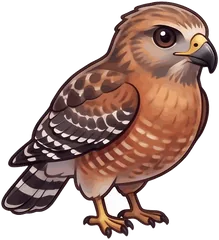 Red-shouldered Hawk
A Red-shouldered Hawk's kee-yeeear also drops in pitch, but it is clearer, shorter and repeated three or four times in a row. The red-tail gives one long hoarse scream and stops.
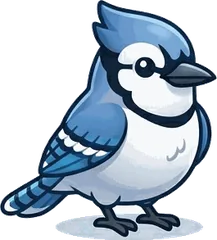 Blue Jay
Blue Jays copy both red-tailed and red-shouldered screams, sometimes well enough to fool birders. A hawk scream from inside a leafy tree at jay height, followed by ordinary jay noise, is a jay.
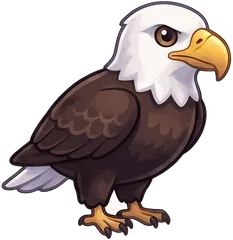 Bald Eagle
On screen the Bald Eagle is given the red-tail's scream. Its real voice is a weak chirping chatter, so a long hoarse kree-eee-ar over the water still means a hawk.
Where the Red-tailed Hawk card lives
In Warble the same bird can be an easy card in one state and a prized one in another, because each album ranks its birds by how often people really report them there. The Red-tailed Hawk appears in 49 state albums:
 Heard one? Open Warble, tap the green button while it sings, and the Red-tailed Hawk card flips into your album. Get the app free.
Questions people ask
Is the eagle scream in movies really a red-tailed hawk?
Yes, nearly always. The Red-tailed Hawk's hoarse, descending scream is the standard raptor sound effect in film and television, dubbed over Bald Eagles and any other large bird of prey. Missouri's conservation department and Wikipedia both note the substitution.
Why is a hawk screaming over my house?
It is probably announcing or defending a territory. Red-tails scream while soaring, at rivals, and at people who come near a nest. In midsummer a repeated whining scream is usually a fledgling begging its parents for food.
Do red-tailed hawks eat chickens?
Rarely. The species is one of three American birds nicknamed the chickenhawk, but rodents make up as much as 85 percent of its diet, with rabbits, snakes and birds up to pheasant size on the side.
Sources
- National Audubon Society, Guide to North American Birds: Red-tailed Hawk. www.audubon.org/field-guide/bird/red-tailed-hawk
- Wikipedia: Red-tailed hawk (vocalizations, media use, measurements, migration, diet, nesting). en.wikipedia.org/wiki/Red-tailed_hawk
- Missouri Department of Conservation, Field Guide: Red-tailed Hawk. mdc.mo.gov/discover-nature/field-guide/red-tailed-hawk
- Wikipedia: Blue jay (imitation of hawk calls). en.wikipedia.org/wiki/Blue_jay