 Warble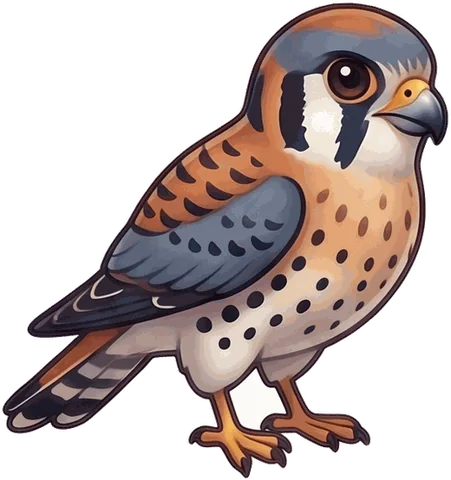
An American Kestrel sounds like a small, excited alarm: a shrill, rapid killy-killy-killy or klee-klee-klee, given in quick series when the bird is upset or excited, and loud enough to carry a long way across a field. It is the smallest falcon in North America, and it calls from a telephone wire, a fence post or while hovering over a grassy highway median. Two softer calls, a whine and a chitter, are kept for mates and nestlings.
What the call sounds like
The kestrel has three calls, and one of them does most of the work. The klee or killy is a short, shrill, high note repeated fast, killy-killy-killy-killy, given by both sexes all year whenever the bird is stressed or excited: a rival on its wire, a hawk overhead, a person too near the nest box. Audubon notes that a rapid klee series travels a considerable distance, which is why you often hear a kestrel before you spot the small shape on the line. Females have a slightly lower voice than males.
Because the note is so high and quick, it can pass for a shorebird at first. What gives it away is the rhythm, a hard, even hammering, and the setting: open country, a high perch, a bird that bobs its head and tail as it calls.
The whine and the chitter
The whine is a longer, drawn-out call tied to food. Adults use it around feeding and mating, and hungry nestlings and fledglings use it constantly, so a kestrel family in July is a chorus of whines every time a parent arrives with a grasshopper. The chitter is a fast, soft, friendly sound exchanged between male and female during courtship feeding, mating and chick care. Nestlings can produce all three calls by about two weeks of age.
When and where you hear it
American Kestrels breed from Alaska and northern Canada south through the whole United States into Mexico and the Caribbean, and the species continues down through South America. It needs three things: open ground to hunt over, a tall perch to hunt from, and a cavity to nest in. That means grasslands, meadows, farmland, desert, forest clearings, and plenty of suburbs and city edges. Northern birds migrate south in fall; birds in the southern states stay all year, and mid-latitude populations shift only a little. Females winter farther south than males. In Missouri kestrels are common migrants and winter residents in the south of the state and uncommon breeders statewide.
The hunting is what most people notice. A kestrel sits on a wire scanning the ground, bobbing its head and tail, then drops on its prey, or, where perches are scarce, hovers over a field on fast wingbeats like a miniature helicopter, as Missouri's guide puts it. Large insects are the main food in summer, grasshoppers above all, along with beetles, dragonflies, cicadas and moths; in winter the menu shifts to voles, mice, shrews, small birds, lizards and frogs.
Kestrels do not build nests. They use natural tree hollows, old woodpecker holes, crevices in cliffs and buildings, cactus cavities in the Southwest, and nest boxes, which they take to readily. The four or five eggs are incubated mostly by the female for 26 to 32 days, and the young fledge after another four weeks or so. Life is short: most wild kestrels do not reach five years. Numbers have been falling since 1966 across the continent, sharply in New England and coastal California, and the southeastern subspecies is down 82 percent since 1940, mainly for lack of nest cavities. In Warble a kestrel calling from a wire is a card worth stopping the car for.
What it looks like
North America's smallest and most colorful falcon, 9 to 12 inches long with a wingspan of about two feet, the female a little bigger than the male. Both sexes have a rusty back, a gray crown and two black vertical stripes on a white face. The male's wings are slate blue and his tail is plain rust with a black band near the tip; the female is rusty all over with dark barring and a streaked breast. On the back of the head are two black spots that look like eyes, thought to discourage attacks from behind. Until 1983 the bird was officially called the sparrow hawk, a name borrowed by mistake from an unrelated European hawk.
Birds that sound similar
 Killdeer
The Killdeer shares the kestrel's fields and its piercing, repeated high notes, but its kill-deer is two syllables, slower and more wailing. The kestrel's series is faster and harder, a hammering rather than a cry.
- ?Merlin
Audubon describes the Merlin's call as a high, loud cackle or a klee-klee-klee like a kestrel's, but the Merlin is usually silent, hunts from a perch or in low fast flight, and does not hover.
Where the American Kestrel card lives
In Warble the same bird can be an easy card in one state and a prized one in another, because each album ranks its birds by how often people really report them there. The American Kestrel appears in 43 state albums:
 Heard one? Open Warble, tap the green button while it sings, and the American Kestrel card flips into your album. Get the app free.
Questions people ask
What does an American kestrel sound like?
A shrill, rapid killy-killy-killy or klee-klee-klee, given in fast series when the bird is excited or alarmed and audible from far off. Softer calls include a whine around food and a chitter between mates. Females sound slightly lower than males.
Why do kestrels hover?
To hunt where there is nothing to perch on. A kestrel normally watches from a high perch and drops on prey, but over open fields and highway medians it hovers on rapid wingbeats, holding position while it scans the grass for grasshoppers, voles and mice.
Are American kestrels declining?
Yes. Populations across North America have been dropping gradually since 1966, faster in New England and coastal California, and the southeastern subspecies has lost 82 percent since 1940. Loss of nest cavities, prey and habitat are the main causes, which is why nest boxes matter.
Is a kestrel the same as a sparrow hawk?
In North America, yes. The American Kestrel was officially called the sparrow hawk until 1983, when the American Ornithologists' Union renamed it, because the old name wrongly linked it to the Eurasian sparrowhawk, which is not a falcon at all.
Sources
- National Audubon Society, Guide to North American Birds: American Kestrel. www.audubon.org/field-guide/bird/american-kestrel
- Wikipedia: American kestrel (calls, plumage, hunting, nesting, decline, sparrow hawk name). en.wikipedia.org/wiki/American_kestrel
- Missouri Department of Conservation, Field Guide: American Kestrel. mdc.mo.gov/discover-nature/field-guide/american-kestrel
- National Audubon Society, Guide to North American Birds: Merlin (voice and hunting style, for comparison). www.audubon.org/field-guide/bird/merlin