 Warble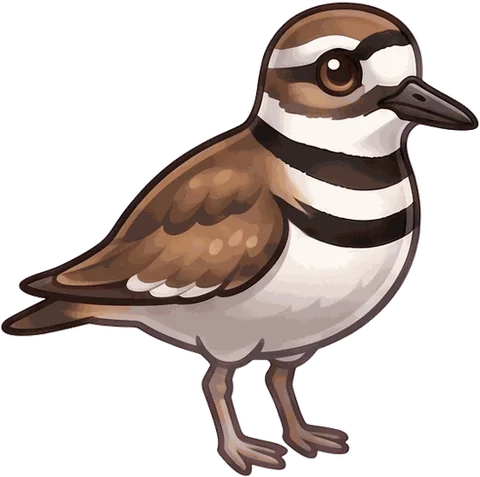
A Killdeer sounds like it is shouting its own name: a loud, shrill, two-syllable kill-deer, kill-deer, repeated over and over, often while the bird circles overhead on stiff, pointed wings. It also gives a rising deee, a fast dee-dee-dee when upset, and a long, fast trill as an alarm near the nest. You hear it on lawns, ballfields, gravel lots, plowed fields and shorelines across the United States, by day and often at night.
The birder's mnemonic
“kill-deer, kill-deer” The name is the call, and the species name vociferus makes the same point.
What the kill-deer call sounds like
A Killdeer has no song in the songbird sense. What it has is one of the most recognizable calls in North America, a piercing, slightly nasal kill-deer or kill-deee with the stress on the second syllable, sometimes shortened to k'dew or drawn into a rising tyeeee. Audubon writes it as kill-deee, fill-deee or killdeer, killdeer. The bird repeats it in a steady series, and the pitch is high enough to cut through traffic, which is why so many people first meet the Killdeer as a voice over a parking lot.
In the display flight, circling on stiff, pointed wings, the call becomes a rolling kill-deer or kee-deeyu, given again and again. Both sexes call, and the calling carries on after dark, since Killdeer feed on moonlit nights as well as by day. Animal Diversity Web notes that other animals treat the Killdeer's alarm as a general warning, so when one starts up, everything in the field looks around.
The other calls: dee-dee-dee and the trill
Short, single deee notes are the everyday contact call, and a rapid kee-di-di-di or dee-dee-dee means the bird is disturbed. The real alarm is a long, fast trill, and it usually means you are close to eggs or chicks. That is when the famous act begins: the parent runs from the nest calling, fans its bright orange rump and tail, droops a wing, crouches and drags itself along the ground as if badly hurt, calling in what Missouri's field guide describes as plaintive, pained notes. Follow it far enough from the nest and it recovers instantly and flies off. Against a cow that will not be lured, a Killdeer may instead raise its wings, lower its head and charge.
When and where you hear it
The Killdeer is a shorebird that mostly lives away from the shore. It wants open ground with almost no vegetation: pastures, plowed fields, airports, golf courses, sports fields, gravel parking lots, muddy pond edges and sandbars, and sometimes flat gravel roofs. It is a year-round resident across most of the contiguous United States. Northern birds head south after mid-July, with the biggest movement in August and September, and come back very early, from February in the middle of the country into May in the far north. A calling Killdeer over a snowy field is one of the first signs of spring in Ohio or Michigan.
The nest is a scrape in soil or gravel, sometimes decorated with pebbles or shell bits, and the eggs are so well camouflaged that most people find nests by the parent's behavior rather than by sight. There are usually four eggs, incubated by both parents for 24 to 28 days, with the male often taking the night shift. The chicks hatch downy and running, follow their parents to feeding areas within hours, and fly at roughly four weeks. Nest failure is common; Wikipedia cites studies in which more than half of nests produced no flying young, mostly because of predators.
Calling peaks from March through July, but a Killdeer can be heard in any month where it winters. Audubon estimates 2.3 million birds and calls the species widespread and abundant, though Missouri lists pesticides and collisions with vehicles and buildings as reasons numbers are slipping, and in 2024 the IUCN moved it to Near Threatened after a drop of more than 20 percent in three generations. It is still an easy first catch in Warble on almost any big lawn.
What it looks like
A slim, long-legged plover about the size of a robin, 8 to 11 inches long, brown above and white below, with a white collar and two bold black bands across the chest. It is the only North American plover with two bands; a young chick has just one. The eye has a thin red ring, the bill is short and dark, and in flight the rump and base of the tail flash rusty orange. It feeds by running a few steps, stopping dead, tilting forward to pick up a beetle or worm, and running again.
Birds that sound similar
- ?Semipalmated Plover
The smaller, single-banded plover of beaches and mudflats gives a soft, plaintive two-note tu-wee and a musical rattle. It never shouts a shrill two-syllable name the way a Killdeer does.
- ?Spotted Sandpiper
Along pebbly streams and pond edges, the Spotted Sandpiper's clear peet-weet can pass for a distant Killdeer. It is thinner and sweeter, and the bird bobs its tail constantly instead of running and stopping.
Where the Killdeer card lives
In Warble the same bird can be an easy card in one state and a prized one in another, because each album ranks its birds by how often people really report them there. The Killdeer appears in 48 state albums:
 Heard one? Open Warble, tap the green button while it sings, and the Killdeer card flips into your album. Get the app free.
Questions people ask
Why is it called a Killdeer?
Because of the call. The loud, repeated kill-deer, kill-deer gave the bird its English name, and the scientific name vociferus makes the same point. Mark Catesby called it the chattering plover in 1731. It has nothing to do with deer.
Do Killdeer call at night?
Yes, often. Killdeer are active by day and by night, especially under a bright moon outside the breeding season, and a shrill kill-deer passing over a neighborhood after dark is one of the most common night bird sounds in the United States.
Why is the Killdeer pretending to have a broken wing?
It is leading you away from a nest or chicks. The parent runs off calling, spreads its orange tail, drags a wing and crouches as if injured, then flies off once you have followed it far enough. Back up and watch where you step.
Where do Killdeer nest?
On bare ground in the open: gravel driveways, ballfields, pastures, parking lot edges, sandbars and occasionally flat gravel roofs. The nest is a shallow scrape with usually four camouflaged eggs, and both parents incubate for 24 to 28 days.
Sources
- National Audubon Society, Guide to North American Birds: Killdeer. www.audubon.org/field-guide/bird/killdeer
- Wikipedia: Killdeer (calls, name origin, measurements, migration dates, displays, nest success, conservation status). en.wikipedia.org/wiki/Killdeer
- Missouri Department of Conservation, Field Guide: Killdeer. mdc.mo.gov/discover-nature/field-guide/killdeer
- Animal Diversity Web: Charadrius vociferus, killdeer (calls as warning system, displays, predators). animaldiversity.org/accounts/Charadrius_vociferus/