 Warble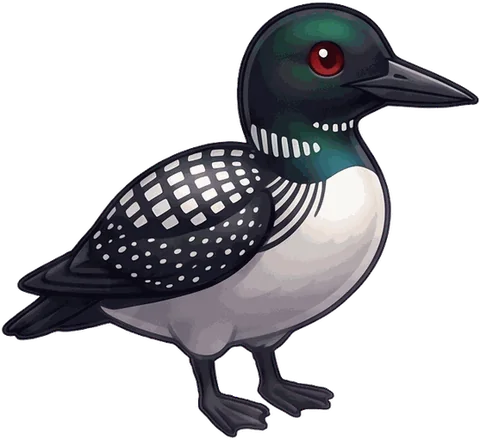
A Common Loon sounds like the North Woods after dark. It has four calls. The wail is a long, rising and falling oo-AH-ho that carries across a lake and is often compared to a wolf's howl. The tremolo is a short, wavering laugh given in alarm. The yodel is a long, complex call given only by males to claim a territory. The hoot is a soft note between mates and chicks. Loons call most at night, and most of all from mid-May to mid-June.
The four calls
The wail is the one people mean when they say a lake sounds lonely. It is a long call of up to three notes, rising through the middle and falling away, which Audubon writes as a mournful oo-AH-ho. Wikipedia compares it to a wolf's howl, and the comparison holds. Pairs use it to find each other across open water, one bird calling and the other answering from a distance.
The tremolo is the laugh: a short, shaking, wavering call that Audubon describes as a loud wailing laugh. It signals distress or alarm, so if a loon starts tremoloing while you paddle toward it, you are too close.
The yodel is the male's alone: a long, complex call, a loud ringing kee-a-ree, kee-a-ree in Audubon's rendering, used to announce that a territory is occupied and to warn off other males. Animal Diversity Web puts it plainly: a loud yodel from the male means this lake is taken.
The hoot is the one you only hear close up: a short, soft note passed between members of a family group or a small flock.
Like the Red-tailed Hawk's scream, the loon's voice has become a stock sound effect. Missouri's field guide notes that studios drop long, mournful loon wails into scenes set in places loons never visit, and Wikipedia adds that the call is used on screen to evoke wilderness and suspense.
Why loons call at night
The wail, yodel and tremolo are all given more often at night than by day, and calling peaks between mid-May and mid-June, when pairs are settling territories and starting nests. Loons also call during migration, sometimes at night as they pass over.
When and where you hear it
Common Loons breed from about 48 degrees north to the Arctic Circle: across Canada, Alaska, the northern tier of states and parts of Greenland and Iceland. Over half the North American breeding population is in Ontario and Quebec. A good lake is a big one, with room for a long takeoff run and plenty of small fish. Loons are heavy birds with solid bones, which helps them dive but means they need a lot of open water to get airborne, and with legs set far back on the body they can barely walk, so the nest is always right at the water's edge.
Fish are about 80 percent of the diet, hunted by sight: a loon dives, driven by its feet, usually 13 to 33 feet down for around 42 seconds, though dives to 200 feet have been recorded. Pairs are monogamous, lay two olive-brown spotted eggs, and share incubation for about 28 days. Chicks are swimming within a day or two and ride on a parent's back.
In fall loons move to the coasts, mainly the North Atlantic and the northeast Pacific, and winter on shallow ocean water near shore as far south as Baja California and southern Texas, plus large ice-free lakes and reservoirs inland, where they are mostly quiet. The loon has been the state bird of Minnesota since 1961, and it is on the Canadian dollar coin, the loonie. It is listed as threatened in Michigan and New Hampshire, and lead fishing sinkers caused about half the loon deaths in one New England survey. For Warble players in most states, the wail is a card worth a trip north.
What it looks like
A big, heavy waterbird, 26 to 36 inches long with a wingspan around four and a half feet, sitting low in the water with a thick, dagger-shaped bill. In breeding plumage the head and neck are black with a green or purple sheen, the eyes are red, a striped black-and-white collar rings the neck, and the back is checkered black and white. From September to March the bird is dark gray above and white below with a pale, indented collar at the side of the neck.
Birds that sound similar
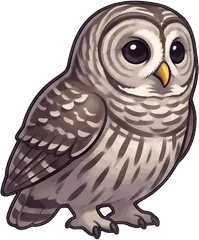 Barred Owl
The Barred Owl is the other famous night voice of northern lakes, but its who cooks for you is a rhythmic, barking hoot in a fixed pattern. A loon's wail slides smoothly up and down with no syllables to count.
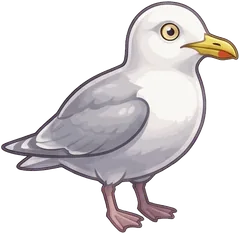 Herring Gull
On the coast in winter a distant loon can be lost among Herring Gulls. Gulls bugle in separate notes that get louder; the loon's wail is one continuous, bending note, and winter loons are mostly silent anyway.
Where the Common Loon card lives
In Warble the same bird can be an easy card in one state and a prized one in another, because each album ranks its birds by how often people really report them there. The Common Loon appears in 13 state albums:
 Heard one? Open Warble, tap the green button while it sings, and the Common Loon card flips into your album. Get the app free.
Questions people ask
Why do loons call at night?
Because that is when they talk most. The wail, yodel and tremolo are all given more often at night than during the day, and calling is heaviest from mid-May to mid-June, when pairs are claiming lakes and starting nests.
What does a loon's yodel mean?
It means this lake is taken. The yodel is a long, complex call given only by males to announce an occupied territory and warn off other males. Audubon writes it as a loud, ringing kee-a-ree, kee-a-ree.
Is the loon Minnesota's state bird?
Yes. Minnesota adopted the Common Loon as its state bird in 1961. It is also the provincial bird of Ontario, which holds the largest breeding population anywhere, and it appears on Canada's one-dollar coin, the loonie.
Can a loon walk on land?
Barely. A loon's legs are set at the very back of its body, which makes it a powerful underwater swimmer and nearly helpless on shore, so nests are built right at the water's edge. It also needs a long run across the water to take off.
Sources
- National Audubon Society, Guide to North American Birds: Common Loon. www.audubon.org/field-guide/bird/common-loon
- Wikipedia: Common loon (the four calls, night calling, diving, range, state bird of Minnesota). en.wikipedia.org/wiki/Common_loon
- Missouri Department of Conservation, Field Guide: Common Loon. mdc.mo.gov/discover-nature/field-guide/common-loon
- Animal Diversity Web: Gavia immer (yodel, legs, breeding). animaldiversity.org/accounts/Gavia_immer/