 Warble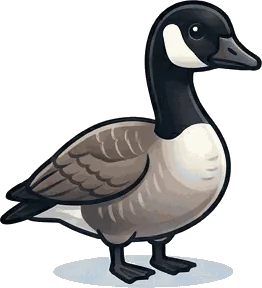
A Canada Goose sounds like a loud, two-part honk, and if you listen closely it is two voices: the gander gives a long, deep a-honk and the goose answers with a shorter, higher hrink or hink, so a pair can sound like one bird with a wobble. Flocks honk constantly in flight, and a V passing overhead in spring or fall is a rolling chorus of both notes. Up close, a goose that feels threatened lowers its head, opens its bill and hisses.
What the honk sounds like
Audubon files the Canada Goose's voice under rich musical honking, and the richness comes from the fact that no two notes are quite alike. Wikipedia splits it by sex: the male's call is the long, loud honk, low and resonant, while the female's hrink is shorter and higher pitched. Since pairs may stay together for life and call back and forth, the honk you think you hear is often a duet, the deep note and the high one alternating so fast they blur into one two-syllable sound.
Geese have about ten distinct vocalizations, each for a different situation, from greeting a mate to keeping contact in flight, so a flock on a pond is never really quiet.
The hiss and the flight call
When a goose feels threatened, especially near a nest or goslings, it starts with a high-pitched hiss, head lowered almost to the ground, bill slightly open, sometimes pumping the head up and down. That is the last warning before a charge, and it is why goose encounters in city parks are a spring tradition. In the air the flock keeps up a steady honking, and the sound usually reaches you before the birds do.
When and where you hear it
Canada Geese nest across Alaska, Canada and most of the northern United States, on tundra, marshes and lakes in wooded country, and winter across the rest of the country wherever fields lie within commuting distance of open water. Historically each population followed a fixed migration route with traditional stopovers, and the V-formations heading north in spring and south in fall are still how many people mark the seasons. Migrating geese fly around 3,000 feet up and have been recorded as high as 29,000.
But a lot of Canada Geese no longer go anywhere. Birds on refuges, golf courses and city ponds with food and open water all year have become permanent residents, and Audubon notes the species has turned into a common resident of city lakes and parks in many areas. The giant Canada Goose of the Midwest was thought extinct in the 1950s until a small wintering flock turned up in Rochester, Minnesota, in 1962; by 1981 more than 6,000 had been released at 83 sites. The continental population was put at 4 to 5 million in 2000, and Audubon now estimates more than 7 million, probably still rising.
Geese are grazers. They walk and clip grass, sedges and shoots, tip up in shallow water for aquatic plants, and clean up waste grain and corn in fields, which is where the trouble with farmers begins. The nest is a shallow bowl of grass and down on slightly raised ground near water, with a clear view; the female incubates four to seven eggs for 25 to 28 days while the male stands guard, and the goslings leave the nest within a day or two and fly at seven to nine weeks. Wild geese that reach adulthood commonly live 10 to 24 years; the record is a 33-year-old female banded in Ohio. In Warble the honk is one of the first water cards most players catch, since the bird lives on nearly every park pond.
What it looks like
A big, long-necked goose, 30 to 43 inches long with a wingspan of four to six feet, and anywhere from about 6 to 20 pounds depending on the population. The head and neck are black with a white chinstrap; the body is brown, paler below. Size and shade vary enormously across the seven subspecies, from the giant Canada Goose to small Arctic forms, and in 2004 the smallest forms were split off as a separate species, the Cackling Goose.
Birds that sound similar
- ?Cackling Goose
The Cackling Goose is a Canada Goose in miniature, some hardly bigger than a Mallard, with a stubby bill. Audubon calls its high-pitched cackling honk the alto to the Canada Goose's tenor.
- ?Sandhill Crane
Sandhill Cranes also pass overhead in loud flocks during migration, but their call is a loud, rolling, rattling kar-r-r-r-o-o-o, a bugle rather than a honk, and it carries much farther.
Where the Canada Goose card lives
In Warble the same bird can be an easy card in one state and a prized one in another, because each album ranks its birds by how often people really report them there. The Canada Goose appears in 47 state albums:
 Heard one? Open Warble, tap the green button while it sings, and the Canada Goose card flips into your album. Get the app free.
Questions people ask
Do male and female Canada geese sound different?
Yes. The gander's honk is long, loud and deep, written a-honk; the goose's call is shorter, faster and higher, written hrink or hink. Because pairs call back and forth, a single pair can sound like one bird honking in two pitches.
Why do Canada geese honk while flying?
To keep the flock together. Geese in a V honk to communicate with one another in flight, and the formation itself saves energy, with the lead bird rotating out because the front is the most tiring spot. Migrating flocks typically fly around 3,000 feet up.
Why do Canada geese hiss?
It is a warning. A goose that feels threatened, usually one guarding a nest or goslings in spring, lowers its head, opens its bill and gives a high-pitched hiss, sometimes pumping its head up and down. Back away; the next step is a charge.
Why don't Canada geese migrate anymore?
Many still do, but geese on city ponds, golf courses and refuges with food and open water all year have no reason to leave, and Audubon notes that many urban and refuge geese are now permanent residents. Restoration programs that released thousands of giant Canada Geese in the mid-1900s helped create these flocks.
Sources
- National Audubon Society, Guide to North American Birds: Canada Goose. www.audubon.org/field-guide/bird/canada-goose
- Wikipedia: Canada goose (calls by sex, ten vocalizations, flight altitude, giant subspecies, Cackling Goose split). en.wikipedia.org/wiki/Canada_goose
- National Audubon Society, Guide to North American Birds: Cackling Goose (voice and size, for comparison). www.audubon.org/field-guide/bird/cackling-goose
- National Audubon Society, Guide to North American Birds: Sandhill Crane (voice, for comparison). www.audubon.org/field-guide/bird/sandhill-crane