 Warble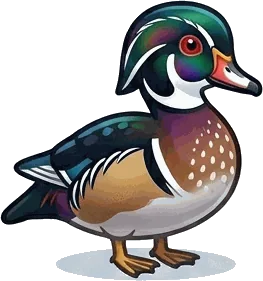
A Wood Duck does not quack. The sound most people hear is the female's loud, rising squeal, written oo-eek! or wooo-eeek!, given as she bursts off a wooded pond or flies over a swamp. The male is much quieter, with a thin, high, rising whistle like jeeee? or ter-weeee?. Listen for the squeal along slow rivers, beaver ponds and flooded timber with big trees overhanging the water, especially in the first hour of daylight when the ducks are moving between roost and feeding spots.
What the whistles sound like
Ducks do not sing, so what a Wood Duck has instead is a set of whistles and squeals, and the two sexes sound nothing alike. The female owns the loud one: a drawn-out squeal that rises sharply in pitch, a haunting oo-eek, oo-eek that carries across a forested wetland. It is her flight call, and you hear it most when a pair explodes off the water in front of you and vanishes between the trunks.
The male's voice is soft and easy to miss: a thin, high, rising whistle, jeeee? or ter-weeee?, with a questioning lift at the end. In courtship, which starts in midwinter, that whistle comes with head bobbing and flashes of the wings and tail, and the female answers with a loud, penetrating call of her own. Animal Diversity Web counts about a dozen distinct adult calls, including pre-flight notes from both sexes and the call the female uses to gather her ducklings.
The call: a sharp cr-r-ek alarm
When something worries her, the female drops the squeal for a sharp, croaking cr-r-ek, cr-e-ek. That alarm sends ducklings toward cover while she distracts or feigns injury to lead the danger away. Ducklings start talking early, with alarm, contact and threat calls two or three days after hatching. Add the rustling, swishing sound of wings on takeoff, and you have the whole Wood Duck soundtrack: brief, high and mostly heard when the birds are leaving.
When and where you hear it
Wood Ducks live where trees meet still or slow water: wooded swamps, beaver ponds, farm ponds with a treed edge, creek backwaters and shaded lake margins. Their range covers the eastern half of the United States, the Pacific coast from British Columbia to Mexico, and adjacent southern Canada, and they have been pushing north and west in recent years. Northern birds migrate south for winter while southern birds stay put. In Missouri they are common in spring, summer and fall, and only a few winter in the southeast corner.
Spring is the loud season. Egg laying runs from February in the South to mid April in the North, and the squeals of females looking for nest cavities are a March sound in the eastern woods. The nest is a hole in a big tree, sometimes 60 feet up and up to a mile from water, or a nest box. The female lays roughly 6 to 15 eggs, more when neighbors sneak eggs into her box, and incubates them alone for about a month. The morning after hatching she calls from below, and the ducklings claw up the cavity wall and jump, from heights of 50 feet, landing in water or leaf litter unhurt. Southern pairs often raise two broods, which no other North American duck does.
This bird nearly disappeared. Market hunting for meat and for the European hat trade, plus the felling of old hollow trees, drove numbers to the edge by the early 1900s. The Migratory Bird Treaty of 1916, hunting rules, wetland protection and thousands of nest boxes put up from the 1930s brought it back. Audubon now puts the population at 4.6 million. It is also one of the harder cards to catch by sound in Warble, because the bird usually calls once while flying away.
What it looks like
The male in breeding plumage is one of the most ornate ducks in the world: a glossy green and purple crested head with white lines running back from the bill, red eyes, a chestnut chest, bronze flanks and a dark back. The female is brownish gray with a crest, a white throat and a white teardrop ring around the eye that tapers to a point behind it. Both are 18 to 21 inches long, about three quarters the length of a Mallard, and in flight they look long-tailed and dark with a white trailing edge on the inner wing. They perch in trees on sharp claws and eat acorns, seeds, berries and insects.
Birds that sound similar
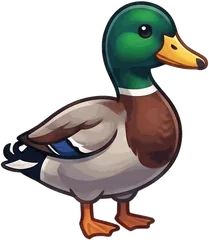
- ?Hooded Merganser
It shares the same wooded ponds and even the same nest boxes, but its voice is hoarse grunts and a low, frog-like croaking chatter, with none of the Wood Duck's high squeal.
Where the Wood Duck card lives
In Warble the same bird can be an easy card in one state and a prized one in another, because each album ranks its birds by how often people really report them there. The Wood Duck appears in 41 state albums:
 Heard one? Open Warble, tap the green button while it sings, and the Wood Duck card flips into your album. Get the app free.
Questions people ask
Do Wood Ducks quack?
No. The female's main call is a loud, rising squeal, oo-eek, given mostly in flight, plus a sharp cr-r-ek alarm. The male gives a soft, high whistle. If you hear a real quack on a wooded pond, it is probably a Mallard.
What is the squealing sound coming from the swamp at dawn?
Very likely a female Wood Duck flushing or flying to feed. Her oo-eek rises sharply and carries a long way over water. Look for a small, long-tailed, dark duck flying fast between the trees.
How do Wood Duck ducklings get out of the tree?
They jump. The morning after hatching, the female calls from the ground or water and the ducklings climb the cavity wall with their claws and leap, sometimes from 50 feet up, landing safely on water or soft leaf litter. They can swim and feed on their own right away.
Why do Wood Ducks nest in boxes?
Because they are cavity nesters and old hollow trees near water became scarce. Boxes put up from the 1930s onward were a big part of the recovery from near extinction. Spacing matters: boxes too close together lead to females dumping eggs in each other's nests.
Sources
- National Audubon Society, Guide to North American Birds: Wood Duck. www.audubon.org/field-guide/bird/wood-duck
- Wikipedia: Wood duck (calls, measurements, nesting, duckling jumps, population history). en.wikipedia.org/wiki/Wood_duck
- Missouri Department of Conservation, Field Guide: Wood Duck. mdc.mo.gov/discover-nature/field-guide/wood-duck
- Animal Diversity Web: Aix sponsa, wood duck (calls, courtship, ducklings, predators). animaldiversity.org/accounts/Aix_sponsa/