 Warble
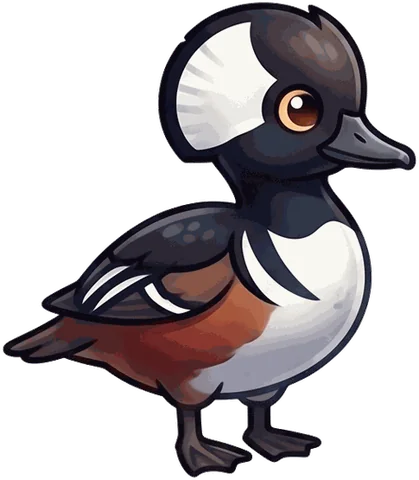
A Hooded Merganser is usually silent, which makes its one memorable sound easy to misplace: during courtship the male gives a low, croaking call that sounds more like a frog than a duck. Females answer with a hoarse gak, and Audubon adds hoarse grunts and chatters to the list. Pairs form in late fall and winter, so listen then on wooded ponds, swamps, creeks and backwaters, where a male is raising his white, fan-shaped crest for a female nearby.
What the courtship croak sounds like
Ducks do not sing, and this one barely talks. The Missouri Department of Conservation describes Hooded Mergansers as usually silent, with one notable exception: during courtship displays the male makes a low, froglike, croaking sound. It is the kind of noise you would expect from the reeds at the pond's edge, not from a handsome black-and-white duck. Audubon files the species' calls under croaks, rattles and odd sounds, and describes them as hoarse grunts and chatters.
The croak comes with a show. In most courtship displays the male raises his crest and spreads it into a nearly circular white fan edged in black, and then can lower it again until it trails flat behind his head. If you hear an odd, frog-like grunt on a cold pond and see a crest snap open, you have found a courting pair.
The female's gak and other calls
Females are just as quiet, but when they call it is a hoarse gak. Later in the season the female does one more thing with her voice: when her ducklings hatch she calls to them from the ground below the nest, and they climb to the cavity entrance and jump.
Most of what a Hooded Merganser does happens underwater. It dives and swims with its feet, hunting by sight with eyes adapted for underwater vision. Mergansers are the only North American ducks that specialize in fish, and the hooded's slim, serrated bill, hooked at the tip, grips slippery prey. Small fish, crayfish and other crustaceans and aquatic insects make up most of the diet, with some tadpoles and frogs; the ducklings start out on insects.
When and where you hear it
This is a duck of wooded water. In summer it lives along forest creeks, narrow rivers and pond edges, and it will move into more open marshes where nest boxes are put up. In winter it uses woodland ponds, wooded swamps and fresh and brackish coastal estuaries. Most birds migrate only short distances, late in fall and early in spring, and southern breeders may stay all year. The smallest of the three native mergansers, it is easily overlooked in swamps and wooded ponds.
Because pairs form in late fall and winter, the courtship croak is a cold-weather sound, heard on ice-free ponds and backwaters. In Missouri, for example, Hooded Mergansers are uncommon migrants and rare summer and winter residents, wintering mainly in the south of the state. In Warble it appears in 28 state albums, uncommon in Minnesota and Washington and rare or legendary in most others.
Nesting in trees
Hooded Mergansers nest in tree cavities near water, usually 10 to 50 feet up, so they need standing dead trees and mature forest along rivers, oxbows and swamps. They also use nest boxes, and nest boxes put up for Wood Ducks have probably helped them. Females often lay eggs in other females' nests, Wood Duck nests included. Only the female incubates, usually for about 33 days.
Within a day of hatching, the downy ducklings leap from the cavity to the forest floor at their mother's call. They find their own food from the start, and the female tends them for several weeks until they can fly at about 70 days old. Habitat loss and overhunting cut their numbers in the early 1900s; landowners who leave dead trees standing and put up boxes help keep them healthy.
What it looks like
A small, slim diving duck about 16 to 19 inches long. The breeding male has a black head, neck and back, a white crest bordered in black that he can raise into a circle or flatten, and chestnut flanks. The female is brown with a bushy, rusty crest at the back of a long, flat head. Legs set far back make mergansers stand upright on land, and in flight they are direct, with rapid wingbeats. The Missouri Department of Conservation notes they are the only mergansers in that state that can leap straight up out of the water.
Birds that sound similar
- ?Bufflehead
Audubon suggests comparing the two by sight, and both nest in tree cavities near ponds. By ear, the male Bufflehead's squeaky whistle is nothing like the merganser's low croak, though the female Bufflehead's soft, hoarse quack is closer to a hooded hen's gak.
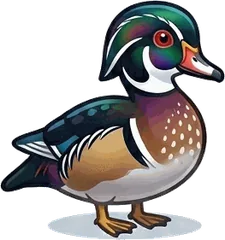 Wood Duck
s share the same wooded ponds and nest boxes. A loud, squealing wooo-eeek! is a female Wood Duck, and the male's jeee is soft; a hoarse gak or a low croak is the merganser.
Where the Hooded Merganser card lives
In Warble the same bird can be an easy card in one state and a prized one in another, because each album ranks its birds by how often people really report them there. The Hooded Merganser appears in 28 state albums:
 Heard one? Open Warble, tap the green button while it sings, and the Hooded Merganser card flips into your album. Get the app free.
Questions people ask
What duck sounds like a frog?
A courting male Hooded Merganser. During his displays he gives a low, froglike croak, usually while raising his white crest into a fan. The rest of the time Hooded Mergansers are mostly silent.
Do hooded mergansers nest in trees?
Yes. They nest in tree cavities near water, often 10 to 50 feet up, and readily use nest boxes. A day after hatching, the ducklings jump from the hole to the ground when their mother calls.
Why does a hooded merganser raise its crest?
Mostly to court. In most of the male's courtship displays the crest is raised and spread into a nearly circular white fan. He can also flatten it so it trails behind his head.
What do hooded mergansers eat?
Mostly small fish, crayfish and aquatic insects, which they catch by diving and chasing prey underwater by sight. The narrow, serrated bill helps them hold slippery fish.
Sources
- National Audubon Society, Guide to North American Birds: Hooded Merganser. www.audubon.org/field-guide/bird/hooded-merganser
- Missouri Department of Conservation, Field Guide: Hooded Merganser (courtship croak, female call, nesting). mdc.mo.gov/discover-nature/field-guide/hooded-merganser
- National Audubon Society, Guide to North American Birds: Bufflehead. www.audubon.org/field-guide/bird/bufflehead
- National Audubon Society, Guide to North American Birds: Wood Duck. www.audubon.org/field-guide/bird/wood-duck