 Warble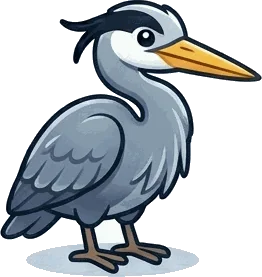
A Great Blue Heron sounds like something prehistoric clearing its throat: a deep, harsh, croaking squawk, written gwock, kraak or frawnk, usually given once or twice as the bird lifts off a pond edge on slow, heavy wings. It is a mostly silent bird, so the squawk is a surprise, loud and low and nothing like a songbird. You hear it at dawn and dusk along rivers, marshes, lake shores and tide flats across the United States in every season, and in spring a nesting colony becomes a croaking racket.
What the squawk sounds like
Herons do not sing, and the Great Blue is quiet even by heron standards. The sound almost everyone knows is the flushing call: a low, rough, drawn-out kraak or gwock, given as the bird is disturbed and takes off, then repeated once or twice as it flaps away. Audubon sums it up as a harsh squawk. It is deep and guttural, more croak than cry, and because the bird is usually silent until the moment it flies, the effect is like a rusty gate suddenly swinging open at the far end of a marsh.
That is essentially the whole vocabulary a person on a riverbank will hear. Animal Diversity Web lists up to seven calls, including a roaring fraunk that a disturbed bird gives near the nest, which can go on for about 20 seconds, and a soft ar used as a greeting between mates. Herons also talk without their voices: pairs clatter their bills together during courtship, and the male shakes twigs and stretches his neck with the plumes fluffed.
The colony: where a silent bird gets loud
The one place a Great Blue Heron is truly noisy is the heronry. These colonies, from a handful of nests to several hundred, sit in tall trees near water, often on islands where raccoons cannot easily reach. In spring the air over one fills with croaks, squawks, bill clacking and the begging of chicks. Audubon notes that early-season disturbance by people can make birds abandon the site, so listen from a distance.
When and where you hear it
This is the most widespread large heron in North America, found from Alaska and southern Canada through the whole of the lower 48 into Mexico and beyond. It hunts in almost any shallow water: marshes, swamps, river edges, farm ponds, lake shores, mangroves, coastal bays and tide flats, and it will stalk voles and gophers in a dry field. Birds east of the Rockies in the north move south for winter, but Pacific coast birds stay put, some even in southeastern Alaska, and anywhere water stays open a heron may be standing in it in January. In Missouri it nests in colonies statewide and is commonest during migration and the late-summer wandering of young birds.
Fishing, and therefore the flushing squawk, peaks at dawn and dusk, though the bird hunts by night as well. Colonies get busy from March to May in the North and from November to April in the South. A pair lays three to five pale blue eggs, both parents incubate for roughly four weeks and feed the chicks by regurgitating fish, and the young can fly at about two months. Bald Eagles, which have recovered across the same waters, attack herons at every age, from egg to adult.
Audubon puts the population at about 700,000 and calls it common and widespread, with the shooting that once thinned it now mostly in the past. For a Warble player the trick is timing: the heron has to be startled into speaking, so a recording usually happens in the two seconds after you round a bend in a creek.
What it looks like
A very tall, long-necked, long-legged wader, 3 to 4.5 feet long with a wingspan of 5.5 to 6.5 feet, weighing 4 to 8 pounds. The body is blue gray, the neck rusty gray streaked with black and white, the thighs reddish brown, and the whitish head carries a black stripe that ends in plumes trailing off the back of the crown. The bill is long, heavy and yellowish, and the wingbeats are slow and broad. In southern Florida there is an all-white form, the Great White Heron, with a yellow bill and pale legs, and an intermediate Wurdemann's Heron with a white head on a gray body. Young birds are duller, with a dark crown and no plumes.
Birds that sound similar
- ?Great Egret
The big white egret gives a similar guttural croak and loud squawks at the colony. By voice alone the two are hard to separate, so look: the egret is pure white with black legs, and a gray bird croaking is the heron.
- ?Black-crowned Night-Heron
Its call is a single, loud, barking kwok! or quawk!, shorter and more clipped than the heron's rolling squawk, and it is heard most at dusk and after dark, often from a bird flying overhead unseen.
Where the Great Blue Heron card lives
In Warble the same bird can be an easy card in one state and a prized one in another, because each album ranks its birds by how often people really report them there. The Great Blue Heron appears in 49 state albums:
 Heard one? Open Warble, tap the green button while it sings, and the Great Blue Heron card flips into your album. Get the app free.
Questions people ask
What does a Great Blue Heron sound like when it flies away?
A deep, harsh, croaking squawk, something like gwock or kraak, given once or a few times as the bird lifts off. It is low, rough and loud, and most people hear it only when they have flushed the heron from a pond edge.
Do Great Blue Herons make noise at night?
Sometimes. They hunt at night as well as by day, and a bird disturbed after dark gives the same harsh squawk. A short barking kwok at night, though, is more likely a Black-crowned Night-Heron.
What do Great Blue Herons eat?
Mostly fish, usually small to medium ones, but almost anything they can swallow whole: frogs, salamanders, snakes, turtles, crayfish, large insects, small birds and rodents. They stalk voles and gophers in dry fields, and they occasionally choke trying to swallow a fish that is too big.
Where do Great Blue Herons nest?
In colonies called heronries, usually in tall trees 20 to 60 feet up near water, on islands or in swamps that keep predators away. Nests are large stick platforms, sometimes hundreds in one stand of trees.
Sources
- National Audubon Society, Guide to North American Birds: Great Blue Heron. www.audubon.org/field-guide/bird/great-blue-heron
- Wikipedia: Great blue heron (measurements, range, colonies, diet, predators). en.wikipedia.org/wiki/Great_blue_heron
- Missouri Department of Conservation, Field Guide: Great Blue Heron. mdc.mo.gov/discover-nature/field-guide/great-blue-heron
- Animal Diversity Web: Ardea herodias, great blue heron (calls, courtship, breeding seasons, threats). animaldiversity.org/accounts/Ardea_herodias/