 Warble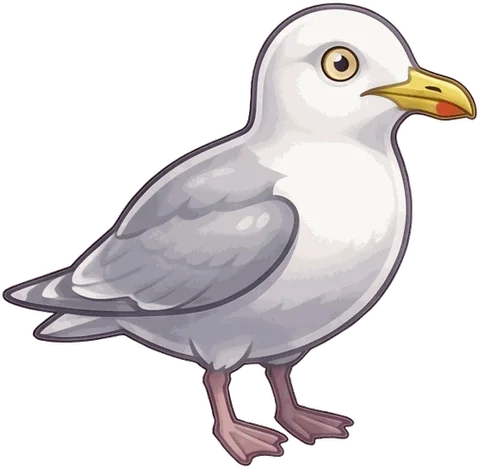
A Herring Gull sounds like the beach in every movie: a loud, clear, bugling keow or klaoh, and the famous long call, a rising series of trumpeted notes, kuk-kuk-kuk, yucca-yucca-yucca, delivered with the head thrown back. Around it are shorter sounds: a quick hahaha when a bird is threatening a rival, a low anxious bark, a soft mew, and the thin peeping of chicks. It is the big pink-legged gull of ocean coasts, the Great Lakes, harbors, big rivers and landfills, and it calls all year.
The long call: what stands in for a song
Gulls do not sing, so the sound that does the work of a song is the long call. A Herring Gull begins it with the head bowed, then throws the head up and back and lets out a rising, rollicking series of loud notes, Audubon writes it as kuk-kuk-kuk, yucca-yucca-yucca, that climbs, holds and tails off. It is a territorial signal that tells neighbors where a boundary lies, and it is the sound most people mean when they say a gull is laughing. On a breeding island in June it never stops.
This is the American Herring Gull, Larus smithsonianus, which the American Ornithological Society split from the European Herring Gull in 2025 after long treatment as a subspecies. The species name honors James Smithson, whose bequest founded the Smithsonian. To your ears the change matters little: the voice is the same big, brassy gull voice on both sides of the Atlantic, and this site simply calls it Herring Gull.
The calls: keow, mew, hahaha and the chicks
Between long calls a Herring Gull has a whole vocabulary. The everyday note is a loud, clear keow or, as Missouri's field guide writes it, a low klaoh or kaow, lower and louder than a Ring-billed Gull's. A fast hahaha is a threat aimed at a rival. A yelping call is the alarm and a low bark means anxiety, both heard when a fox, an eagle or a person walks into a colony. During courtship the male gives a soft mew and a strangled choking call.
Chicks beg with a repetitive, high-pitched peep and a flick of the head, and they peck at the red spot on the parent's yellow bill to trigger a meal.
When and where you hear it
The Herring Gull breeds from central Alaska across Canada to Maine and down the Atlantic coast to North Carolina, and around the Great Lakes, on islands and sometimes on gravel roofs. It is a year-round presence from New England, the Great Lakes and southern Alaska southward, and in winter it spreads along every coast and up the big rivers; in Missouri flocks gather at the locks and dams of the Mississippi and at landfills from September to April. Younger birds travel farther south than adults, some to Mexico, Panama and the West Indies.
Wherever there is food it will call: beaches, mudflats, piers, fishing boats, plowed fields, parking lots and dumps. It eats fish, crabs, mussels, sea urchins, worms, insects, other birds and their eggs, carrion and garbage, and it carries clams and mussels aloft to drop them on rocks or roads, a trick that seems to be learned rather than inborn. Pairs form in March and April, lay usually three blotched eggs in a ground scrape lined with grass and seaweed, incubate for about four weeks, and the young fly at six or seven weeks but stay dependent for months.
The species was nearly wiped from the Atlantic coast by egg collecting and plume hunting in the 1800s, then boomed under protection through the middle of the 1900s. Audubon now counts about 3.9 million, though Wikipedia notes declines in some areas. Every one of them is loud, which makes this one of the simplest coastal cards to catch in Warble: point the phone at the pier and wait.
What it looks like
A big gull, about 22 to 26 inches long with a wingspan of four to five feet and a weight of two to three pounds. The adult has a white head and body, a pale gray back, black wingtips with white spots, pink legs, a pale eye and a yellow bill with a red spot on the lower mandible; in winter the head and neck are streaked gray brown. It is a four-year gull: first-year birds are dark gray brown all over with a blackish bill and dark tail, and each year they get paler until the adult plumage arrives in the fourth winter.
Birds that sound similar
- ?Ring-billed Gull
The commoner gull of parking lots and inland lakes gives a similar raucous mewing cry, but higher pitched and thinner. If the long call sounds deep and full-throated, it is the bigger Herring Gull.
- ?Great Black-backed Gull
The largest gull in the world, on the Atlantic coast and the Great Lakes, calls like a Herring Gull but deeper and more guttural, a hoarse keeow. Its black back settles the question in daylight.
Where the Herring Gull card lives
In Warble the same bird can be an easy card in one state and a prized one in another, because each album ranks its birds by how often people really report them there. The Herring Gull appears in 20 state albums:
 Heard one? Open Warble, tap the green button while it sings, and the Herring Gull card flips into your album. Get the app free.
Questions people ask
What is the classic seagull sound?
Usually a Herring Gull. Its loud, clear keow and its long call, a rising series of bugled notes given with the head thrown back, are the gull sounds used in films and on beach postcards. The Laughing Gull's ha-ha-ha is the other common one on Atlantic and Gulf beaches.
Why do seagulls scream so much?
Because almost everything a gull does is public. The long call marks territory, the yelp warns the colony of a predator, the hahaha threatens a rival, and chicks peep constantly for food. Add a colony of hundreds of pairs and the noise follows.
Is the American Herring Gull a different species from the Herring Gull?
As of 2025, yes. The American Ornithological Society recognized the North American bird, Larus smithsonianus, as a species separate from the European Herring Gull, Larus argentatus. Guides and apps may list either name; the voice is essentially the same.
How long do Herring Gulls live?
A long time for a bird. The closely related European Herring Gull has reached 49 years, and both species take about four years to reach adult plumage.
Sources
- National Audubon Society, Guide to North American Birds: American Herring Gull. www.audubon.org/field-guide/bird/american-herring-gull
- Wikipedia: American herring gull (taxonomy, calls, measurements, plumage by age, range, diet, population). en.wikipedia.org/wiki/American_herring_gull
- Missouri Department of Conservation, Field Guide: American Herring Gull. mdc.mo.gov/discover-nature/field-guide/herring-gull
- Wikipedia: European herring gull (long call posture, alarm and anxiety calls, chick begging, longevity). en.wikipedia.org/wiki/European_herring_gull