 Warble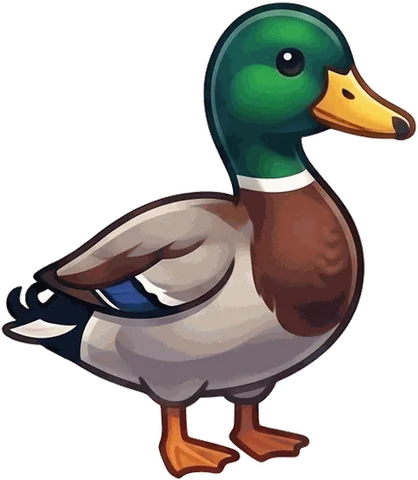
A Mallard sounds like the duck in every cartoon, but only if it is a female. The hen gives the loud, deep, classic quack, usually in a series of two to ten that starts strong and fades away. The drake does not really quack: his voice is a quieter, deeper version of the same note, what Audubon calls soft, reedy notes. You hear both on almost any pond, park lake, marsh or river across the United States, in every month of the year.
The quack, and who makes it
The stereotypical duck quack comes from the female Mallard. It is deep, loud and flat, and Wikipedia describes the typical delivery as a sequence of 2 to 10 quacks in a row, starting loud and gradually getting quieter, so that a calling hen sounds as if she is losing interest halfway through.
The drake is the quiet one. His call is phonetically close to the female's quack but deeper and softer, and Audubon sums up the two sexes as soft, reedy notes from the male and a loud, familiar quack from the female. Mallards are a noisy species in general, and one study found that urban Mallards in London called much louder and more often than rural birds in Cornwall, apparently keeping up with the traffic.
A hen that is incubating or guarding ducklings uses a clipped, truncated version of her quack, and ducklings find it highly attractive: this is the call that keeps a brood in a line behind her.
Sounds through the year
Pairs form in October and November, and the fall and winter flocks are the noisiest. By spring the pair is quiet and hidden while the hen nests. At the beginning and end of summer the drakes molt into a drab eclipse plumage that makes them look like females, and for a while the easiest way to tell who is who on the pond is to listen for the loud quack, which still belongs to the hens.
When and where you hear it
Mallards are among the most abundant and widespread ducks in the world. In North America they breed from Alaska across Canada and the northern and central states, with the biggest numbers on the prairie potholes, and winter across the rest of the country, gathering in the swamps and lakes of the lower Mississippi Valley. Wild Mallards are migratory, with a slow fall migration and an early return in spring, but feral and park birds stay all year, so in most towns the quack never leaves.
They want fresh water, and shallow: marshes, wooded swamps, ponds, rivers, lakes, flooded grain fields and city parks, usually less than three feet deep, with coastal bays only in winter. A Mallard feeds by dabbling, dipping its head under or tipping up with the tail in the air, and rarely dives. The menu is anything: seeds, stems and roots of sedges, grasses and pondweeds, acorns, waste grain, plus insects, snails, crustaceans, worms and tadpoles.
The drake follows the hen back to her breeding grounds. She builds the nest alone, a plant-lined bowl on the ground in vegetation, sometimes more than a mile from water, and lays 7 to 13 eggs, incubating them for 23 to 30 days. Ducklings swim as soon as they hatch and fly at 50 to 60 days. Average life expectancy is about three years, though birds have reached twenty. The Mallard is the ancestor of almost every domestic duck breed, first domesticated in Southeast Asia at least 4,000 years ago, and it has hybridized with more than 40 wild species, most often the American Black Duck in the Northeast, which is why park flocks are full of odd-looking crosses. In Warble it is one of the first cards almost everyone catches, usually from a hen at a park pond.
What it looks like
A big dabbling duck, 20 to 26 inches long with a wingspan around three feet. The breeding drake has a glossy green head, a white neck ring, a chestnut breast, a gray body and a yellow bill. The hen is mottled brown with buff cheeks, a dark eye stripe and an orange bill smudged with black. Both sexes show a purple-blue wing patch, the speculum, edged in white, which is the mark to look for on drakes in eclipse plumage and on the many hybrids.
Birds that sound similar
- ?American Black Duck
The American Black Duck's call is the typical duck quack, so by ear it is a Mallard hen. Look instead: both sexes resemble a female Mallard but much darker, with a gray head and a purple speculum without the Mallard's bold white edges.
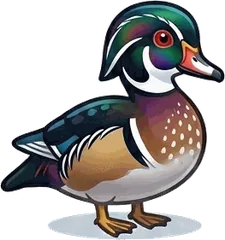 Wood Duck
A Wood Duck hen does not quack. Her call is a loud, rising wooo-eeek, usually given as she flushes from a wooded pond, and the drake's is a thin jeee or ter-weeeee. Nothing in it is deep or flat.
Where the Mallard card lives
In Warble the same bird can be an easy card in one state and a prized one in another, because each album ranks its birds by how often people really report them there. The Mallard appears in 51 state albums:
 Heard one? Open Warble, tap the green button while it sings, and the Mallard card flips into your album. Get the app free.
Questions people ask
Do male mallards quack?
Not really. The loud, classic quack is the female's call. The drake makes a sound shaped like a quack but much deeper and quieter, which Audubon describes as soft, reedy notes. If a duck is quacking loudly at you in the park, it is a hen.
Why does a mallard quack over and over?
It is usually a hen calling. The female's typical series is 2 to 10 quacks in a row, starting loud and fading, and a shorter clipped version is what she uses to gather her ducklings. Urban Mallards have been found to call louder and more often than rural ones.
Are domestic ducks descended from mallards?
Almost all of them. Every domestic duck breed except a few Muscovy breeds descends from the Mallard, which was first domesticated in Southeast Asia at least 4,000 years ago. Escaped domestic birds and their crosses are why park Mallards come in so many odd shapes and colors.
Do mallards stay all winter?
In most of the country, yes. Wild Mallards migrate, moving south gradually through fall to winter across the United States, especially the lower Mississippi Valley, and feral park birds do not leave at all.
Sources
- National Audubon Society, Guide to North American Birds: Mallard. www.audubon.org/field-guide/bird/mallard
- Wikipedia: Mallard (female decrescendo quack, male call, urban study, breeding, domestication, hybrids). en.wikipedia.org/wiki/Mallard
- National Audubon Society, Guide to North American Birds: American Black Duck (voice and comparison). www.audubon.org/field-guide/bird/american-black-duck
- National Audubon Society, Guide to North American Birds: Wood Duck (voice, for comparison). www.audubon.org/field-guide/bird/wood-duck