 Warble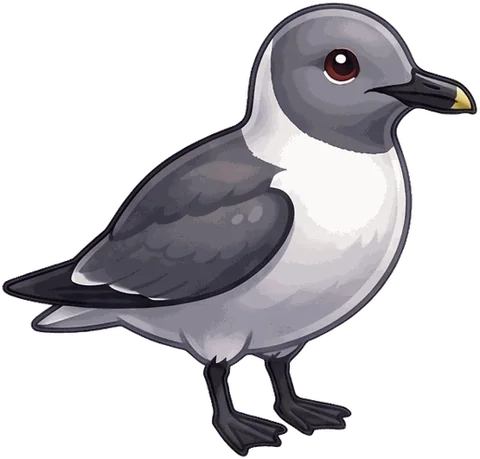
A Laughing Gull sounds exactly like its name: a loud, high, nasal series of notes, ha-ha-ha-ha-haah-haah-haah, that starts fast and slows into longer, drawn-out laughs. Single calls are a raucous kee-agh. Audubon calls it the characteristic sound of tidewater country, and on Atlantic and Gulf coast beaches, salt marshes and piers from spring through fall it is often the loudest bird around. Wikipedia describes the call as a high-pitched laugh, and once you have heard it beside a Herring Gull's lower bugle, the two never blur again.
The laugh: what stands in for a song
Gulls do not sing, and what a Laughing Gull has instead of a song is the long call that gave it its name. It opens with a run of quick, even ha-ha-ha-ha notes, then the notes stretch into longer, higher haah, haah, haah cries and trail off. The tone is nasal and strident, higher than any big gull's, and a bird in full display pours the whole thing out toward a rival or a mate. In a colony of thousands of pairs, and Wikipedia notes colonies up to 25,000, the laughing rolls across the marsh all day.
Animal Diversity Web simply says the bird is named for a call that sounds like ha ha ha, and describes the species as noisy, aggressive and quarrelsome. That is fair. Laughing Gulls call while stealing a fish from a Brown Pelican, while squabbling over a dropped french fry, while chasing a tern, and while flying along the surf. On a summer beach in New Jersey or Texas you may hear little else.
The calls: kee-agh and the beach chorus
Away from the display, single notes carry the conversation. The commonest is a loud, raucous kee-agh, given in flight, in alarm and in arguments over food. Strings of them turn into the laugh when the bird gets worked up. The pitch is what separates it from the other beach gulls: higher and more nasal than a Herring Gull or a Ring-billed Gull. From late May through July the chicks in a colony add a constant begging chorus.
When and where you hear it
This is a coastal gull of the East and the Gulf. It breeds from Nova Scotia down the Atlantic coast, around the Gulf of Mexico, through the Caribbean to northern South America, and a separate population lives at the Salton Sea and on the Pacific coast of Mexico. It nests in big colonies on the ground, in grass and low bushes on salt marsh islands and barrier beaches, laying usually three olive or buff eggs blotched with brown. Both parents incubate for roughly three weeks, and the young fly at five to six weeks. Nesting starts in late April in the South and mid to late May in the North.
Laughing Gulls pull out of the northern part of the range in fall, and many winter from the southern United States to Venezuela, so the laugh is a spring-to-fall sound in the Northeast and a year-round one in Florida and along the Gulf. Inland it is rare except in Florida and near the Salton Sea, though single birds wander a few miles up rivers and to fields and dumps. It eats small fish, crabs, insects, worms, snails, horseshoe crab eggs, tern eggs and chicks, refuse, and whatever it can take from other birds. Banding records give an average lifespan around 20 years.
Plume hunters nearly emptied the colonies in the 1800s; protection brought the bird back in the early 1900s, and Audubon now estimates 1.6 million, calling it abundant and widespread. It is also the gull most likely to be in your photo of a Brown Pelican, waiting for a fish to slip out. Record the laugh with Warble on any Atlantic pier in summer and you will have it.
What it looks like
A medium-sized, slim gull about 14 to 16 inches long with a wingspan around three and a half feet, weighing seven to twelve ounces. In summer the adult has a black hood, a dark gray back and wings with black tips and none of the white spots a Franklin's Gull shows, a white body and a long red bill. In winter the hood is mostly lost. It takes three years to reach adult plumage: first-year birds are brownish with a gray back, a paler head and an all-black tail, and second-year birds show a partial hood. Legs and bill are dark, often tinged red.
Birds that sound similar
- ?Franklin's Gull
The prairie cousin, which passes through the middle of the country in migration, gives a strident ha-ha-ha-ha much like a Laughing Gull's but higher pitched, and it is a bird of inland marshes and plowed fields, not the surf.
 Herring Gull
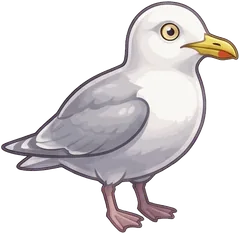
The Herring Gull shares the same beaches but is much bigger and its long call is a deeper, fuller bugle, kuk-kuk-kuk, yucca-yucca, with a clear keow. The Laughing Gull is higher, faster and unmistakably a laugh.
Where the Laughing Gull card lives
In Warble the same bird can be an easy card in one state and a prized one in another, because each album ranks its birds by how often people really report them there. The Laughing Gull appears in 18 state albums:
 Heard one? Open Warble, tap the green button while it sings, and the Laughing Gull card flips into your album. Get the app free.
Questions people ask
Why is it called a Laughing Gull?
Because its long call sounds like laughter: a loud, high series of ha-ha-ha notes that slow into longer haah cries. The scientific name is about the look, not the sound: atricilla means black tail, for the tail of young birds.
Where can I hear a Laughing Gull?
On Atlantic and Gulf coast beaches, salt marshes, piers and boardwalks from Nova Scotia to Texas, and year-round in Florida and along the Gulf. Northern birds leave in fall. It is rare inland apart from Florida and the Salton Sea in California.
Do Laughing Gulls really steal fish from pelicans?
Yes. Audubon lists stealing from Brown Pelicans in its diet, and Animal Diversity Web notes that it often takes food from pelicans and terns right after they make a catch. It also raids tern nests for eggs and chicks.
Do Laughing Gulls have a black head all year?
No. The black hood is breeding plumage. In winter it is mostly lost, leaving a largely white head. Young birds have no full hood for their first year, and only a partial one in their second summer.
Sources
- National Audubon Society, Guide to North American Birds: Laughing Gull. www.audubon.org/field-guide/bird/laughing-gull
- Wikipedia: Laughing gull (name and call, measurements, plumage by age, colonies, nesting dates). en.wikipedia.org/wiki/Laughing_gull
- Animal Diversity Web: Larus atricilla, laughing gull (call, behavior, stealing from pelicans, lifespan, plume trade). animaldiversity.org/accounts/Larus_atricilla/