 Warble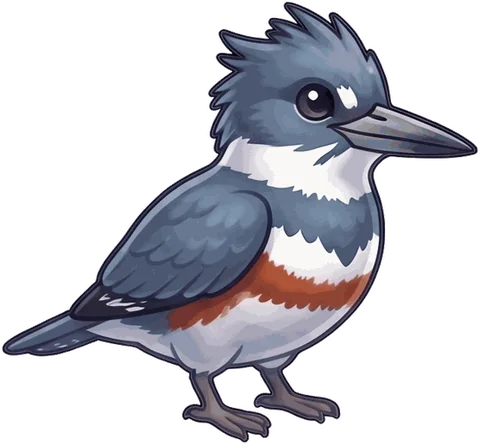
A Belted Kingfisher sounds like a wooden rattle being shaken hard: a loud, dry, penetrating chatter of fast clicking notes, all at roughly the same pitch, that goes on for a second or two and usually comes from a bird already in flight. It is not musical at all. You hear it along clear streams, rivers, ponds, lakes and coastlines across almost all of North America, most often when the kingfisher leaves its fishing perch or chases another kingfisher off its stretch of water. The rattle is its territory marker, fired off at almost any disturbance.
What the rattle sounds like
Kingfishers do not sing. What the Belted Kingfisher has instead is one of the most recognizable non-musical sounds on any waterway: a long, loud, high-pitched rattle or chatter made of dozens of hard, dry notes run together. Think of a fishing reel paying out fast, or a stick dragged along a picket fence. It carries far over water and is almost always given on the wing, as the bird leaves one perch and heads for the next, so the sound usually travels along the stream ahead of you.
Animal Diversity Web counts at least six calls that the bird combines in different ways, but the rattle is the one that matters, and it is used to mark territory. Kingfishers are solitary and fiercely territorial outside the nesting season, each defending a stretch of shoreline, and an intruder, whether another kingfisher, a hawk or a person in a canoe, gets pursued and rattled at until it leaves. Audubon adds that a kingfisher will also scream during threat displays or when retreating.
The call in context: a bird that announces itself
There is no soft contact note that a casual listener will pick up; the rattle does all the work. It gets louder and longer when two birds are disputing a boundary, and you may hear a burst every time the bird changes perch. Both adults rattle when a predator comes near the nest burrow, and young kingfishers add to the noise once they leave the tunnel.
When and where you hear it
The kingfisher needs two things: clear water with fish it can see from above, and a perch, a dead branch, a wire or a piling, from which to watch. That puts it on streams, rivers, small lakes, ponds, estuaries, bays and rocky coasts across Canada and the whole of the United States. For nesting it also needs a steep, bare earthen bank, usually sand or loam, into which the pair digs a horizontal burrow three to six feet long, sloping slightly upward. Both birds dig, using the bill and their oddly fused inner toes as a shovel.
Most American kingfishers move only as far as they must to find open water, so the rattle is a year-round sound wherever creeks and rivers do not freeze, from the southern coast of Alaska to the Gulf. Northern birds head south along rivers and coastlines in fall, some reaching Central America and the West Indies. In Missouri it is an uncommon summer resident and rarer in winter. The loudest time is spring, when territories are being carved up along every stream; the five to eight white eggs hatch after 22 to 24 days, and the young leave the tunnel in under a month.
Audubon estimates about 1.8 million birds and rates it of low conservation concern, but Missouri notes a decline of around 46 percent since the 1960s, and the bird abandons stretches of water where people are constantly present. For a Warble player the rattle is one of the easier water sounds to catch: it is loud, distinctive, and the bird tends to give it just as you arrive.
What it looks like
A stocky, big-headed bird about a foot long with a 19 to 23 inch wingspan, a shaggy double-pointed crest and a heavy, straight bill longer than its head. The upperparts and a band across the chest are slate blue, the collar and belly white. Unusually, the female is the more colorful sex: she adds a rusty band across the belly and down the flanks, which the male lacks. Watch it hover over a pool, fold up and plunge headfirst, eyes closed, then carry the fish back to the perch and whack it against the branch before swallowing it head first.
Birds that sound similar
- ?Hairy Woodpecker
Its loud rattle stays on one pitch and can fool you near a wooded stream, but it comes from a bird clinging to a trunk, not flying over water, and it is broken up by sharp single peek notes.
 Pileated Woodpecker
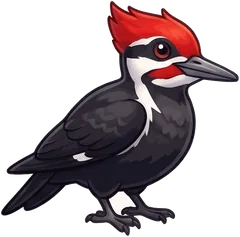
The Pileated Woodpecker gives a loud cuk-cuk-cuk series that rises and falls in pitch and sounds like laughter. The kingfisher's rattle is drier, faster and flat, with no rise or fall.
Where the Belted Kingfisher card lives
In Warble the same bird can be an easy card in one state and a prized one in another, because each album ranks its birds by how often people really report them there. The Belted Kingfisher appears in 47 state albums:
 Heard one? Open Warble, tap the green button while it sings, and the Belted Kingfisher card flips into your album. Get the app free.
Questions people ask
What bird makes a loud rattling sound near water?
Almost certainly a Belted Kingfisher. Its call is a long, dry, mechanical rattle given mostly in flight along streams, rivers, ponds and shores. Look for a big-headed, crested blue-gray bird with a white collar flying low over the water or perched on a dead branch above it.
Why do kingfishers rattle?
It is a territorial call. Each kingfisher defends its own stretch of shoreline, and the rattle warns off other kingfishers and anything else that comes too close, including people. That is why you usually hear it the moment the bird sees you.
Do Belted Kingfishers stay for the winter?
Many do. They only need open water with visible fish, so they stay wherever rivers and coasts do not freeze, even along the southern coast of Alaska. Birds from frozen regions move south along rivers and coasts.
Where do kingfishers nest?
In a tunnel they dig into a steep dirt or sand bank near water, three to six feet long and angled slightly uphill. Both parents dig, incubate the five to eight eggs for 22 to 24 days, and feed the young.
Sources
- National Audubon Society, Guide to North American Birds: Belted Kingfisher. www.audubon.org/field-guide/bird/belted-kingfisher
- Wikipedia: Belted kingfisher (measurements, plumage, burrow, range). en.wikipedia.org/wiki/Belted_kingfisher
- Missouri Department of Conservation, Field Guide: Belted Kingfisher. mdc.mo.gov/discover-nature/field-guide/belted-kingfisher
- Animal Diversity Web: Megaceryle alcyon, belted kingfisher (calls, territory, burrow digging, feeding). animaldiversity.org/accounts/Megaceryle_alcyon/