 Warble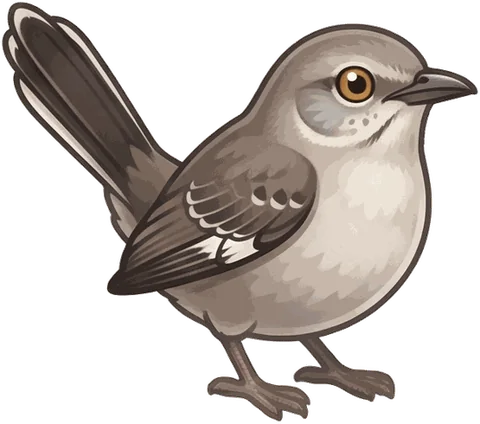
A Northern Mockingbird sounds like a dozen birds taking turns from one bush. It sings a long, loud series of musical and grating phrases, many of them copied from other birds, and repeats each phrase three or more times, typically three to five, before switching to the next. Unmated males often keep it up all night in spring. The everyday call is a harsh chack.
What the song sounds like
The structure is the key. Each phrase is given three or more times in a row, usually three to five, and then the bird moves on to a completely different one, so the song comes across as a series of short, insistent bursts, tweet-tweet-tweet-tweet, churr-churr-churr, whit-whit-whit, and so on for minutes at a time. The volume is high: a male sings from a rooftop or a wire and can be heard down the block.
Much of the material is borrowed. Mockingbirds copy the songs and calls of dozens of species, Carolina Wren, Northern Cardinal, Wood Thrush and Eastern Bluebird among them, plus frogs, crickets, dogs, cats, creaky hinges, unoiled wheels, cell phones, car horns and car alarms. A male learns somewhere between roughly 40 and 200 song types depending on where he lives, and keeps adding new ones all his life. Females sing too, more quietly, mostly in fall and when the male is away from the territory.
Males start singing in late January or February in the South and keep going through summer, then sing again in fall as they set up winter territories.
The call: a harsh chack
The call is a loud, harsh chack or tcheck, sometimes a thinner tseek, given when a cat, a hawk or a person comes near the nest or the bird's winter berry bush. You will hear a lot of it. Mockingbirds are famously aggressive: they dive at cats, dogs, hawks and people who come too close, and they can learn to recognize individual humans and treat the ones they consider a threat differently.
When and where you hear it
Northern Mockingbirds live year-round across most of the continental United States, from the Maritime Provinces of Canada to southern Oregon and south through Mexico and the Caribbean, and they are thickest in the South: Texas and southern Florida have more than anywhere else. They spread north over the last two centuries, helped by plantings of multiflora rose. They do not migrate, so the chack is a winter sound too.
The habitat is open ground with shrubs: suburbs, parks, farmland, roadsides, woodland edges and, in the West, desert scrub and chaparral. Summer food is insects, beetles, grasshoppers, caterpillars, ants and wasps, taken mostly while walking and running on the lawn; in fall and winter the diet swings hard to berries, and a mockingbird will defend a single holly or fruiting shrub against every other bird all winter. Nesting starts early, by late winter in the South, in a dense shrub or tree three to ten feet up, with two or three broods a year. In Warble it is the state-bird card in five southern albums.
Singing at night
The bird singing at two in the morning in April is almost always an unmated male. Unpaired males sing far more than paired ones, in more bouts and in more directions, and on moonlit spring nights they may go almost without stopping, day and night, until a female turns up. Paired males in brightly lit suburban neighborhoods will sometimes sing after dark as well.
What it looks like
A slim, gray, robin-sized bird, about ten inches long with a wingspan of twelve to fourteen inches: gray above, whitish below, with a long tail it cocks and flicks, a thin, slightly down-curved bill and a pale yellow eye. Two white wing bars and a white crescent at the base of the flight feathers become big white wing patches when the bird flies, and the outer tail feathers are white. The sexes look alike. Young birds have dark streaks on the chest and can be mistaken for a thrasher. On the ground a mockingbird walks, hops, stops, and jerks its wings open in a two-step motion that shows the white patches, a wing flash that may startle insects out of the grass.
Birds that sound similar
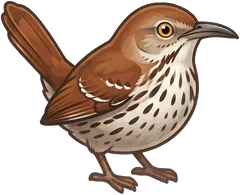 Brown Thrasher
The Brown Thrasher sings a similar string of varied phrases but repeats each one only two or three times, usually in pairs, and its call is a loud smack. A mockingbird runs each phrase three or more times.
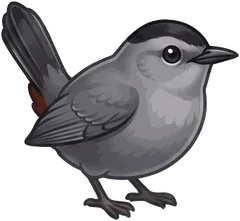 Gray Catbird
The Gray Catbird's song is a jumble of varied phrases with little or no repetition, and its call is a nasal meeoow. A mockingbird is louder and repeats everything.
Where the Northern Mockingbird card lives
In Warble the same bird can be an easy card in one state and a prized one in another, because each album ranks its birds by how often people really report them there. The Northern Mockingbird appears in 34 state albums:
 Heard one? Open Warble, tap the green button while it sings, and the Northern Mockingbird card flips into your album. Get the app free.
Questions people ask
Why does a mockingbird sing all night?
Because it has not found a mate. Night singers are mostly unmated males, which sing almost continuously on moonlit spring nights to advertise for a female. Mated males in brightly lit suburban neighborhoods sometimes sing after dark too. The singing eases once the bird pairs.
How do you tell a mockingbird from a brown thrasher by song?
Count the repeats. A mockingbird repeats each phrase three or more times before changing; a Brown Thrasher gives each phrase twice, occasionally three times; and a Gray Catbird hardly repeats at all. The thrasher's call is a loud smack, the catbird's a nasal meeoow.
Which states have the mockingbird as state bird?
Five: Arkansas, Florida, Mississippi, Tennessee and Texas. Tennessee adopted it in 1933.
What sounds can a mockingbird imitate?
Dozens of other birds, including Carolina Wrens, cardinals, Wood Thrushes and bluebirds, as well as frogs, crickets, barking dogs, cats, creaky hinges, unoiled wheels, cell phones, car horns and car alarms. Each male knows somewhere between about 40 and 200 song types.
Sources
- National Audubon Society, Guide to North American Birds: Northern Mockingbird. www.audubon.org/field-guide/bird/northern-mockingbird
- Wikipedia: Northern mockingbird (repertoire, mimicry, calls, range and state bird status). en.wikipedia.org/wiki/Northern_mockingbird
- Missouri Department of Conservation, Field Guide: Northern Mockingbird. mdc.mo.gov/discover-nature/field-guide/northern-mockingbird
- Tennessee Wildlife Resources Agency: Northern Mockingbird. www.tn.gov/twra/wildlife/birds/grassland-and-shrub-birds/northern-mockingbird.html