 Warble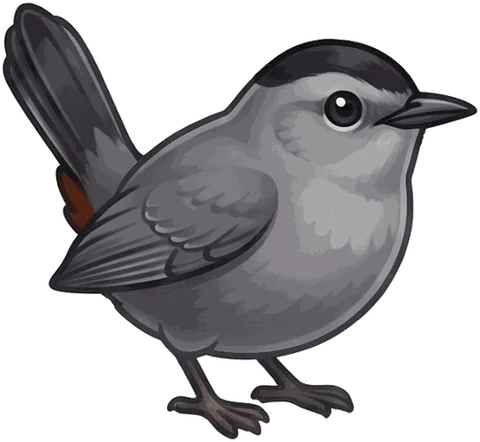
A Gray Catbird sounds like a bird making it up as it goes: a long, irregular run of whistles, squeaks, harsh chatters and copied sounds, sung from inside a thicket, with almost no phrase sung twice. It is raspier and less polished than a mockingbird, and a good singer can keep going for minutes. The everyday call is the one that named the bird: a nasal, down-slurred mew that sounds convincingly like a cat somewhere in the hedge.
The birder's mnemonic
“mew” That is the call, not the song. For the song, count the repeats: a catbird sings each phrase about once, a Brown Thrasher twice, a Northern Mockingbird three times or more.
What the song sounds like
The song is a long, loose jumble with no fixed shape: clear whistles, squeaky notes, clicks, nasal sounds, harsh chatters and the odd borrowed fragment, in no particular order. The thing to listen for is what is missing. A Northern Mockingbird hammers each phrase three or more times and a Brown Thrasher sings its phrases in pairs, but a catbird moves on after almost every phrase, so the song never settles into a rhythm you can tap along to. It is also raspier than either relative, and it can run on without a break for minutes at a time.
The singer is usually invisible. Catbirds sing from inside dense shrubs and vine tangles rather than from an exposed treetop, and the genus name records the habit: Dumetella comes from the Latin for a thorny thicket. Like the other mimics, the catbird has a voice box that can make two sounds at once, which explains some of the strange overlapping notes.
The mimicry is real but modest. A catbird copies bits of other birds' songs, tree frogs and mechanical noises and drops them into its own song, so the borrowed material goes by before you can place it.
The call: a cat in the hedge
The call is a nasal, whining mew, slurred downward and drawn out, close enough to a house cat that people go looking for one under the bushes. You hear it in every month the bird is around, almost always from inside the cover. Alongside it there are harsh tcheck notes and a dry chatter.
When and where you hear it
Catbirds breed across most of the country east of the Rockies and north into southern Canada, then clear out for the winter. Spring migration runs from March into May and the fall movement from late August into November, mostly at night; birds from the western edge of the range fly east first and then turn south. Winter birds settle in the Southeast, Mexico, Central America and the Caribbean, in berry-rich thickets near water, and a few hardy ones now stay through midwinter as far north as Ohio.
Habitat is the giveaway: dense, low, leafy growth. Woodland edges, streamside thickets, shrubby swamps, overgrown fields, old orchards, fencerows and the hedge at the back of a suburban yard all hold catbirds; deep unbroken forest and conifer stands do not. Look for the bird on the ground under the shrubs, hunting beetles, ants and caterpillars, or up in a berry bush in late summer and fall. Catbirds also recognize a Brown-headed Cowbird egg in their nest and peck it to pieces.
Because the singer stays hidden, this is a bird most people learn by ear before they ever see it, and in most eastern states the mew from the hedge is an early Warble catch.
What it looks like
A catbird is a slim, long-tailed bird, 8 to 9 inches long and 1 to 2 ounces, smooth lead gray all over with a neat black cap. The one splash of color is a patch of rusty chestnut under the base of the tail, which shows when the bird flips its tail up, and it does that a lot. Males and females look alike. Seen well it is unmistakable. Seen the way it usually is, as a dark shape slipping through a hedge, the mew is a faster identification than any field mark.
Birds that sound similar
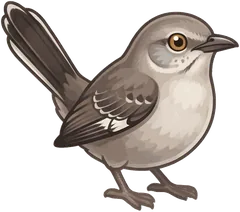 Northern Mockingbird
A mockingbird repeats each phrase three or more times, sings from an open perch, often at night, and sounds cleaner and more musical. The catbird's phrases go by once, from inside a bush, with a raspy edge.
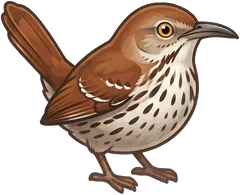 Brown Thrasher
A Brown Thrasher sings in pairs: each phrase twice, then a new one. It is louder and more musical than the catbird, delivered from a high perch rather than a thicket, and its call is a sharp smack instead of a mew.
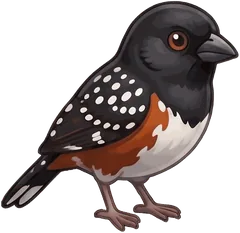 Spotted Towhee
On the Plains and in the West, a Spotted Towhee gives a questioning, nasal meewww that can pass for a catbird for a moment. The towhee's note rises like a question, and its song is a long buzzy trill, nothing like the catbird's ramble.
Where the Gray Catbird card lives
In Warble the same bird can be an easy card in one state and a prized one in another, because each album ranks its birds by how often people really report them there. The Gray Catbird appears in 40 state albums:
 Heard one? Open Warble, tap the green button while it sings, and the Gray Catbird card flips into your album. Get the app free.
Questions people ask
Why is it called a catbird?
Because of its call, a nasal, drawn-out mew that sounds like a house cat hidden in the shrubbery. The scientific name Dumetella carolinensis says the rest: a thicket bird from the Carolinas.
What do Gray Catbirds eat?
Mostly insects and berries: beetles, ants and caterpillars in summer, then wild berries and cultivated fruit in fall and winter. A berry bush beside a hedge is the surest way to bring one into a yard.
Where do Gray Catbirds go in winter?
South. Most leave the northern states between late August and November for the southeastern US, Mexico, Central America and the Caribbean, where they live in berry-rich thickets near water. A few now linger through midwinter as far north as Ohio.
Sources
- National Audubon Society, Guide to North American Birds: Gray Catbird. www.audubon.org/field-guide/bird/gray-catbird
- Wikipedia: Gray catbird (song, range, migration and name). en.wikipedia.org/wiki/Gray_catbird
- Missouri Department of Conservation field guide: Gray Catbird. mdc.mo.gov/discover-nature/field-guide/gray-catbird
- National Audubon Society, Guide to North American Birds: Northern Mockingbird (for the phrase-repetition comparison). www.audubon.org/field-guide/bird/northern-mockingbird