 Warble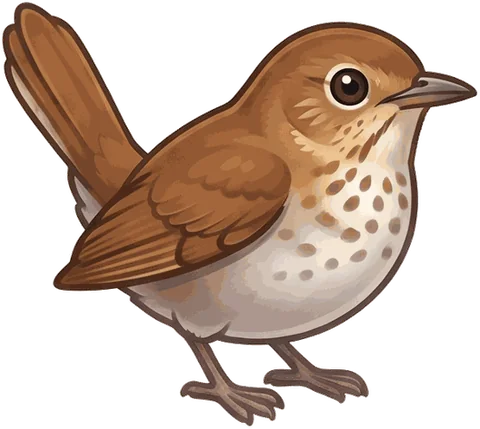
A Veery sounds like a flute note tumbling down a spiral staircase. The song is a breezy, reedy roll of phrases that slide steadily downward in pitch, each one a little lower than the last, with a hollow, echoing quality. It is sung from a low, hidden perch in damp deciduous woods, mostly in the northern states and southern Canada, and it is at its best in the last light of dusk. The call is a harsh, descending veer or whew, and that call is where the name comes from.
What the song sounds like
The song is a rich downward spiral. It starts fairly high, rolls through a series of breathy, reedy, flute-like phrases, and each phrase drops a step below the one before, so the whole song corkscrews down and fades. There is no held opening note, no pause between parts, and no bold central phrase, only the continuous falling roll. The tone is airy rather than pure, and it carries a long way through wet woods at evening.
Direction is the key to the brown thrushes. A Swainson's Thrush sings a similar spiral that climbs upward. A Hermit Thrush opens each phrase with one long, clear note before a soft flourish. A Wood Thrush sings a loud, three-part ee-oh-lay with a buzzy end.
The singer is usually low and concealed, and the song is most often heard at dusk, when it echoes through the darkening forest after most other birds have stopped. Veeries also know when to be quiet: in playback experiments, birds hearing a Barred Owl nearby sang less often and for shorter stretches, presumably to avoid becoming dinner.
The call: a falling veer
The common call is a harsh, descending veer or vee-er, sometimes written whew, that slides downward like a miniature version of the song. It is the sound that named the bird. Other notes include a low chuckle, a sharp, low wuck, and a slow wee-u. On migration nights Veeries give a contact call that keeps a flock together in the dark.
When and where you hear it
Veeries breed from southern British Columbia east to Newfoundland and south to Arizona, South Dakota, Minnesota and New Jersey, with a finger of range running down the Appalachians to Georgia. Roughly a third of the population nests in the boreal forest of Canada. The habitat is damp deciduous woods with a dense, leafy understory, usually near a stream or swamp; in the West they also use willow thickets along creeks, and on the northern Great Plains they turn up in more open country. Listen in early summer, in the hour after sunset.
They migrate at night and winter east of the Andes in South America, across the Amazon basin, Mérida state in Venezuela, the headwaters of the Orinoco and as far south as São Paulo state in Brazil. Tracked birds from Delaware stopped on the Gulf coast, the Carolina coast, Cuba, Jamaica, Colombia and Venezuela on the way. In summer they feed on the forest floor, flipping leaves for beetles, ants, caterpillars and snails and occasionally flying up to snatch an insect, then switch to berries and small fruit in late summer and fall.
The nest sits on or close to the ground, usually at the base of a shrub under five feet up, holding about four eggs. In Vermont, New York and the rest of the northern woods the dusk song is a reliable summer catch for Warble.
What it looks like
The least spotted of the brown thrushes. A Veery is 6.3 to 7.7 inches long and about 1 to 1.4 ounces, a uniform warm tawny or cinnamon brown from crown to tail, with white underparts and only faint, blurry brownish spots on a buff-washed upper breast. The face is pale and plain, with a poorly defined eye ring, and the legs are pink. Western birds are a little duller with slightly heavier spotting. Compared with a Hermit Thrush there is no contrast between back and tail.
Birds that sound similar
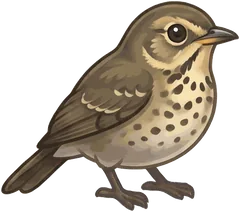 Swainson's Thrush
Swainson's Thrush sings the same kind of breathy spiral but it climbs upward and ends high. The Veery falls the whole way and ends low.
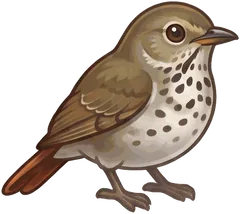 Hermit Thrush
A Hermit Thrush opens each phrase with one long, clear, level note and pauses between phrases. The Veery never pauses and never holds a note; it just rolls downhill.
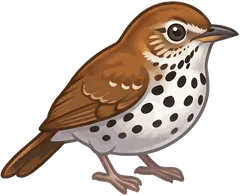 Wood Thrush
The Wood Thrush is louder and sings in separate phrases with a ringing ee-oh-lay in the middle. The Veery's song is softer, continuous and always descending.
Where the Veery card lives
In Warble the same bird can be an easy card in one state and a prized one in another, because each album ranks its birds by how often people really report them there. The Veery appears in 8 state albums:
 Heard one? Open Warble, tap the green button while it sings, and the Veery card flips into your album. Get the app free.
Questions people ask
Why is it called a Veery?
After its call, a harsh, downslurred veer or vee-er. The song echoes the same shape, spiraling downward, so both the name and the song point the same direction.
When do Veeries sing?
Mostly on the breeding grounds from late spring into early summer, and most persistently at dusk, when the song carries through the darkening woods after other birds have gone quiet. They sing from low, hidden perches, so you will usually hear one long before you see it.
Where do Veeries go in winter?
To South America, east of the Andes: the Amazon basin, Venezuela, the upper Orinoco and southern Brazil. They fly at night, and birds tracked from Delaware stopped along the Gulf coast, in the Carolinas, in Cuba and Jamaica, and in Colombia and Venezuela on the way.
How do I tell a Veery from a Swainson's Thrush by ear?
Follow the pitch. Both sing a breathy flute-like spiral, but the Veery's slides down and the Swainson's climbs up. The calls differ too: a descending veer for the Veery, a soft whit for Swainson's.
Sources
- National Audubon Society, Guide to North American Birds: Veery. www.audubon.org/field-guide/bird/veery
- Wikipedia: Veery (song, calls, name origin, wintering range and owl study). en.wikipedia.org/wiki/Veery
- Boreal Songbird Initiative: Veery. www.borealbirds.org/bird/veery