 Warble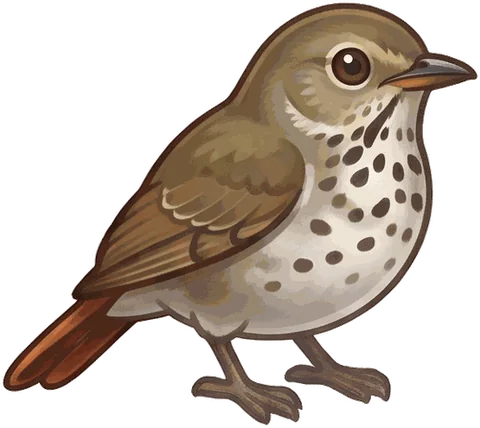
A Hermit Thrush sounds like a flute player who tests one long note before every run. Each phrase opens with a single clear, piping whistle held for a moment, then breaks into a soft, reedy, echoing tremolo that fades away. After a pause the bird sings the next phrase on a different pitch, higher or lower, so a long bout wanders up and down the scale without ever repeating itself in a row. It is quieter and more spacious than a Wood Thrush and has none of the continuous spiral of a Veery or a Swainson's Thrush. The call is a low tuck or tchup.
What the song sounds like
Each phrase of the song has two parts. It begins with one clear, pure introductory note, longer than anything a Veery or Swainson's Thrush sings, and then spills into a soft, reedy tremolo of several notes that seem to descend and echo, often with a wistful, minor-key feel. Then the bird waits. The next phrase comes on a noticeably different pitch, and the one after that on another, so the effect over a minute is of the same short melody tried in a series of keys.
Researchers who analyzed the pitches found that the notes within a phrase tend to be related by simple whole-number ratios, the same relationships that underlie scales in human music, which is part of why the song sounds so deliberately musical to us. In Vermont, where it is the state bird, it has long been called the American nightingale.
It is a summer sound of northern and mountain forests. The Wood Thrush has a bold ee-oh-lay in the middle of each phrase and a buzzy ending; the Veery spirals down and the Swainson's Thrush spirals up, both without the held first note.
The call: a low tuck
The usual call is a low, soft tuck or tchup, given from the ground or a low perch. It often comes with a signature movement: when the bird lands, it raises its tail quickly and then lowers it slowly, and flicks its wings while it sits. A startled Hermit Thrush tends to perch low, stare at you, and do exactly that.
When and where you hear it
Hermit Thrushes breed across Canada and southern Alaska, through the Northeast, and down the mountain ranges of the West, in spruce woods, sphagnum bogs, dry pine forest and thickly wooded canyons of spruce and fir. In Vermont they arrive in April and leave in the middle of October. Of all the brown thrushes this one migrates north earliest in spring and lingers latest in fall, and it is the only spotted thrush you are likely to see in the United States in winter. Wintering birds settle in almost any kind of woodland across the southern states, a few staying as far north as the coastal Northeast and southern Ontario, and others go on to Central America.
They migrate at night and feed on the ground, taking insects in summer and turning heavily to fruit in winter: elderberries, pokeberries, serviceberries, wild grapes and mistletoe berries, sometimes plucked in a brief hover. A woodland thicket with berries in December, anywhere from North Carolina to Texas, is a good place to hear the tuck.
Vermont adopted it as state bird in 1941. Walt Whitman gave the song to the grieving hermit of his Lincoln elegy, and T. S. Eliot wrote it into The Waste Land.
What it looks like
A small thrush, 6.3 to 7.5 inches long and 0.8 to 1.3 ounces, brown above with a reddish tail that contrasts with the duller back. That warm tail is the field mark: the other brown thrushes are one color from crown to tail. Below it is white with dark spots on the breast and grayish or brownish flanks, with a clean white eye ring and pink legs. Eastern birds run olive-brown, western birds grayer. Watch for the slow tail lift on landing.
Birds that sound similar
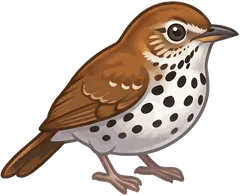 Wood Thrush
The Wood Thrush is louder, with a ringing ee-oh-lay in the middle of each phrase and a buzzy, doubled trill at the end. The Hermit Thrush opens with one long note and finishes softly.
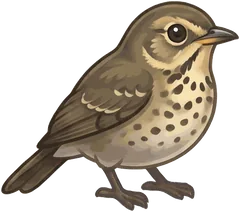 Swainson's Thrush
Swainson's Thrush sings a hurried, continuous spiral that climbs upward, with no held opening note and no pause between parts. The Hermit's phrases are separate, each starting level and then falling away.
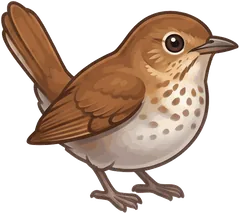 Veery
VeeryThe Veery rolls downward in a breathy, evenly spaced spiral. The Hermit Thrush is more deliberate: a clear single note, a flourish, then a change of key.
Where the Hermit Thrush card lives
In Warble the same bird can be an easy card in one state and a prized one in another, because each album ranks its birds by how often people really report them there. The Hermit Thrush appears in 25 state albums:
 Heard one? Open Warble, tap the green button while it sings, and the Hermit Thrush card flips into your album. Get the app free.
Questions people ask
Which thrush stays in the United States in winter?
The Hermit Thrush. It is the only spotted thrush normally found in North America in winter, wintering in woodlands across the southern states and along the coasts, while the Wood Thrush, Veery and Swainson's Thrush go to the tropics.
Why is the Hermit Thrush called the American nightingale?
For its song, a series of clear, flute-like phrases in changing keys that is often called the most beautiful of any North American bird. Analysis of the notes found the same simple pitch ratios found in human music.
What is the state bird of Vermont?
The Hermit Thrush, adopted in 1941. It is in Vermont from April to mid-October and winters to the south.
How do I tell a Hermit Thrush from a Swainson's Thrush by song?
Listen to the first note. A Hermit Thrush begins each phrase with one long, clear, level whistle, then a soft flourish, then a pause. A Swainson's Thrush has no held note: it starts rolling immediately and spirals upward without a break.
Sources
- National Audubon Society, Guide to North American Birds: Hermit Thrush. www.audubon.org/field-guide/bird/hermit-thrush
- Wikipedia: Hermit thrush (song structure, harmonic study, range, winter status and literature). en.wikipedia.org/wiki/Hermit_thrush
- Vermont Fish and Wildlife Department: Hermit Thrush. vtfishandwildlife.com/learn-more/vermont-critters/birds/hermit-thrush
- Wikipedia: List of U.S. state birds (Vermont, 1941). en.wikipedia.org/wiki/List_of_U.S._state_birds