 Warble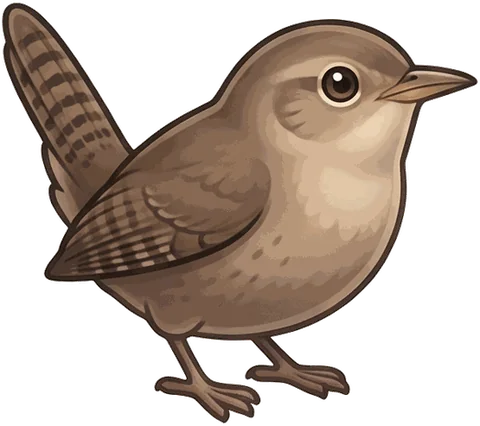
A House Wren sounds like someone shaking a box of tiny bells. The song is a fast, bubbling, exuberant jumble of trills and gurgles that starts with a few stuttering notes, rises in pitch and energy, and then tumbles downhill to the finish, all in two or three seconds. It is repeated over and over from a nest box, a fence or a low branch through late spring and early summer, and an unmated male can keep it up for minutes at a stretch. The calls are a harsh, scolding rattle and a sharp tchur.
What the song sounds like
The song is a rush of twittering, gurgling and chattering notes packed tightly together, first rising, then falling away toward the end. There is no single repeated phrase to hang onto, which is what separates it from a Carolina Wren: the House Wren does not shout one thing many times, it pours out a whole tumbling sentence and then does it again. The tone is bright, liquid and slightly frantic, and for a bird that weighs about as much as two nickels it is remarkably loud.
Males have a large vocabulary, with about 130 song types known across the species, and each bird varies its song noticeably from one bout to the next. An unmated male sings almost continuously, and can go on for ten minutes at a time. Once he has a mate he quiets down and adds a very soft whispering song given only around the time of mating. Females sing too, briefly, in the first days after pairing, and their song seems to play a part in competing with other females.
The song is common during the nesting season and rare afterward, so by late summer the yard goes quiet even though the birds are still there.
The calls: rattles and a sharp tchur
House Wrens scold constantly. The calls are a series of stuttering notes, a buzzy rattle that speeds up when a cat, a jay or a person comes near the nest, and a sharp, harsh tchur. A rattling from the hedge with a small brown tail flicking above it is almost always this bird.
When and where you hear it
House Wrens breed across southern Canada, most of the United States and into Mexico, and they leave the northern part of that range in winter for the southern states and Mexico. Most arrive back on territory in late April or May and leave again around September or early October. In a state like Missouri it is a common summer resident statewide that rarely lingers into late fall. Song starts as soon as the males arrive.
The name is earned. This is a bird of open woods, thickets, orchards, woodlots, streamside groves and, above all, towns, gardens and suburban backyards with a nest box. It nests in any cavity it can find: old woodpecker holes, hollow stumps, crevices in buildings, mailboxes, planters and nest boxes. The highest densities are in floodplain forests on the western Great Plains, where woodpecker holes are plentiful. The genus name Troglodytes means hole dweller, a nod to the way the bird vanishes into crevices to hunt.
House Wrens are also famously ruthless neighbors. The male fills several cavities with sticks as dummy nests and the female picks one and finishes it. Adults puncture the eggs of other birds nesting nearby, including other House Wrens, and stuff rival cavities with sticks to make them unusable. They eat insects and spiders almost entirely, with some millipedes and snails, so a yard with wrens is a yard with fewer caterpillars.
What it looks like
A very small, plain, hyperactive brown bird, 4.3 to 5.1 inches long and 0.3 to 0.4 ounces, with a thin bill and a short tail usually cocked upward. It is gray-brown above and paler below, with fine dark barring on the wings and tail, a faint pale eyebrow and a thin eye ring. It lacks the bold white eyebrow of the Carolina Wren and the white tail corners of a Bewick's Wren. This species was recently split from its Latin American relatives, so newer lists call it Northern House Wren.
Birds that sound similar
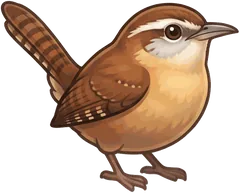 Carolina Wren
The Carolina Wren repeats one loud phrase, teakettle, several times. The House Wren never repeats a phrase; its song is a continuous bubbling run that rises and then falls.
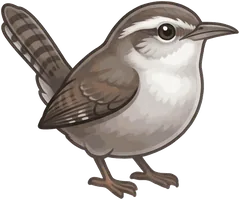 Bewick's Wren
In the West, a Bewick's Wren sings a more structured song with distinct parts and a clear trill at the end. The House Wren is faster, more jumbled and bubblier.
- ?Winter Wren
The Winter Wren's song is a much longer, thinner, tinkling cascade given in dense, mossy forest. The House Wren's is shorter, louder and bubblier, given around yards.
Where the House Wren card lives
In Warble the same bird can be an easy card in one state and a prized one in another, because each album ranks its birds by how often people really report them there. The House Wren appears in 43 state albums:
 Heard one? Open Warble, tap the green button while it sings, and the House Wren card flips into your album. Get the app free.
Questions people ask
Why does a House Wren sing all day?
Because he has not found a mate yet. Unmated males sing almost nonstop, sometimes for ten minutes without a break, from the box or cavity they are advertising. Once paired they sing far less, and the song nearly stops after nesting ends in late summer.
Do House Wrens destroy bluebird eggs?
They can. Adults are known to puncture the eggs of other birds nesting in their territory, including other House Wrens, and to fill other birds' nests with sticks to make them unusable. A bluebird box near a wren's thicket is at risk.
Is the House Wren the same as the Northern House Wren?
Yes. The House Wren complex was split into several species, and the bird of the United States and Canada, Troglodytes aedon, is now called Northern House Wren on newer lists, including the list Warble uses. Most people still say House Wren.
Sources
- National Audubon Society, Guide to North American Birds: Northern House Wren. www.audubon.org/field-guide/bird/house-wren
- Wikipedia: Northern house wren (song, migration timing, nesting habits and the split). en.wikipedia.org/wiki/Northern_house_wren
- Missouri Department of Conservation field guide: Northern House Wren. mdc.mo.gov/discover-nature/field-guide/house-wren
- Animal Diversity Web (University of Michigan): Troglodytes aedon. animaldiversity.org/accounts/Troglodytes_aedon/