 Warble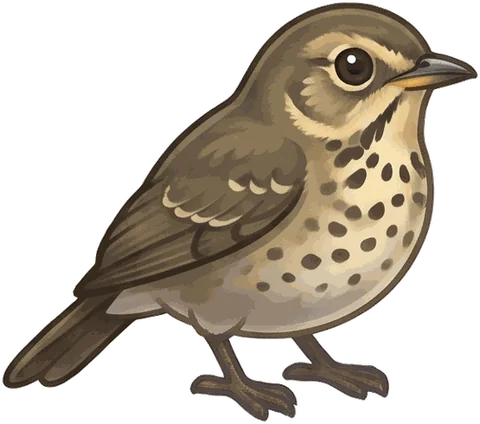
A Swainson's Thrush sounds like a Veery played backward. The song is a hurried series of reedy, flute-like phrases that roll upward, each one spiraling a little higher than the last, so the whole thing seems to climb and thin out into the treetops. It is sung from spruce forests and dense streamside woods across Alaska, Canada, the northern states and the western mountains. The everyday call is a soft, liquid whit, and on clear nights in spring and fall its short peep flight calls drift down from migrating birds passing overhead.
What the song sounds like
The song is a quick, continuous spiral that climbs. It opens low and rolls through several reedy, flute-like phrases inflected upward, each turn of the spiral higher and thinner than the last, until the final notes are faint and high. It is more hurried than the other thrush songs, finished in a couple of seconds, and it has an airy, slightly buzzy tone rather than the pure roundness of a Wood Thrush.
Among the brown thrushes the rule is simple. The Veery spirals down; the Swainson's spirals up. The Hermit Thrush holds one long clear note before each soft flourish and pauses between phrases. The Wood Thrush sings a loud three-part ee-oh-lay with a buzzy finish. A rising flute with no held note and no pause is a Swainson's.
There are two forms. Birds across the continent, the olive-backed group, are olive-brown above; birds along the Pacific coast, the russet-backed group, are redder. The two lines separated roughly 10,000 years ago and differ slightly in voice: the coastal birds' calls are a little more liquid and the inland birds' a little sharper.
The calls: whit, and peeps in the night
The common call is a soft, liquid, rising whit, and a bird whose nest is threatened adds a whit-burr. On migration the usual note becomes a short, clear peep, and because Swainson's Thrushes travel at night, those peeps are often the only trace of them: on a clear night in May or September you can stand outside and hear them falling from the dark sky.
When and where you hear it
Swainson's Thrushes breed across Alaska and Canada, through the northern tier of the United States and down the mountains of the West, in spruce forest, other conifer woods with thick leafy undergrowth, and dense streamside woods. Along the Pacific coast they also nest in deciduous trees and thickets beside creeks. Singing is a summer sound of those forests, from sea level to high elevation.
For most people in the country, though, this is a migrant. Spring passage is late and drawn out, running from March into late May, with some northbound birds still crossing the southern states at the start of June. Males arrive on territory first. The trip south runs from September into early December. Winter quarters stretch from southern Mexico to Argentina, and the two forms part ways: coastal birds winter from Mexico to Costa Rica, while inland birds take a long detour to spend the winter from Panama to Bolivia.
They feed on the forest floor and in the trees, mostly on insects, with beetles, ants and caterpillars leading the list, and berries and fruit make up more than a third of the summer diet. The nest is a bulky open cup of twigs, bark, moss and grass holding three or four pale blue eggs, built about three weeks after the males arrive.
What it looks like
A slim thrush, 6.3 to 7.9 inches long and about 0.8 to 1.6 ounces, olive-brown above, redder along the Pacific coast, with brown spots on a white throat and chest and a buff wash on the sides of the breast. The best mark is the face: a bold buff eye ring that joins a buff line to the bill, giving the bird a pair of pale spectacles that no other brown thrush has so clearly. Legs are pink. Without the spectacles it would be an olive-backed thrush with a spotted chest and an even-colored tail, which is exactly why the spectacles matter.
Birds that sound similar
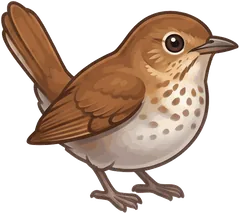 Veery
VeeryThe Veery sings the same breathy spiral in the opposite direction, sliding downward to a low finish. The Swainson's climbs and ends high, and its call is a rising whit rather than a falling veer.
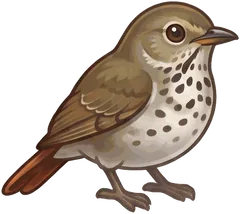 Hermit Thrush
A Hermit Thrush starts each phrase with one long, clear, held note, then a soft flourish and a pause. The Swainson's never holds a note and never pauses; it hurries upward from the first sound.
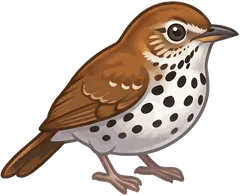 Wood Thrush
The Wood Thrush is louder and sings in separate phrases, each with a ringing ee-oh-lay and a buzzy doubled ending. The Swainson's is one quick, continuous, rising roll.
Where the Swainson's Thrush card lives
In Warble the same bird can be an easy card in one state and a prized one in another, because each album ranks its birds by how often people really report them there. The Swainson's Thrush appears in 13 state albums:
 Heard one? Open Warble, tap the green button while it sings, and the Swainson's Thrush card flips into your album. Get the app free.
Questions people ask
What are the peeps I hear in the sky at night in May?
Very often Swainson's Thrushes. They migrate at night, and their short, clear peep flight calls carry down to the ground on clear nights in spring and again in fall as the birds pass over.
How do I tell a Swainson's Thrush from a Hermit Thrush?
By ear, the Swainson's song spirals upward without a pause, while the Hermit's phrases each open with a long clear note and then stop. By eye, the Swainson's has bold buff spectacles and a tail the same color as its back; the Hermit has a plain white eye ring and a reddish tail that stands out.
What is the difference between olive-backed and russet-backed Swainson's Thrushes?
They are the two regional groups of the species. Russet-backed birds breed along the Pacific coast, are redder above and winter from Mexico to Costa Rica. Olive-backed birds breed across the rest of the range, are olive-brown and winter from Panama to Bolivia. Their calls differ slightly too.
Sources
- National Audubon Society, Guide to North American Birds: Swainson's Thrush. www.audubon.org/field-guide/bird/swainsons-thrush
- Wikipedia: Swainson's thrush (song, subspecies groups, wintering ranges). en.wikipedia.org/wiki/Swainson%27s_thrush
- Animal Diversity Web (University of Michigan): Catharus ustulatus. animaldiversity.org/accounts/Catharus_ustulatus/