 Warble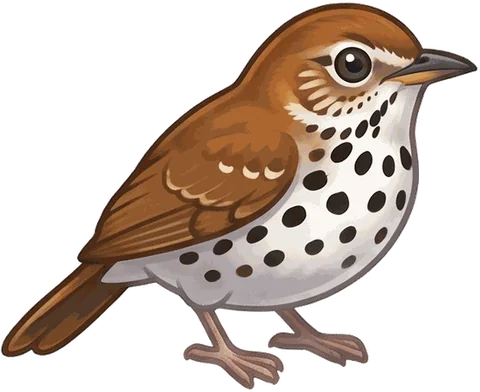
A Wood Thrush sounds like a flute played slowly in a shady forest. Each song has three parts: two to six quiet, low bup bup bup notes you only catch up close, then a loud, ringing, liquid phrase usually written ee-oh-lay, then a high, buzzy, trilled flourish in which the bird actually sings two notes at once. The phrases come unhurried, with pauses between them, loudest just before sunrise and again at dusk, from deciduous woods across the eastern United States. The call is a sharp, fast pit-pit-pit-pit.
The birder's mnemonic
“ee-oh-lay” That is only the middle of the song. Listen for the soft bup bup before it and the buzzy, doubled trill after it.
What the song sounds like
The male's song has a fixed shape with three pieces. First come a few short, low bup notes, two to six of them, so quiet you only hear them up close. Then the part everyone remembers: a loud, clear, rolling phrase of three or four notes, ee-oh-lay, with the pure round tone of a wooden flute. Last comes a ventriloquial, trill-like flourish made of pairs of notes given at the same time. The songbird voice box has two sides, and the Wood Thrush uses both at once, which is why the ending shimmers.
Each male has his own set of variations for each of the three parts and mixes them in different combinations, so consecutive songs from the same bird differ in the ee-oh-lay and the flourish. The delivery is slow: one phrase, a pause, the next phrase. Singing peaks just before sunrise and picks up again at dusk, when the woods are otherwise going quiet.
Among the brown forest thrushes this is the one with a clear three-part phrase and the loud middle. A Hermit Thrush opens each phrase with one long held note. A Veery spirals downward and a Swainson's Thrush spirals upward, both in a breathy, continuous roll with no bold ee-oh-lay in the middle.
The call: pit-pit-pit
The everyday call is a sharp, rapid pit-pit-pit-pit. The low bup bup from the start of the song also works as a call, louder and faster when the bird is agitated, and there is a soft tut, tut of annoyance near the nest. On migration nights the flight call is an emphatic, buzzy heeh.
When and where you hear it
The Wood Thrush breeds across the eastern half of the continent, from Manitoba, Ontario and Nova Scotia south to northern Florida, and from the Atlantic coast west to the Missouri River and the eastern edge of the Great Plains. Birds arrive in April, singing begins within days, and the song runs through early summer. Fall migration is quiet and early, from mid-August through mid-September. They travel at night, many of them straight across the Gulf of Mexico, and winter in the understory of lowland forest from southern Mexico to Panama.
The best places to listen are moist, shady deciduous or mixed woods with tall trees, a fairly open floor under a leafy understory, damp soil, deep leaf litter and, ideally, running water. Large tracts hold the most birds, though pairs will nest in suburbs and parks with big trees. The bird itself feeds on the ground, flipping leaves aside for beetles, caterpillars, ants, snails and earthworms, and switches to fruit in late summer.
Wood Thrush numbers have fallen by roughly half since 1966, and the species has become a symbol of the decline of eastern songbirds that winter in the tropics. Chopping forests into small woodlots lets cowbirds and nest predators reach nests that deep forest once protected, and wintering forest is being lost as well. It is the official bird of the District of Columbia, adopted in 1938.
What it looks like
A plump, robin-shaped thrush about 8 inches long and 1.7 to 2.5 ounces. The crown and nape are warm cinnamon or rusty brown, shading to plainer brown on the back and grayish brown on the tail. The underparts are bright white with large, round, dark spots from the throat down the breast and along the flanks, bolder than on any other brown thrush. A crisp white eye ring and finely streaked black-and-white cheeks finish the face. Males and females look the same.
Birds that sound similar
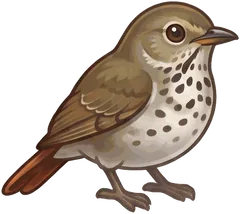 Hermit Thrush
The Hermit Thrush starts each phrase with a single long, clear note, then a softer reedy flourish, and the phrases jump between pitches. No bold ee-oh-lay, no buzzy doubled ending.
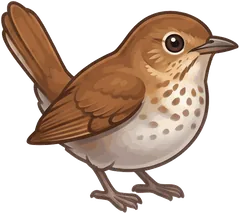 Veery
VeeryThe Veery's song is one continuous breathy spiral that slides downward. The Wood Thrush sings in separate, clearly shaped phrases with a loud, level middle.
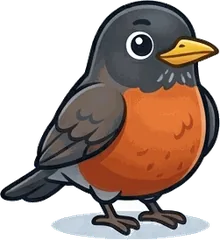 American Robin
A robin's caroling has a similar unhurried rhythm, but the notes are plainer whistles with no flute tone and no shimmering trill at the end. Robins sing from open perches; Wood Thrushes sing from inside the woods.
Where the Wood Thrush card lives
In Warble the same bird can be an easy card in one state and a prized one in another, because each album ranks its birds by how often people really report them there. The Wood Thrush appears in 21 state albums:
 Heard one? Open Warble, tap the green button while it sings, and the Wood Thrush card flips into your album. Get the app free.
Questions people ask
Which bird sings ee-oh-lay?
The Wood Thrush. Ee-oh-lay is the loud, flute-like middle phrase of its three-part song, heard in eastern deciduous woods from April to early summer, especially before sunrise and at dusk.
How does a Wood Thrush sing two notes at once?
Its voice box, the syrinx, has two independent sides, and in the final trill of the song the bird sounds both at the same time, producing pairs of notes that are not harmonically related. That doubling gives the song its shimmering, otherworldly quality.
Are Wood Thrushes endangered?
Not endangered, but declining. The population has dropped by about half since 1966 and the species is listed as Near Threatened. Forest fragmentation on the breeding grounds, cowbird parasitism and the loss of tropical wintering forest are the main causes.
What is the official bird of Washington, DC?
The Wood Thrush, adopted in 1938. It is one of the few state or district birds you are more likely to hear than see.
Sources
- National Audubon Society, Guide to North American Birds: Wood Thrush. www.audubon.org/field-guide/bird/wood-thrush
- Wikipedia: Wood thrush (song structure, calls, migration, decline and DC status). en.wikipedia.org/wiki/Wood_thrush
- Missouri Department of Conservation field guide: Wood Thrush. mdc.mo.gov/discover-nature/field-guide/wood-thrush
- Wikipedia: List of U.S. state birds (District of Columbia, 1938). en.wikipedia.org/wiki/List_of_U.S._state_birds