 Warble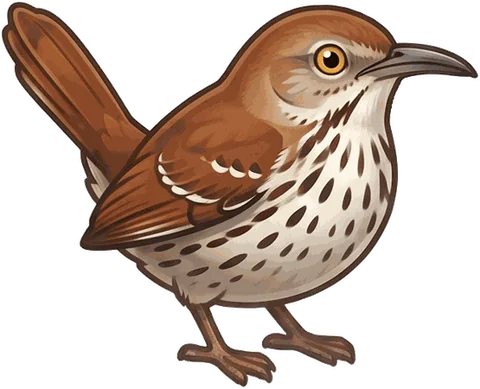
A Brown Thrasher sounds like a mockingbird that says everything twice. The song is a long, loud, richly musical series of short phrases, and each phrase is repeated, usually two times and sometimes three, before the bird moves on to a new one. That pairing is the whole trick: a Northern Mockingbird repeats a phrase three or more times, a Gray Catbird barely repeats at all, and the thrasher sits in between, singing in couplets from the top of a tall tree. The everyday call is a sharp smack, like a loud kiss.
What the song sounds like
The song is a long chain of short musical phrases, one or a few notes each, sung loudly and clearly with each phrase repeated before the next one starts. Most phrases come in pairs; some come three times, almost none only once. The tone is rich and full, more musical than a catbird, with a few harsh notes mixed in. A male in full voice sings from a prominent perch, often the very top of a tree, and can keep going for minutes at a time.
The variety is astonishing. The male Brown Thrasher may have the largest song repertoire of any bird in North America: more than 1,000 distinct song types have been documented, and some estimates run to 3,000 phrases per bird. It borrows too, though less than its famous cousin. Fragments of Tufted Titmouse, Northern Cardinal, Wood Thrush and Northern Flicker turn up in thrasher songs, each one sung twice like everything else.
If you are standing under a singing mimic and cannot see it, count. Three or more repeats means mockingbird. Two means thrasher. A ramble with no repeats at all, from inside a bush, means catbird.
The call: a loud smack
The common call is a sharp, wet smack, much like a quick, loud kiss. You hear it from thickets in every season, usually from a bird you cannot see. There is also a harsh chakk, a low rolling rrrrr, a slurred teeooo alarm, and a hissing note given around dusk and dawn.
When and where you hear it
The Brown Thrasher is the only thrasher that lives mainly east of the Rocky Mountains and central Texas, and it is common across the eastern and central United States and into southern Canada. Southern birds stay all year. Northern birds are migrants, moving short distances at night, though a few tough it out near feeders or in berry-rich thickets well to the north. In Missouri, for example, it is a common summer resident and a rare winter one.
Singing peaks in spring, when males climb to the treetops to claim territory and attract a mate. The rest of the year the bird is easier to hear than see: it lives in dense low growth, at thicket edges of deciduous or mixed woods, along shrubby swamp margins, in the undergrowth of open pine woods, and in suburban yards with thick shrubbery. Thrashers feed on the ground, flipping dead leaves aside with the bill and digging in the soil for beetles, caterpillars, grasshoppers and cicadas, plus berries and acorns in fall and winter.
It is the state bird of Georgia, adopted in 1928. Numbers have been falling across North America for decades as brushy habitat is cleared, which makes the paired phrases a satisfying Warble catch.
What it looks like
This is a big, lanky songbird, about 11.5 inches long and 2 to 3 ounces, with a long tail and a long, slightly downcurved bill. The upperparts are bright foxy red-brown, the cheeks are gray, and the pale underparts are heavily streaked with dark brown teardrops. The eyes are a startling yellow. A Wood Thrush is the usual mix-up on the ground: it is chunkier and more robin-shaped, with big dark eyes and round spots rather than streaks. Thrashers defend their nests hard, and a parent will strike a dog, a cat or a person who gets too close.
Birds that sound similar
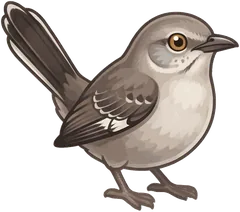 Northern Mockingbird
The mockingbird repeats each phrase three times or more, often sings from a rooftop or wire, and keeps going at night. The thrasher sings in pairs, from a treetop, and stops at dark.
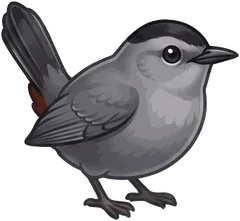 Gray Catbird
A catbird sings each phrase about once, in a raspier, more rambling voice, from inside a bush. Its call is a nasal mew, not a smack.
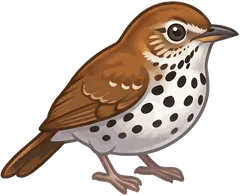 Wood Thrush
The Wood Thrush sings short flute-like phrases with pauses between them, a few phrases per minute, not a running stream of couplets. Thrashers sometimes copy it, so listen for the pairs.
Where the Brown Thrasher card lives
In Warble the same bird can be an easy card in one state and a prized one in another, because each album ranks its birds by how often people really report them there. The Brown Thrasher appears in 30 state albums:
 Heard one? Open Warble, tap the green button while it sings, and the Brown Thrasher card flips into your album. Get the app free.
Questions people ask
How do you tell a Brown Thrasher from a mockingbird by song?
Count the repeats. A Brown Thrasher sings each phrase twice, sometimes three times, then changes. A Northern Mockingbird repeats each phrase three or more times. The thrasher's voice is also richer and a bit harsher, and it sings from a tree rather than a wire or rooftop.
Do Brown Thrashers mimic other birds?
Yes, though less than a mockingbird. Thrasher songs include copied bits of titmice, cardinals, Wood Thrushes and flickers, and their repertoire of more than 1,000 documented song types may be the largest of any North American bird.
Which state has the Brown Thrasher as its state bird?
Georgia, which adopted the Brown Thrasher as its state bird in 1928. The bird is common in the state's brushy edges and suburban shrubbery year-round.
Are Brown Thrashers aggressive?
Around the nest, yes. Both parents chase off intruders and will strike animals and even people with the bill. Away from the nest they are shy, skulking birds that spend most of the day hidden in thickets.
Sources
- National Audubon Society, Guide to North American Birds: Brown Thrasher. www.audubon.org/field-guide/bird/brown-thrasher
- Wikipedia: Brown thrasher (repertoire, mimicry, calls, range and state bird status). en.wikipedia.org/wiki/Brown_thrasher
- Missouri Department of Conservation field guide: Brown Thrasher. mdc.mo.gov/discover-nature/field-guide/brown-thrasher
- Wikipedia: List of U.S. state birds (Georgia, 1928). en.wikipedia.org/wiki/List_of_U.S._state_birds