 Warble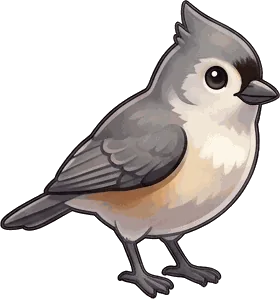
A Tufted Titmouse sounds like someone whistling peter, peter, peter loudly and quickly from the trees: a clear two-syllable whistle, the first syllable higher, repeated four to eight times in a row and then started again. It is louder than you expect from a bird this small. Away from the song, titmice make harsh, nasal scolding notes and thin, high tseet calls as they move through the branches with chickadees, and they are quick to join any commotion started by other birds.
The birder's mnemonic
“peter-peter-peter” Put the stress on the first syllable and whistle it clean and fast; if the phrase slurs or speeds into a trill, you are hearing a cardinal instead.
What the song sounds like
The titmouse song is a whistled two-note phrase, peter, with the first note higher than the second, repeated in a run of four to eight. There is a short pause, and then it starts again, over and over from the same tree. The notes are clear and strong, not buzzy and not slurred, which is why it carries so well through leafless woods in March.
Not every titmouse says peter. The basic song comes in around twenty recognizable variations, and some birds use a single repeated note. In central and southern Texas the closely related Black-crested Titmouse sings a very similar song and uses the one-note version more often; the two were once treated as a single species, and where they meet they sometimes interbreed.
Titmice are talkative all year, but the whistled song is mostly a late-winter and spring sound, and one of the first songs of the year in an eastern woodlot.
The calls: scolding and squeaking
Between songs, titmice keep up a running commentary of harsh, nasal scolding notes and thin, high tseet calls. The scold has a raspy, complaining tone. Titmice react quickly to alarm calls from other species, so when a hedge fills with scolding, the titmouse is often the loudest voice in it even if a chickadee started the fuss.
In winter these calls are the sound of a mixed flock on the move. Small groups of titmice travel with chickadees, nuthatches and Downy Woodpeckers, each species working a different part of the tree, and the titmouse is usually the most conspicuous member of the party.
When and where you hear it
The Tufted Titmouse does not migrate, so its scolding is a year-round sound of deciduous woods with tall trees across the eastern United States. It also does well in orchards, wooded suburbs and city parks, as long as the trees are big enough to hold a nest cavity. Song peaks from late winter through spring.
This is a bird on the move northward. It was originally a species of the Ohio and Mississippi river basins, and through the second half of the twentieth century it pushed steadily north, reaching Ontario and Quebec; winter bird feeders are usually credited with helping it survive the colder edge of its range. Young birds scatter in every direction after fledging, including north, which keeps the frontier advancing.
At the feeder a titmouse works like a courier: it watches from cover, darts in for one sunflower seed, and flies back to a branch to hold the seed with its feet and hammer it open, or to hide it for later. It opens acorns the same way. In Missouri and across the East it is one of the commonest cards in the Warble album, and the peter song is one of the easiest to learn.
What it looks like
A small, plain gray bird with a pointed crest, about six inches long. The upperparts are soft gray, the face pale with a big dark eye, the forehead black, the underparts white with a rusty wash along the sides. It is, as the Missouri field guide puts it, the only small, mostly gray bird with a definite crest, so once you have seen the point on its head there is nothing else to confuse it with.
Titmice nest in a natural hole or an old woodpecker cavity, since they cannot dig their own, and they line it with animal hair, some of it plucked directly from live mammals. A pair lays five or six eggs, the female sits for twelve to fourteen days, and the young leave the nest at about two weeks. Sometimes a young bird from the previous year stays on to help feed the next brood.
Birds that sound similar
 Northern Cardinal
A cardinal's what-cheer, cheer, cheer and purty-purty-purty are also loud clear whistles, but they slur up or down and often speed into a trill. The titmouse keeps to two even notes and never slurs.
 Carolina Wren
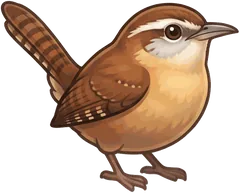
The Carolina Wren's tea-kettle, tea-kettle, tea-kettle has three syllables per phrase and a rolling, rhythmic feel, and it goes on all day in every season. The titmouse phrase is two notes, thinner and more whistled.
- ?Black-crested Titmouse
In central and southern Texas the Black-crested Titmouse sings almost the same peter-peter-peter, but it uses a single repeated note more often. Look for the black crest.
Where the Tufted Titmouse card lives
In Warble the same bird can be an easy card in one state and a prized one in another, because each album ranks its birds by how often people really report them there. The Tufted Titmouse appears in 34 state albums:
 Heard one? Open Warble, tap the green button while it sings, and the Tufted Titmouse card flips into your album. Get the app free.
Questions people ask
What bird says peter peter peter?
The Tufted Titmouse. Its song is a loud, clear whistled peter-peter-peter, four to eight two-note phrases in a row with the first syllable higher, repeated from the trees mostly in late winter and spring.
Do Tufted Titmice migrate?
No. They are permanent residents wherever they live, and pairs stay together on the same patch of woods all year. Their range has been spreading north for decades, into southern Canada, with winter feeders helping them through the cold months.
Why is a titmouse pulling hair from my dog?
It is collecting nest lining. Titmice line their tree cavity with soft material, especially animal hair, and they are known to pluck it straight off living mammals rather than wait to find it.
How do I tell a titmouse from a chickadee by sound?
The titmouse whistles a strong two-note peter repeated in a run; a chickadee's whistled song is a thinner fee-bee or see-dee, see-dee. The titmouse's scold is harsher than the chickadee's buzzy chick-a-dee-dee-dee.
Sources
- National Audubon Society, Guide to North American Birds: Tufted Titmouse. www.audubon.org/field-guide/bird/tufted-titmouse
- Wikipedia: Tufted titmouse (song variation, range expansion, flocks, hair plucking). en.wikipedia.org/wiki/Tufted_titmouse
- Missouri Department of Conservation, Field Guide: Tufted Titmouse. mdc.mo.gov/discover-nature/field-guide/tufted-titmouse
- National Audubon Society, Guide to North American Birds: Black-crested Titmouse. www.audubon.org/field-guide/bird/black-crested-titmouse