 Warble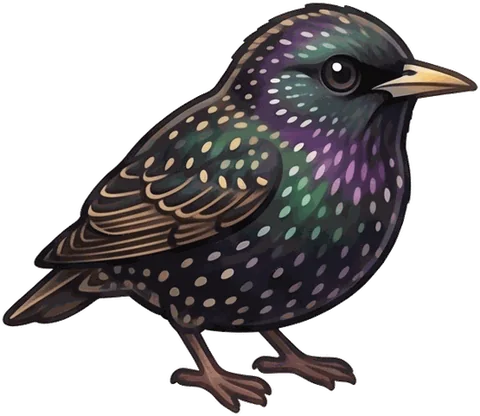
A European Starling sounds like a radio scanning between stations: long, rambling bouts of squeaky whistles, rattles, clicks, gurgles and rasping notes, mixed with copies of other birds and even mechanical sounds, delivered from a rooftop, a chimney or a wire. A bout can run a minute or more and almost never repeats itself cleanly. The one clean sound is a drawn-out, descending whistle, whee-ee, often the first thing you notice. A flock adds a constant chattering roar.
What the song sounds like
The starling's song is less a tune than a collage. A singing male, usually perched high, runs through a bout lasting a minute or more that falls into a rough order: some pure, sliding whistles first, then a long variable stretch of warbles and squeaks that includes snatches copied from other species, then a run of repeated clicks, and finally a burst of high, thin notes. Skilled birds carry up to 35 different song types and more than a dozen kinds of click, and the more complicated the song, the sooner the male tends to attract a mate.
The mimicry is what people remember. Starlings copy other birds, sometimes after hearing them only once, and they copy things that are not birds: frogs, cats, goats and mechanical sounds. In captivity they can learn to imitate human speech.
They sing in every month except during the molt, when they go quiet, and the volume rises steadily as breeding approaches in late winter and spring.
The calls: whee-ee and the flock
The most recognizable single note is a clear, slurred whistle that slides downward, whee-ee. Beyond that there are around a dozen distinct calls, from a snarling note used in squabbles to a harsh scream when a hawk appears. A feeding flock on a lawn keeps up a low, continuous chatter, and a roost in the evening produces a wall of squeaks and whistles that can be heard from far off and stops abruptly at dark.
When and where you hear it
None of this was here before 1890. That year a small group of starlings was released in New York's Central Park by Eugene Schieffelin and the American Acclimatization Society, whose members were fond of Shakespeare; a club in Portland, Oregon released more around the same time. From those few birds the species spread across the whole continent, reaching the Pacific by 1950 and now numbering roughly 150 million from southern Canada and Alaska to Central America.
Starlings live wherever people have opened up the land: cities, parks, suburbs, farms, groves and fields. They are scarce in extensive wild forest, scrub or desert unless a town is nearby. Southern birds stay put all year, while many northern ones move south in fall, traveling by day. They nest in cavities, tree holes, woodpecker holes, birdhouses and gaps in buildings, and they compete hard for them, evicting native cavity nesters such as bluebirds, Wood Ducks, sapsuckers, flycatchers and Purple Martins.
The famous sight is the murmuration: fall and winter flocks that twist across the sky at dusk in dense, shape-shifting clouds before dropping into a roost, a defense against falcons and hawks. Roosts can be enormous, with Europe's largest holding over a million birds. In Warble the starling is a common card everywhere, and its impressions are a fair test for any listener, human or app.
What it looks like
A chunky, short-tailed, robin-sized bird, 8 to 9 inches long, with a long, thin, sharply pointed bill. It changes costume with the season. In spring and summer the plumage is glossy black shot with purple and green and the bill is bright yellow; after the fall molt every fresh feather is tipped with white or buff, so the bird looks spangled with stars, and the bill turns dark. Through the winter those pale tips wear away until, by spring, the bird is glossy black again without having grown a single new feather. Juveniles are plain gray-brown with a dark bill. Starlings feed mostly on insects, probing lawns with the bill, and also eat berries, seeds and scraps.
Birds that sound similar
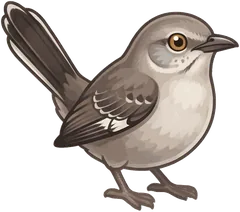 Northern Mockingbird
The mockingbird also imitates, but it repeats each phrase three or more times, loud and clean, before moving on, and it often sings at night. A starling's imitations are squeakier, tumble past once and are buried in rattles and clicks.
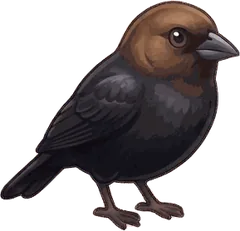 Brown-headed Cowbird
The cowbird's song is a short, liquid, squeaky gurgle followed by a thin whistle, over in a second or two, plus a rattle. A starling's squeaks keep going for a minute and include whistles, clicks and copied calls.
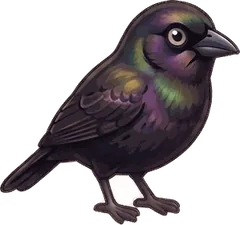 Common Grackle
A Common Grackle gives a single harsh, scraping note like a rusty hinge and low clucks, the same creak repeated. A starling strings dozens of different sounds together without ever settling on one.
Where the European Starling card lives
In Warble the same bird can be an easy card in one state and a prized one in another, because each album ranks its birds by how often people really report them there. The European Starling appears in 49 state albums:
 Heard one? Open Warble, tap the green button while it sings, and the European Starling card flips into your album. Get the app free.
Questions people ask
Can starlings mimic other birds?
Yes, expertly. Starlings copy other species, sometimes after a single hearing, and also imitate frogs, cats and mechanical sounds. In captivity they can learn human words. The copies are worked into a long, squeaky song rather than repeated in neat sets like a mockingbird's.
Why are starlings speckled in winter and black in summer?
After the fall molt each new feather has a white or buff tip, which gives the winter bird its spangled look. Those tips wear away over the winter, so by spring the same feathers show only their glossy black bases. The bill changes too, from dark in winter to yellow in the breeding season.
Why are there starlings in America?
They were released in New York's Central Park in 1890 by Eugene Schieffelin and the American Acclimatization Society, a group fond of Shakespeare. From those few birds they spread to the Pacific by 1950 and now number about 150 million across North America.
Why do starlings fly in huge swirling flocks?
Those clouds are murmurations, formed near roosts in fall and winter. Moving as a dense, shifting mass makes it hard for a falcon or hawk to single out one bird. The flock eventually pours into the roost, chattering loudly until dark.
Sources
- National Audubon Society, Guide to North American Birds: European Starling. www.audubon.org/field-guide/bird/european-starling
- Wikipedia: Common starling (song structure, mimicry, introduction, murmurations, plumage). en.wikipedia.org/wiki/Common_starling
- Missouri Department of Conservation, Field Guide: European Starling. mdc.mo.gov/discover-nature/field-guide/european-starling
- Animal Diversity Web (University of Michigan): Sturnus vulgaris. animaldiversity.org/accounts/Sturnus_vulgaris/