 Warble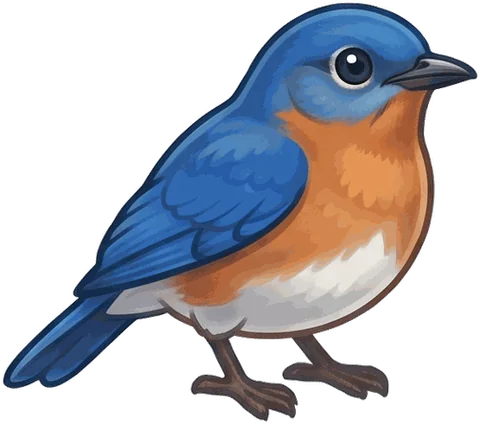
An Eastern Bluebird sounds gentle: a soft, low warble of a few slurred notes, something like chur-lee, chur-lee or tu-a-wee, given quietly from a fence post or a wire over an open field. Audubon describes the song as a soft melodious warble and the call as a liquid, musical turee or queedle. There is nothing showy about it, and it is easy to miss under a robin, but once you know it the sound of a pasture edge in March changes.
The birder's mnemonic
“cheer, cheerful charmer” That is how the Missouri field guide writes the blurry whistled song; Wikipedia renders it chiti WEEW wewidoo, which is closer to the rhythm.
What the song sounds like
The song is a short, blurry series of whistled notes, low in pitch and soft in volume, with a slurred, throaty quality: chiti WEEW wewidoo, or a run of jeew and chir-wi phrases strung loosely together. It rarely lasts more than a second or two and it is not loud. Where a robin carols from the top of a tree so the whole block can hear, a bluebird murmurs from a fence post, and you often notice it only because you were already looking at the bird.
Males sing most in early spring while claiming a nest hole, and they have a louder, song-like version they use as a warning when a rival or a predator turns up near the cavity. Females sing too, softly, and a pair in flight keeps up a running conversation of call notes.
The call: a liquid tu-a-wee
The call is the sound you will hear most, and it is lovely: a soft, liquid tu-a-wee or turee, dropping slightly and then lifting at the end, given from a perch and constantly in flight. The Missouri field guide writes it chuiree. A pair moving along a fence line, or a family group drifting across a field in September, announces itself with this note long before you pick out the blue.
When and where you hear it
The Eastern Bluebird is the most widespread of the three bluebirds, found east of the Rockies from southern Canada to the Gulf states, with a separate population from southeastern Arizona south to Nicaragua. Across the South it stays all year. Farther north it arrives very early in spring and lingers late into fall; how far it moves depends on food, and birds that stay through a northern winter bunch up in thickets and orchards where berries hold out. In Missouri, where it is the state bird, it is common from March through November and present all year in the south. It is the state bird of New York as well.
Listen along open country with scattered trees and short grass: pastures, farm roads, orchards, golf courses, big suburban lawns, forest clearings and open pine woods. The bird hunts from a low perch, dropping to the ground for a grasshopper or cricket, sometimes hovering, sometimes snapping an insect out of the air. Insects make up about two thirds of the diet, with wild grapes, holly and other fruit carrying the birds through winter.
Bluebirds nest in holes: old woodpecker cavities, natural hollows and, increasingly, nest boxes, usually 2 to 20 feet up. The female builds a loose cup of grass and lays four or five pale blue eggs, and most pairs raise two broods, some three. The species fell hard through the early and middle twentieth century as habitat and nest sites disappeared and DDT thinned its eggshells. Bluebird trails, lines of boxes on fence posts first strung in the 1930s, and the North American Bluebird Society, founded in 1978, turned it around; the population has grown more than 1.5 percent a year since the 1960s and now stands near 23 million. If you play Warble, a box on a fence post is the surest place to catch the card.
What it looks like
A small, round-shouldered thrush, six to eight inches long, with a short straight bill and a plump body. The male is brilliant blue on the head, back, wings and tail, rusty orange on the throat, breast and sides, and white on the belly. The female wears the same pattern in gray-blue and pale orange, with real blue only in the wings and tail. Juveniles are gray and heavily spotted, with a hint of blue in the wings, which marks them as thrushes, cousins of the American Robin.
Birds that sound similar
 American Robin
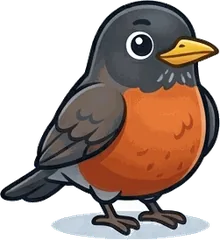
The robin's song is loud, long and carries across the neighborhood, a caroling cheer-up, cheerily that rises and falls for minutes at a time, often before first light. The bluebird's warble is soft, short and low, and it stays near the ground.
 Western Bluebird
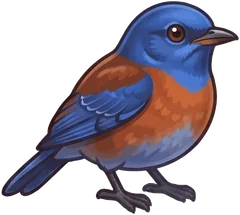
The Western Bluebird's song is a short, subdued cheer, cheer-lee, churr with soft phew and chuck calls, very close to the Eastern's. Range settles it most of the time: Western Bluebirds live from the Rockies west.
Where the Eastern Bluebird card lives
In Warble the same bird can be an easy card in one state and a prized one in another, because each album ranks its birds by how often people really report them there. The Eastern Bluebird appears in 36 state albums:
 Heard one? Open Warble, tap the green button while it sings, and the Eastern Bluebird card flips into your album. Get the app free.
Questions people ask
Do Eastern Bluebirds sing?
Yes, but quietly. The song is a soft, low warble of slurred notes, often written chur-lee or tu-a-wee, and it carries only a short distance. Most people hear the liquid call note far more often than the song.
What time of year do bluebirds show up?
In the South they never leave. Farther north they are among the earliest arrivals, back in the first weeks of spring, and they stay into late fall. In Missouri they are common from March through November.
Which states have the Eastern Bluebird as state bird?
Missouri and New York. Missouri's conservation department lists it as the state's official bird, and Wikipedia records the same status in New York.
How do I attract bluebirds to my yard?
Give them open ground and a hole. Bluebirds want short grass with low perches to hunt from, a nest box mounted on a post in the open, and berry-bearing shrubs for winter. Seed feeders do little for them; insects and fruit are the diet.
Sources
- National Audubon Society, Guide to North American Birds: Eastern Bluebird. www.audubon.org/field-guide/bird/eastern-bluebird
- Wikipedia: Eastern bluebird (song, decline and recovery, state bird status). en.wikipedia.org/wiki/Eastern_bluebird
- Missouri Department of Conservation, Field Guide: Eastern Bluebird. mdc.mo.gov/discover-nature/field-guide/eastern-bluebird
- National Audubon Society, Guide to North American Birds: Western Bluebird (voice compared). www.audubon.org/field-guide/bird/western-bluebird