 Warble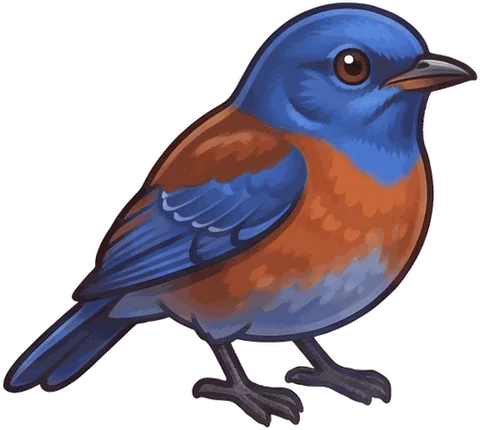
A Western Bluebird sounds soft and unhurried. The song is a short, subdued run of a few notes, cheer, cheer-lee, churr, given by the male from a low perch in spring, often while he flutters in front of the female. The everyday calls are a gentle phew or kew and a quiet chuck or che-check, which a pair uses to keep track of each other. In oak woodland and open pine forest from California to the Rockies, these quiet notes are usually the first sign that bluebirds are nearby.
What the song sounds like
The song is modest: a short phrase of a few soft notes, written cheer, cheer-lee, churr, with a slightly burry quality and none of the volume of the robins and thrushes it is related to. Males sing it in spring from a fence post or a low oak limb. The same cheer, chur-chur and chup notes serve as mating calls, helping a male find a female and telling other males the cavity is taken.
Males arrive on the breeding grounds ahead of females and sing to hold a territory. In courtship the male may flutter in front of the female with wings and tail partly spread while singing, easy to watch because the birds stay in the open. When a rival shows up, the song gives way to a chattering call and, if the intruder persists, a squawk.
The calls: phew and chuck
Most of what you hear from Western Bluebirds is contact calling. The phew, also written kew, is a soft whistle; the chuck or che-check is a quiet, dry note. Mates use both to tell each other where they are, and in winter, when the birds live in small groups of relatives, the calls pass constantly along a fence line as birds drop to the ground and back.
Nestlings begin calling for food at about two weeks old, so thin begging from inside a nest box means the brood is well along.
When and where you hear it
The Western Bluebird lives year-round in California, the southern Rocky Mountains, Arizona and New Mexico, and south into Mexico as far as Oaxaca and Veracruz. In summer the range extends north through Oregon and Washington to British Columbia and east to Montana, and those northern birds move south for the winter. Migration is short-distance, roughly July to October southbound and February to March back north, and birds from high elevations drop to lower ground in winter.
Unlike the Mountain Bluebird, this is not a bird of open meadows. It wants scattered trees: oak woodland, open pine forest, farms, forest edges, and especially burned or logged areas where snags provide perches and nest holes. In winter it spreads into semi-open country, brush and desert.
Western Bluebirds hunt from a low perch, dropping onto grasshoppers, caterpillars, beetles, ants and spiders, sometimes with a brief hover before the pounce, and sometimes catching insects in the air. In winter the diet shifts to fruit, above all mistletoe berries, plus juniper and elderberry. The nest goes in a natural hollow in an oak or pine, an old woodpecker hole or a nest box; the bill is too weak to dig a cavity, so the birds depend on woodpeckers and people. The female lays four to six pale blue eggs and incubates them for 12 to 18 days, and the young fledge at about three weeks. Pairs often raise two broods, sometimes with help from older offspring whose own nests have failed. Numbers have declined over much of the range as natural cavities disappear, and House Sparrows, European Starlings and Tree Swallows compete hard for the ones left. Nest box programs across California have helped, and a 1.5-inch hole keeps starlings out. In Warble, the soft calls are an easy catch along an oak-studded fence line.
What it looks like
A small, stocky thrush, 6.3 to 7.1 inches long. The male is deep purplish blue on the head, back, wings, tail and throat, with a rusty orange chest and sides, often a brownish patch on the upper back, and a gray belly. The female is much duller and grayer, with a solid gray throat, muted orange breast, and blue only in the wings and tail. Juveniles are spotted. The throat sorts the three bluebirds: blue on the Western, rusty orange on the Eastern, and no orange at all on the Mountain, which is also longer, paler and thinner-billed.
Birds that sound similar
 Mountain Bluebird
The Mountain Bluebird's call is a thinner few and its song a lower, burrier warble, and it hunts by hovering over wide open ground. The Western gives a softer phew and chuck and sticks to places with trees.
 Eastern Bluebird
The Eastern Bluebird's turee or queedle is more liquid and musical than the Western's quiet phew, and its warble is sweeter. An orange throat on a blue male means Eastern.
Where the Western Bluebird card lives
In Warble the same bird can be an easy card in one state and a prized one in another, because each album ranks its birds by how often people really report them there. The Western Bluebird appears in 4 state albums:
 Heard one? Open Warble, tap the green button while it sings, and the Western Bluebird card flips into your album. Get the app free.
Questions people ask
What is the difference between a Western Bluebird and a Mountain Bluebird?
The male Western has a blue throat and rusty chest; the male Mountain is sky blue all over with no orange. The Western lives among scattered trees and hunts from perches, while the Mountain prefers wide open country and hovers. The Mountain's call is thinner and its warble lower.
Do Western Bluebirds sing?
Yes, but softly. The song is a short, subdued cheer, cheer-lee, churr, mostly from males in spring, sometimes during a fluttering display in front of the female. The rest of the year you hear mainly the quiet phew and chuck contact calls.
Will Western Bluebirds use a nest box?
Readily, and they do better in boxes than in natural cavities, with earlier laying and more fledglings. Use a 1.5-inch entrance hole to keep starlings out; House Sparrows and Tree Swallows will still compete for it.
Why are Western Bluebirds declining?
Mostly because of lost nesting cavities. The birds cannot dig their own holes, and logging, fire suppression and the removal of dead trees take away the woodpecker holes they need, while starlings and House Sparrows claim many of the rest.
Sources
- National Audubon Society, Guide to North American Birds: Western Bluebird. www.audubon.org/field-guide/bird/western-bluebird
- Wikipedia: Western bluebird (plumage, range, calls, nest boxes, competition). en.wikipedia.org/wiki/Western_bluebird
- Animal Diversity Web: Sialia mexicana. animaldiversity.org/accounts/Sialia_mexicana/
- National Audubon Society, Guide to North American Birds: Eastern Bluebird. www.audubon.org/field-guide/bird/eastern-bluebird