 Warble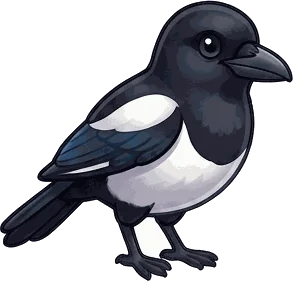
A Black-billed Magpie sounds like a fast, nasal, questioning mag? mag? mag? or yak yak yak, given in short bursts from a fencepost or the top of a cottonwood. The alarm is a harsh rattle, ka-ka-ka-ka, that gets quicker and more excited as danger gets closer. Around those two sounds a flock keeps up a vocabulary of coos, purrs, squeals and squawks. If a crow-sized black and white bird with a very long tail is scolding you from a ranch yard in Montana, this is the bird.
What the song sounds like
Magpies do not sing in the way a thrush or a sparrow does. What people mean by the magpie's song is its chatter: rapid, nasal notes in runs of three or four, each one with a rising, questioning edge. Audubon writes it as mag? mag? mag? or yak yak yak. The tone is dry and unmusical, lower and rougher than a jay, and it carries a long way across open rangeland, which is where you usually hear it.
That is only the loudest part of the repertoire. Magpies also tweet, coo, purr, shrill and squawk, and a family group feeding along a creek keeps up a running conversation. The voice is one of the things that separates this bird from the Eurasian Magpie, which it was lumped with until 2000; it sounds much more like the Yellow-billed Magpie of California, its closest relative.
The call: a rattle that speeds up
The alarm call is a harsh rattle, ka-ka-ka-ka, sometimes with a skah-skah in front of it. Its speed and volume change with the level of danger: a slow, loud rattle marks something worth watching, and a quick, staccato version tells the flock it is time to leave. Nesting pairs can recognize individual people. Biologists who handled nestlings found the same birds mobbing them on later visits while ignoring everyone else nearby.
Magpies also gather in trees near a dead magpie and call loudly, a behavior sometimes described as a funeral, though nobody fully understands it. Nesting pairs go quieter and defend the territory by sitting visibly in the treetops, so the loudest magpie season is fall and winter, when flocks form.
When and where you hear it
The Black-billed Magpie lives across western North America, from coastal southern Alaska down through the Rocky Mountains to northern Arizona, New Mexico and western Texas, and east across the prairie provinces to northern Minnesota and Iowa. Heat and humidity seem to set the eastern edge. It wants semi-open country: rangeland, streamside thickets, forest edges and farmland, usually near water, and it avoids both unbroken forest and treeless grassland. In winter you will find flocks at feedlots, grain elevators and landfills.
This is mostly a year-round resident. Some birds move upslope in fall and a few drift south, but the magpies in a Montana or Wyoming ranch yard in January are usually the same ones that nested there. Family flocks of six to ten birds form after the breeding season, and winter roosts can hold several hundred. In Colorado, Utah and Idaho it is one of the easiest Warble cards to catch in town, where the chatter from the yard almost always gives it away.
Watch what they do and the voice makes more sense. Magpies walk with a swagger, flip things over with the bill, and land on cattle, elk and deer to pick off ticks. They eat insects, carrion, rodents, eggs and nestlings, and berries and seeds in winter. When Lewis and Clark met them in South Dakota in 1804, the birds walked into tents and took food from the hand.
What it looks like
Nothing else in the West looks like it. The bird is 18 to 24 inches long with a wingspan of 22 to 24 inches and a weight of 5 to 7 ounces, and about half of that length is tail. The head, breast, back and tail are black, the belly and shoulders are white, and large white wing patches flash in flight. In good light the wings and tail show green and blue iridescence. The bill is all black, the mark that separates it from the Yellow-billed Magpie.
The nest is the other giveaway: a huge domed ball of sticks, often three feet across, built by both birds over five to seven weeks, with a mud cup inside for six or seven eggs.
Birds that sound similar
- ?Yellow-billed Magpie
The voices are close: a raucous qua-qua-qua and a querulous quack. The Yellow-billed lives only in California's Central Valley and coast ranges, so location settles it, and so does the bill.
 Steller's Jay
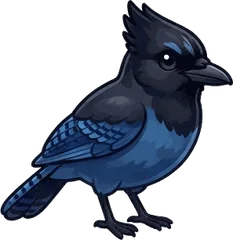
A Steller's Jay's shack-shack-shack is also a harsh repeated series, but it is faster, higher and comes from inside conifer forest. The magpie's notes are more nasal and drawn out, and it calls from open country.
 American Crow
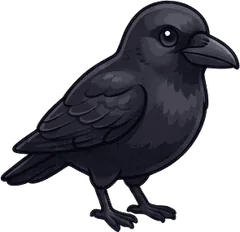
A crow's caw is longer, deeper and slowly repeated. Magpie notes are clipped, quick and nasal, and a chattering flock sounds more like an argument than steady cawing.
Where the Black-billed Magpie card lives
In Warble the same bird can be an easy card in one state and a prized one in another, because each album ranks its birds by how often people really report them there. The Black-billed Magpie appears in 12 state albums:
 Heard one? Open Warble, tap the green button while it sings, and the Black-billed Magpie card flips into your album. Get the app free.
Questions people ask
Is the Black-billed Magpie the same bird as the magpie in Europe?
Not anymore. It was treated as a subspecies of the Eurasian Magpie until 2000, when DNA studies showed a deep split. The two also differ in voice and social behavior, and the North American bird is closer to California's Yellow-billed Magpie.
Why do magpies gather and call around a dead magpie?
Nobody is sure. Magpies often collect excitedly in the trees near a dead magpie and call loudly for a while before moving on. It is sometimes called a funeral, but the purpose of the gathering is still poorly understood.
Can a magpie talk?
Captive birds can. Magpies raised around people have learned words and phrases, and one is on record imitating human speech. Wild birds stick to their own chatter, rattles and squawks.
Do magpies migrate?
Mostly no. The Black-billed Magpie is a permanent resident across its range. Some birds move upslope after nesting and a few head south, but most stay put and gather in winter flocks around feedlots and farms.
Sources
- National Audubon Society, Guide to North American Birds: Black-billed Magpie. www.audubon.org/field-guide/bird/black-billed-magpie
- Wikipedia: Black-billed magpie (vocalizations, measurements, range, behavior, taxonomy). en.wikipedia.org/wiki/Black-billed_magpie
- Animal Diversity Web: Pica hudsonia. animaldiversity.org/accounts/Pica_hudsonia/
- National Audubon Society, Guide to North American Birds: Yellow-billed Magpie. www.audubon.org/field-guide/bird/yellow-billed-magpie