 Warble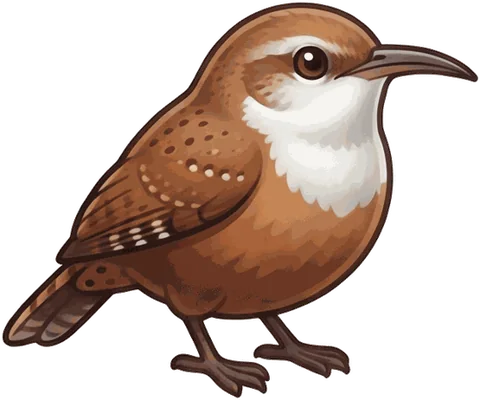
A Canyon Wren sounds like someone pouring a bucket of clear whistles down a cliff: a series of high, sweet notes that fall in pitch and slow down, one after another, until the last ones are low and drawn out. Audubon calls it a rippling, musical cascade of descending notes, and the rock walls it lives on throw the sound back so that it seems to fill the whole canyon. It sings mostly in spring, but mated pairs may sing at any time of year. Few western birds are heard so often and seen so rarely.
What the song sounds like
The song is a high, clear series of descending notes. It starts near the top of the bird's range and steps down the scale, each whistle a little lower and a little slower than the one before, so the effect is of something tumbling and then settling. The notes are pure and loud for a bird that weighs half an ounce, and the setting does half the work: a Canyon Wren sings from steep rock, and cliffs, boulder piles and canyon walls echo the song back until it sounds as though it is coming from everywhere at once.
Males sing consistently through the breeding season and most often in spring. Females rarely sing except in answer to a male, but a mated pair may sing at any season, sometimes spontaneously in winter. When a male is defending the territory against a rival the song comes out harsher and lower in pitch. Because territories are large and widely spaced, you usually hear one bird at a time, which makes the cascade easy to pick out.
The call: a buzz from the rocks
Between songs the Canyon Wren is quiet or nearly so. Audubon lists a buzz and a chip among its calls, and the buzz is the note you are most likely to hear from a bird working a rock pile a few feet away, often before you have found it. The song, not the call, is how most people know the bird.
When and where you hear it
This is a bird of steep rock in dry country. It lives from southern British Columbia, in the Okanagan Valley, down through much of the western United States and into Mexico, with isolated populations in the Black Hills of South Dakota, northeastern Wyoming and southeastern Montana. Look and listen along cliffs, canyon walls, rockslides and boulder fields, and sometimes on stone buildings. Canyons with a stream, shade and some dense low growth are favorites, and the bird will forage down near the water.
The Canyon Wren is a permanent resident everywhere it occurs. Some birds make short moves to lower elevations or denser cover in winter, but the pair on a given cliff is usually there all year. Spring is the best time for the song, on a trail in Utah, Arizona, Colorado or the Texas Hill Country, and it is often the first voice of the morning in a side canyon. In Warble it is a card most players catch with the phone pointed at a rock wall, because the bird itself may never show.
Watch the rocks and you may spot it hopping through a pile of boulders, pushing its long bill deep into crevices for termites, ants, beetles, leafhoppers and spiders. It will steal prey from spiderwebs and wasp nests and occasionally snap an insect out of the air. The nest is tucked into a hole or crevice in a cliff: a base of twigs, grass and bark with a soft cup of fur, spider silk and feathers, holding about five white eggs with reddish specks. The female incubates for 12 to 18 days while the male brings food, and pairs, which can stay together for several seasons, sometimes reuse the nest.
What it looks like
A small wren, 5 to 6 inches long with a 7 to 8 inch wingspan, weighing 0.4 to 0.6 ounces. The body is dark chestnut finely speckled with black and white, the head shades to gray, and the throat and upper chest are a clean, bright white that catches the eye even in shadow. The tail is short and rusty with black bars. The bill is very long and thin and the head looks flattened, both adaptations for reaching into narrow cracks in rock. Against speckled canyon stone the bird vanishes the moment it stops moving.
Birds that sound similar
- ?Rock Wren
The Rock Wren shares the same slopes but sings a dry trill and rhythmic repeated phrases, chewee, chewee, chewee, on a level pitch. Nothing in its song steps steadily down the scale the way the Canyon Wren's does.
 Bewick's Wren
A Bewick's Wren song is a bubbly mix of notes, a buzz and a closing trill, delivered from brush rather than bare rock. The Canyon Wren's song is all clear whistles, slowing and falling with no trill.
 House Wren
The House Wren's song rises first and then tumbles down in a fast, gurgling jumble. The Canyon Wren's descent is slower and made of separate, pure whistles that you can almost count.
Where the Canyon Wren card lives
In Warble the same bird can be an easy card in one state and a prized one in another, because each album ranks its birds by how often people really report them there. The Canyon Wren appears in 1 state albums:
 Heard one? Open Warble, tap the green button while it sings, and the Canyon Wren card flips into your album. Get the app free.
Questions people ask
What bird sings a song that goes down the scale in a canyon?
Almost certainly a Canyon Wren. Its song is a series of clear whistles that fall in pitch and slow down, and cliffs and canyon walls echo it. It sings from steep rock across the West, from southern British Columbia to Mexico.
Do Canyon Wrens sing in winter?
Sometimes. The song is most frequent in spring and during the breeding season, when males sing steadily, but mated pairs may sing at any time of year, and pairs occasionally sing spontaneously in winter.
Why can I hear a Canyon Wren but never see it?
Because it is small, speckled chestnut that matches the rock, and it hops through crevices and boulder piles instead of perching in the open. The echo off the canyon walls also makes the song hard to place. Scan for a flash of white throat.
Do Canyon Wrens migrate?
No. They are permanent residents throughout their range. Some make short seasonal moves to lower elevations or denser habitat in winter, but most pairs stay on the same cliffs all year.
Sources
- National Audubon Society, Guide to North American Birds: Canyon Wren. www.audubon.org/field-guide/bird/canyon-wren
- Wikipedia: Canyon wren (song, range, habitat, nesting). en.wikipedia.org/wiki/Canyon_wren
- Animal Diversity Web: Catherpes mexicanus. animaldiversity.org/accounts/Catherpes_mexicanus/
- National Audubon Society, Guide to North American Birds: Rock Wren. www.audubon.org/field-guide/bird/rock-wren