 Warble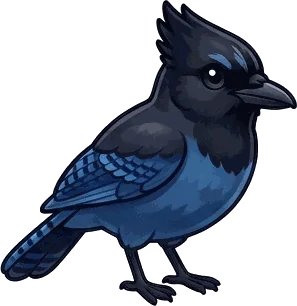
A Steller's Jay sounds harsh and loud: a fast, scratchy shack-shack-shack-shack or chook-chook-chook given from a conifer, and a lower shook-shook as the bird swoops up to a perch. It also does a convincing Red-tailed Hawk scream, which sends smaller birds diving for cover. Between those you may hear a creaky skreeka, soft hoodle-hoodle whistles and, rarely, a quiet warbled song. If you are camping in pine or fir forest anywhere in the West and something is shouting at you from the trees, it is probably this bird.
What the song sounds like
Steller's Jays are not really singers. The sound most people mean by the song is the loud contact call, a harsh series of three to five identical notes, shack-shack-shack-shack, sometimes written SHACK-sheck-sheck-sheck with the first note stressed. It is rougher and faster than a Blue Jay's jay and it carries a long way through dense conifers, which is the point: the call tells the rest of the group where the bird is.
There is a true song, and almost nobody hears it. It is a moderate to soft warble, given quietly near the nest or in a loose flock, with none of the volume of the calls. The pair also goes quiet during nesting, so a forest that seemed full of jays in March can sound empty in May while the birds are sitting on eggs.
Other sounds fill the gaps. A creaky skreeka, skreeka that has been compared to an old pump handle, a soft, liquid hoodle hoodle, a nasal alarm note, a dry rattle from the female and a high gleep gleep from the male. Once you know the family you will start sorting them apart.
The call that is really a hawk
The trick that fools everyone is the hawk scream. Steller's Jays imitate Red-tailed Hawks well, and also Red-shouldered Hawks and Ospreys, plus a range of other birds and even mechanical sounds. The imitation is used as a warning and as a territorial signal, and it works: other birds scatter when they hear it. A long, descending scream from inside a pine, with no hawk in the sky, is a good moment to look for a crested blue bird instead.
The alarm system is more precise than it sounds. Research has shown the jays vary their alarm calls by the kind of predator and by how they detected it, giving different responses to a Sharp-shinned Hawk than to a Northern Goshawk. When they find a Cooper's Hawk or an owl, a group will mob it loudly, and that racket is often how you find the raptor.
When and where you hear it
This is the jay of western conifer forests, from the southern coast of Alaska down the Pacific slope and through the Rocky Mountains into Mexico and as far south as Nicaragua. The eastern edge runs along the Rocky Mountain foothills, roughly to eastern Colorado. It is most numerous as a breeder in mountain forests of pine, spruce and fir and along the northern coast, and it also uses pine-oak woodland, orchards and well-wooded suburbs in the off season.
Steller's Jays do not migrate in the usual sense, but many move downslope in winter, and every so often a food failure in the mountains sends large numbers into the lowlands. They are vocal in every month except the quiet weeks of nesting. Campgrounds and picnic areas are reliable places to hear them, because they have learned that people leave food behind, and they will compete with Canada Jays for it. At feeders they take black-oil sunflower seed, whole peanuts and suet.
The diet is about two-thirds plant matter and one-third animal. Acorns and conifer seeds are the staple outside the breeding season, often cached in the ground or in tree bark for later; in summer they add beetles, wasps and wild bees, spiders, and the eggs and nestlings of other birds. Across Washington, Oregon and California this is one of the easiest Warble cards to catch at a mountain campsite, though the app can hesitate on a hawk imitation, and so does everyone else.
What it looks like
The only dark jay with a crest. The head, crest and upper body are blackish brown to dark blue depending on region, shading into deep blue on the wings, belly and long tail, with fine black barring on the flight feathers. It is about 12 to 13 inches long and weighs 3.5 to 5 ounces, with a slimmer bill and longer legs than a Blue Jay. Coastal birds have faint or no marks on the face; birds of the interior Rockies show white streaks on the forehead and above the eye, and those in between show pale blue ones. Juveniles have a shorter crest and sooty gray heads.
The bird is named for Georg Wilhelm Steller, the German naturalist who recorded it in 1741, and it is the provincial bird of British Columbia.
Birds that sound similar
 Blue Jay
The Blue Jay's jay, jay is a slower, clearer scream, and its ranges barely overlap with the Steller's. The Steller's call is faster, drier and more like a rattle of shack notes.
 California Scrub-Jay
A California Scrub-Jay gives single or paired rising weep or shreep notes rather than a run of identical harsh syllables. Scrub-jays also live in oak and chaparral, not deep conifer forest.
 Red-tailed Hawk
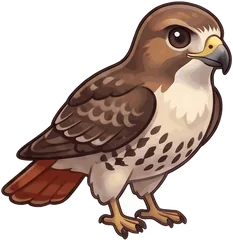
The jay's Red-tailed Hawk imitation is nearly perfect. A scream from inside a conifer, at close range, followed by jay chatter, is the giveaway; a real hawk usually screams while soaring.
Where the Steller's Jay card lives
In Warble the same bird can be an easy card in one state and a prized one in another, because each album ranks its birds by how often people really report them there. The Steller's Jay appears in 11 state albums:
 Heard one? Open Warble, tap the green button while it sings, and the Steller's Jay card flips into your album. Get the app free.
Questions people ask
Why does a Steller's Jay sound like a hawk?
Because it is imitating one. Steller's Jays mimic Red-tailed Hawks, Red-shouldered Hawks and Ospreys, and use the scream as a warning to their group and to claim territory. Other birds treat it as real and flee, which may clear a feeder for the jay.
Do Steller's Jays sing?
Barely. They have a soft, moderate warble that is rarely heard, and they go quiet during nesting. Nearly everything you hear from them is a call: the harsh shack series, the shook-shook flight call, a creaky skreeka, whistles and alarms.
Are Steller's Jays and Blue Jays the same bird?
No. They are in the same genus but the Steller's Jay is the western species, dark headed with a black crest, and the Blue Jay is eastern with a white face and belly. Their calls differ too, and the two rarely meet except along the Rocky Mountain foothills.
Why are Steller's Jays so loud at campgrounds?
They have learned that campsites and picnic tables mean food, and the contact call keeps the group together while they scavenge. They cache what they cannot eat, so the same bird may return many times to a single picnic.
Sources
- National Audubon Society, Guide to North American Birds: Steller's Jay. www.audubon.org/field-guide/bird/stellers-jay
- Wikipedia: Steller's jay (vocalizations and mimicry, measurements, range, provincial bird). en.wikipedia.org/wiki/Steller%27s_jay
- Animal Diversity Web: Cyanocitta stelleri. animaldiversity.org/accounts/Cyanocitta_stelleri/