 Warble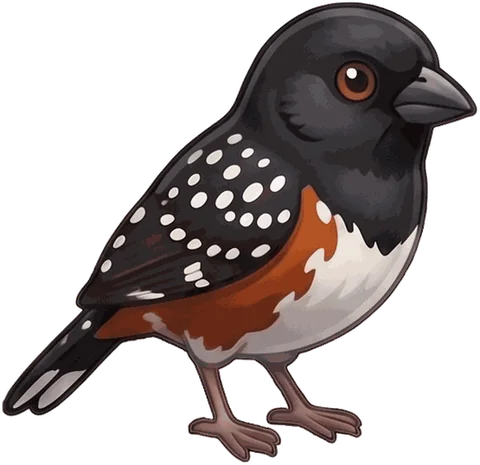
A Spotted Towhee sounds like a buzzy, drawn-out trill, cheweeeee, often with one or two short notes in front of it, sung from the top of a bush in chaparral or a brushy yard. The everyday call is a rising, nasal, catlike meewww?. Next to the Eastern Towhee the song is harsher and more variable, and it usually skips the clear whistled drink-your opening. The other sound that gives it away is not a voice at all: loud two-footed scratching in dry leaves under a shrub.
What the song sounds like
The core of the song is a long buzzy trill, written by Audubon as cheweeeee. Many western birds add one to three short introductory notes and then let the trill run; others give only the trill, so what you hear is a dry, insect-like buzz that repeats every few seconds. The tone is coarse rather than musical. Audubon describes the Spotted Towhee's voice as more variable and much harsher than the Eastern Towhee's, and that is the quickest way to tell the two by ear where they meet.
Until 1995 both birds were one species, the Rufous-sided Towhee, and they still hybridize where their ranges overlap on the Great Plains, mainly in Nebraska and the Dakotas. The Eastern Towhee's classic song is drink-your-teeeaaa: a couple of clear notes and then a trill. The Spotted Towhee keeps the trill and tends to drop or roughen the first part. Males sing from the top of a shrub to hold territory in spring and early summer.
The call: a cat in the bushes
The call note is an inquisitive, nasal meewww?, rising at the end, and both towhees share it. It comes from deep inside a thicket, often when you are standing too close to a foraging bird. Towhees also give flat or rising chirps and short whistles, and they respond readily to pishing, so a few psh-psh-psh sounds will often bring one up to a visible branch, red eye and all.
Then there is the scratching. A Spotted Towhee feeds mostly on the ground, kicking both feet backward at the same time to throw leaf litter out of the way. In quiet chaparral or under a hedge the rustling is loud enough to sound like a much bigger animal.
When and where you hear it
The Spotted Towhee is a bird of the West. It lives year-round in California, Nevada, Arizona, Utah, Oregon, Washington, Idaho and southern British Columbia, and breeds east through the Rockies and onto the Plains and into Texas. It stays out of true desert, so you will not find it in the Sonoran lowlands, but it fills chaparral, manzanita and scrub oak thickets, pinyon-juniper slopes, streamside brush, clear-cuts and shrubby suburban lots. Southern birds stay put; northern interior birds move east onto the Great Plains in winter, and a few wander as far as the Atlantic coast.
Listen in spring and early summer for the song, from a perch a few feet up in a shrub, and all year for the mew call and the scratching. The bird is doing well: in Washington it was once rare west of the Cascades, and clearing of forests has given it the shrubby habitat it likes, with a significant increase since 1966. Across California and the Northwest it is one of the first western cards most Warble players catch, usually from the sound in the hedge before the bird shows itself.
In the breeding season towhees eat beetles, caterpillars, true bugs, spiders, snails and millipedes from the leaf litter, and in fall and winter they switch to acorns, seeds and berries. The nest is a bulky cup of bark strips, leaves and grass, on the ground or in a shrub rarely more than five feet up, with three to five spotted eggs.
What it looks like
A big, long-tailed sparrow, around 7 to 8 inches long and 1.2 to 1.7 ounces. The male has a solid black hood, back and tail, rusty sides, a white belly, white spots on the back and wings, white corners on the tail and a bright red eye. The female is the same pattern in dark brown and gray. Juveniles are heavily streaked. Interior birds have larger spots and more white in the tail than coastal birds. The Eastern Towhee has no white spotting on the back.
Birds that sound similar
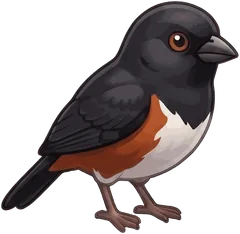 Eastern Towhee
The Eastern Towhee usually opens with two clear notes, drink-your, before the trill, and its whole song is cleaner and less variable. The mew call is nearly the same. The two meet and hybridize on the Plains.
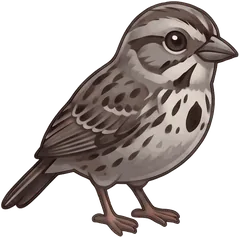 Song Sparrow
A Song Sparrow starts with three short notes and finishes with a varied, musical trill that changes from song to song. The towhee's trill is buzzier, coarser and more uniform, with little or no melodic introduction.
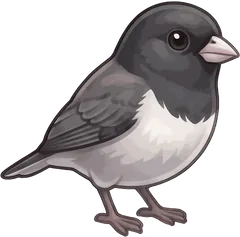 Dark-eyed Junco
A Dark-eyed Junco gives a ringing, metallic trill on one pitch with no notes in front of it. The towhee's trill is lower, rougher and buzzier, and it comes from inside a shrub rather than a treetop.
Where the Spotted Towhee card lives
In Warble the same bird can be an easy card in one state and a prized one in another, because each album ranks its birds by how often people really report them there. The Spotted Towhee appears in 13 state albums:
 Heard one? Open Warble, tap the green button while it sings, and the Spotted Towhee card flips into your album. Get the app free.
Questions people ask
What is the difference between a Spotted Towhee and an Eastern Towhee song?
The Eastern Towhee's song is clearer and more fixed, typically a couple of whistled notes and then a trill, the familiar drink-your-tea. The Spotted Towhee's song is harsher and more variable, often just the buzzy trill with a short rough introduction or none at all.
What bird makes a cat sound in the bushes?
In the West it is often a Spotted Towhee. Its call is a nasal, rising meewww? given from inside dense brush. The Eastern Towhee shares the same call east of the Plains.
What is scratching so loudly in the leaves under my hedge?
Probably a towhee. Spotted Towhees feed by kicking both feet backward at once to clear leaf litter, and the noise carries. Look for a black and rust bird with a long tail in the shadows.
Was the Spotted Towhee once called the Rufous-sided Towhee?
Yes. The Spotted and Eastern Towhees were treated as one species, the Rufous-sided Towhee, until they were split in 1995. They still interbreed where they overlap on the Plains.
Sources
- National Audubon Society, Guide to North American Birds: Spotted Towhee. www.audubon.org/field-guide/bird/spotted-towhee
- Wikipedia: Spotted towhee (split from Eastern Towhee, measurements, range, diet, nesting). en.wikipedia.org/wiki/Spotted_towhee
- BirdWeb (Seattle Audubon): Spotted Towhee. birdweb.org/birdweb/bird/spotted_towhee
- National Audubon Society, Guide to North American Birds: Eastern Towhee. www.audubon.org/field-guide/bird/eastern-towhee