 Warble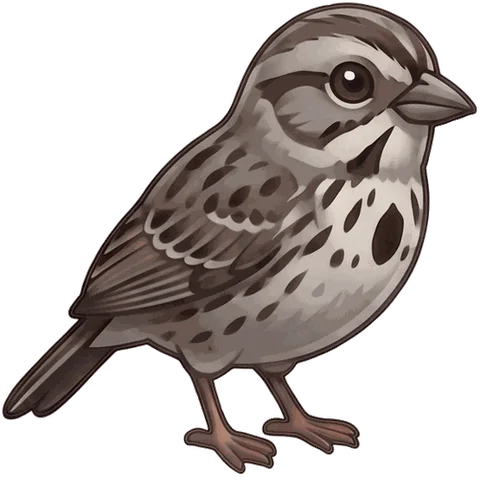
A Song Sparrow sounds like a bird clearing its throat and then improvising: three or four short, clear whistled notes, then a buzzy or slurred note, then a tumbling trill and jumble of warbles that varies every time. The old mnemonic is Madge, Madge, Madge, put on your tea-kettle-ettle-ettle. Each male has around twenty songs and repeats one many times before switching. The everyday call is a dull, nasal tchep from deep in a bush.
The birder's mnemonic
“Madge, Madge, Madge, put on your tea-kettle-ettle-ettle” The three clear notes at the start are the reliable part; what follows changes from song to song and bird to bird.
What the song sounds like
The typical song opens with three or four short, clear, evenly spaced notes, then a couple of slurred or buzzy notes, and then a descending jumble of warbling whistles and trills that lasts another second or two. It is crisp and precise rather than musical, and the shape, a steady introduction followed by a mess, is what you learn to recognize, because the details never stay the same.
A single male knows as many as twenty different songs, and he can vary each one in hundreds of small ways. Unlike a thrush, which moves through its songs one after another, a Song Sparrow repeats the same song many times before switching to the next. A 2022 study found that males keep track of roughly half an hour of their own singing and use that memory to decide what comes next, so a bird does not repeat itself more than it has to.
Young males learn their songs from a handful of adults holding neighboring territories. Females can pick out their own mate's songs from those of the neighbors, and they prefer the songs of neighbors to those of strangers.
The call: a nasal tchep
The common call is a dull, nasal tchep, lower and flatter than the sharp chips of most sparrows, given from inside a thicket or hedge. There are also thin, high notes and buzzy calls, and males sing from an exposed perch, a fencepost or the top of a bush, where they are easy to watch.
When and where you hear it
Song Sparrows live almost everywhere in the United States and Canada where there is low, dense cover near water or open ground: brushy fields, streamside thickets, marsh edges, hedgerows, roadsides and well-planted gardens. Along the coasts they use salt marshes, in the desert Southwest dense streamside brush, and in the Aleutians any thick low cover on the shore.
Birds in the southern half of the range stay all year. Northern and interior birds move south in fall to the southern states and northern Mexico, which is why a place like Missouri has Song Sparrows every month: common in winter across the whole state, and breeding mainly in the north.
Song Sparrows feed on the ground, scratching in leaf litter, sometimes wading into water a fraction of an inch deep, and they visit feeders that have good cover close by. Summer food is mostly insects; winter is mostly grass and weed seeds; coastal birds add tiny crabs and snails. Because males often defend only small territories, good habitat can be packed with them, each one singing from his own perch. In most state albums it is a common Warble card.
What it looks like
A medium-sized, long-tailed sparrow, five to seven inches, brown and streaky above and white below with heavy brown streaks that usually run together into a dark blotch in the center of the breast. The face is gray with a brown stripe through the eye and a brown crown, and a white throat is set off by dark whisker marks. In flight it pumps its rounded tail up and down. Across its range, 25 subspecies are recognized out of more than 50 that have been named, from large dark birds in the Aleutians to small pale ones in the desert Southwest.
The nest is a grass cup on the ground under a tussock or shrub, or low in a bush, usually under four feet up. The female lays three to five greenish-white eggs heavily spotted with reddish brown and incubates them for about two weeks; the young fledge at ten to twelve days and stay with the parents about three weeks more. Cowbirds often lay in Song Sparrow nests, and although the sparrows recognize cowbirds and attack them, one study found that the mobbing itself may tip off female cowbirds to which sparrows are the most capable foster parents.
Birds that sound similar
- ?Lincoln's Sparrow
A Lincoln's Sparrow's song is a rich, gurgling, wren-like run that rises in the middle and drops off sharply at the end, without the Song Sparrow's clear opening notes. Its call is a harder chep, and it skulks in wetter, denser cover.
- ?Fox Sparrow
The Fox Sparrow also opens with clear whistles and follows with short trills or churrs, but the whole song is livelier and more whistled, and the call is a sharp chink. It is a bigger bird with bolder streaks, found in brushy woods.
- ?Swamp Sparrow
The Swamp Sparrow sings a sweet, slow trill all on one note from cattails and sedges. The Song Sparrow's song has a distinct introduction and changes shape halfway through.
Where the Song Sparrow card lives
In Warble the same bird can be an easy card in one state and a prized one in another, because each album ranks its birds by how often people really report them there. The Song Sparrow appears in 48 state albums:
 Heard one? Open Warble, tap the green button while it sings, and the Song Sparrow card flips into your album. Get the app free.
Questions people ask
How many songs does a Song Sparrow have?
As many as twenty distinct songs per male, each with hundreds of small variations. A bird repeats one song many times before switching, and it seems to remember what it sang over the previous half hour so it can rotate through its repertoire.
How do I tell a Song Sparrow from a Lincoln's Sparrow by sound?
The Song Sparrow starts with three or four clear, separate notes and then tumbles into a trill. Lincoln's Sparrow skips the clear introduction and gives a rich, bubbling, wren-like song that swells in the middle and ends abruptly.
Do Song Sparrows migrate?
Some do. Birds in the southern half of the range are permanent residents, while northern and interior populations move to the southern United States and northern Mexico for the winter. In much of the country you have Song Sparrows year-round, though the individuals change with the season.
Do cowbirds lay eggs in Song Sparrow nests?
Yes, often. Song Sparrows recognize Brown-headed Cowbirds as a threat and attack them near the nest, but a study found that this aggression may actually help female cowbirds choose which sparrows are most likely to raise a cowbird chick successfully.
Sources
- National Audubon Society, Guide to North American Birds: Song Sparrow. www.audubon.org/field-guide/bird/song-sparrow
- Wikipedia: Song sparrow (repertoire, song learning, subspecies, cowbird parasitism). en.wikipedia.org/wiki/Song_sparrow
- Missouri Department of Conservation, Field Guide: Song Sparrow. mdc.mo.gov/discover-nature/field-guide/song-sparrow
- National Audubon Society, Guide to North American Birds: Lincoln's Sparrow. www.audubon.org/field-guide/bird/lincolns-sparrow