 Warble
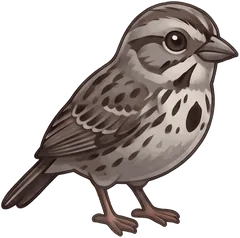
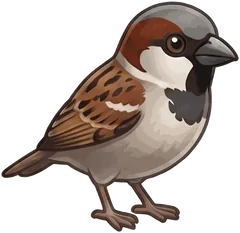
Listen for a tune. A Song Sparrow really sings: three or four clear opening notes, then a couple of slurred ones and a tumbling jumble of whistles and trills, the pattern behind the old mnemonic Madge, Madge, Madge, put on your tea-kettle-ettle-ettle. A House Sparrow has no tune at all, just a slurred, unmusical chireep repeated over and over. If you can see the bird, look at the breast. A Song Sparrow is streaked, the streaks often merging into a dark central spot. A female House Sparrow is plain below, and a male wears a black bib.
Side by side
| Song Sparrow | House Sparrow | |
|---|---|---|
| Song | Three or four clear notes, two slurred notes, then a falling jumble of whistles and trills | A repeated, slurred, unmusical chireep; no tune |
| Call | A dull, nasal tchep | A harsh chireep; chirps and rattles |
| Breast | Whitish with brown streaks, often merging into a central spot | Male: black throat and upper breast. Female: plain, unstreaked |
| Face | Gray cheeks and eyebrow, white throat with dark whisker marks | Male: gray crown, chestnut nape, pale cheek. Female: pale buff eyebrow |
| Size and shape | 5 to 7 inches; long, rounded tail pumped in flight | 5 to 6.5 inches; male often shows a white wing bar |
| Where | Brushy fields, streamside thickets, marsh edges, hedgerows, gardens | Around buildings: city centers, suburbs, farms, parking lots |
| When | All year in many places; northern interior birds go south in winter | All year; does not migrate |
| Origin | Native American sparrow | Old World sparrow, brought from abroad in the 1800s |
By ear: a song or a chirp
The names are a fair guide. A Song Sparrow sings a real, structured song. It opens with three or four clear whistled notes, adds a couple of slurred notes, then tumbles down through a jumble of warbling whistles and trills. Birders remember it as Madge, Madge, Madge, put on your tea-kettle-ettle-ettle: the steady notes at the start are the part to listen for, because the ending changes from song to song. Males usually sing from an exposed perch, so the singer is often easy to find.
A House Sparrow does not sing anything you could whistle back. Its song is a single slurred, nonmusical chireep or chirip, repeated over and over; Audubon sums up the effect as shrill, monotonous, noisy chirping. House Sparrows often nest in small colonies and gather in large roosts, so the sound is often a whole hedge or storefront sign chirping at once, even on cold winter days.
When nobody is singing, the calls still differ: a dull, nasal tchep from the Song Sparrow, a harsh chireep from the House Sparrow.
By sight: streaks or a bib
The two are about the same size, roughly six inches, and both are brown and streaky on the back, which is why people mix them up. The breast settles it. A Song Sparrow is whitish below with brown or red-brown streaks that often run together into one blurry dark spot in the middle of the chest. Its face is striped: gray cheeks and eyebrow, a gray stripe down the center of the crown, and a white throat bordered by heavy dark whisker marks. In flight it pumps its long, rounded tail up and down as it goes from bush to bush.
A male House Sparrow has a black throat and upper breast, a gray crown, a chestnut nape and a black line through the eye, with a pale grayish cheek and often a single white wing bar. The female is the tricky one. Her back is brown with black and buff stripes and she has a pale buff eyebrow and a yellowish bill, but her chest is plain, with no streaks and no spot. That plain breast is the quickest way to tell her from a Song Sparrow.
Song Sparrows vary a lot from place to place, from large dark birds in the Aleutians to small pale ones in the desert Southwest, so trust the pattern, streaks and spot, over the exact shade.
Where you will meet each one
The House Sparrow goes where people go. In North America it lives essentially only around buildings: city centers, suburbs, farms, even isolated buildings in desert or forest. It forages at bird feeders, in fast-food parking lots and outdoor seating areas, and it nests in almost any hole, from a gap behind a sign to a rain gutter or a birdhouse. It is rarely found in healthy native habitat such as forest, marsh or prairie, and it stays all year.
It is also not from here. The House Sparrow is an Old World sparrow, native to Eurasia and northern Africa, and it was released in New York in the 1800s partly in the hope that it would eat insect pests. It ate few, multiplied fast and now often evicts bluebirds, Purple Martins, Tree Swallows and woodpeckers from nest boxes and holes.
The Song Sparrow is a native bird of brushy, often wet edges: thickets, brushy fields, streamsides, shrubby marsh edges, hedgerows and gardens, plus salt marshes on some coasts. It is very widespread. Many stay all year, while birds from the northern interior winter in the southern United States or northern Mexico. It will visit a feeder, especially one with good cover close by. So a sparrow chirping on a shop awning is almost surely a House Sparrow, and one singing from a willow by a creek is very likely a Song Sparrow.
 Still not sure which one is outside? Warble listens while it sings and tells you, then adds the card to your album. Get the app free.
Questions people ask
What sparrow sings Madge, Madge, Madge, put on your tea-kettle?
The Song Sparrow. The phrase matches its song: three or four clear opening notes, then a quick run of slurred notes and trills. The opening is steady; the ending varies from song to song.
Is the House Sparrow a real sparrow?
Not in the American sense. It is an Old World sparrow, more closely related to birds of Europe, Asia and Africa than to native sparrows such as the Song Sparrow.
What sparrow has a black bib?
Usually a male House Sparrow, with a black throat and upper breast, gray crown and chestnut nape. In winter in Missouri, for example, a Harris's Sparrow also has a black bib, but it has a pink bill, a white belly and black on the crown.
Sources
- National Audubon Society, Guide to North American Birds: Song Sparrow. www.audubon.org/field-guide/bird/song-sparrow
- National Audubon Society, Guide to North American Birds: House Sparrow. www.audubon.org/field-guide/bird/house-sparrow
- Missouri Department of Conservation field guide: Song Sparrow (song, call, plumage). mdc.mo.gov/discover-nature/field-guide/song-sparrow
- Missouri Department of Conservation field guide: House Sparrow (song, plumage, origin, similar species). mdc.mo.gov/discover-nature/field-guide/house-sparrow