 Warble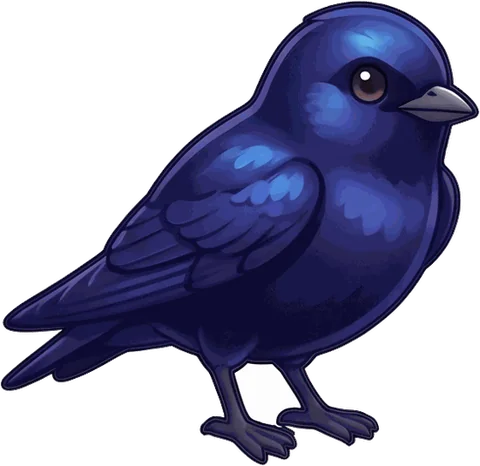
A Purple Martin sounds like a big swallow talking to itself: a low, rich, gurgling warble, throatier than any other swallow, mixed with chirps, chortles, rattles and croaks. The common call is a two-note tchew-tchew or chur-chur, and there is a penetrating tee-tee-tee as well. Males also sing a special dawn song in the dark a few hours before sunrise.
What the song sounds like
The song is a liquid, guttural warble, the kind of sound you would get if a swallow sang from the bottom of its throat. Individual notes are written tchew-wew, pew pew, choo, cher, zweet and zwrack, and a male runs them together with rattles and croaks into phrases that rise and fall. It is lower and richer than a Tree Swallow and has none of the dry rattle of a Barn Swallow. Males have a gurgling courtship song, a distinct dawn song, and a quieter subsong toward the end of the season.
The dawn song is the one people notice. Males sing it in full darkness, a few hours before sunrise, often from high in the air. It carries a long way and it appears to draw other martins to the colony, which is why recordings of it are sold to people trying to start a new martin house.
The call: a two-note tchew-tchew
The everyday call is the two-note tchew-tchew or chur-chur, given by birds coming and going from the house and by flocks feeding overhead. Listen also for a high, penetrating tee-tee-tee. Everything a martin says has the same throaty, rich quality, which is the tell when a dark swallow passes too high to see well.
When and where you hear it
Purple Martins breed across the eastern United States and southeastern Canada, with scattered populations along the Pacific Northwest coast and in Arizona and New Mexico. They winter in the Amazon basin, in Brazil, Bolivia and Peru, and they come back early. The first birds reach Florida and Texas as early as January, Missouri in early March, the northern states in April and Canada as late as May. The oldest birds arrive first and claim the best rooms; the younger birds follow weeks later.
By July the colonies break up and the birds gather in enormous pre-migration roosts. In Missouri an August roost can hold more than 30,000 martins. Fall migration runs from July into October. Because martins hunt only flying insects, a stretch of cold, rainy weather can starve a colony, and regional die-offs happen.
East of the Rockies, martins now nest almost entirely in housing people put up for them: multi-room houses and clusters of gourds on poles in open yards near water. The habit is old. The Cherokee hung hollowed gourds for martins before European settlement, and by 1808 Chickasaw, Choctaw and African American communities kept gourd racks too. Western martins still use woodpecker holes in trees and saguaros. The species is in trouble in the West and declining in the East, in large part because starlings and House Sparrows take over any house that is not watched, sometimes killing adults and young. In Warble the gurgle is a summer catch anywhere a martin house stands within earshot.
What it looks like
The largest swallow in North America, seven to eight and a half inches long with a wingspan around fifteen inches, long pointed wings and a forked tail. The adult male is the only North American swallow that is dark all over: glossy blue-black that reads as purple in good light and plain black in poor light. Females and young birds are dark above with a duller sheen, gray on the throat and chest and whitish on the belly. Both sexes take two years to reach adult plumage, and a young male molting in his first black chest feathers looks blotchy.
Birds that sound similar
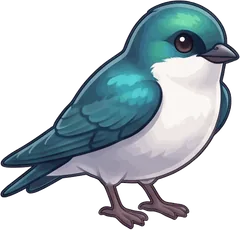 Tree Swallow
The Tree Swallow's twitter is higher, thinner and faster, all liquid chirps. A martin's warble is lower, throatier and richer, with croaks mixed in.
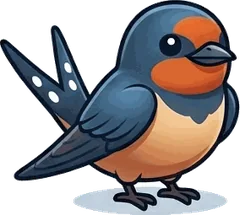 Barn Swallow
A Barn Swallow chatters continuously with a dry, grating rattle in the middle of the song. Martins gurgle rather than rattle, and the two-note tchew-tchew is unlike the Barn Swallow's soft witt-witt.
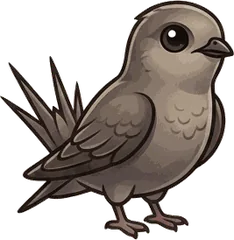 Chimney Swift
A Chimney Swift's voice is a fast run of hard, high, dry chips, nothing like a martin's low gurgle. Swifts also fly on stiff crescent wings and cannot land on a house or a wire.
Where the Purple Martin card lives
In Warble the same bird can be an easy card in one state and a prized one in another, because each album ranks its birds by how often people really report them there. The Purple Martin appears in 18 state albums:
 Heard one? Open Warble, tap the green button while it sings, and the Purple Martin card flips into your album. Get the app free.
Questions people ask
Do purple martins really eat 2,000 mosquitoes a day?
No. That claim has no factual support. Martins feed high in the air, often far above where mosquitoes fly, on wasps, winged ants, bees, true bugs, flies, beetles, moths, butterflies and dragonflies. A 2015 study even found invasive fire ants to be a significant part of the diet in some places.
When do purple martins arrive?
It depends on where you live. The first birds appear in Florida and Texas as early as January, in the middle of the country in early March, in the northern states in April and in Canada in May. Older birds arrive first, weeks ahead of the young ones.
Why won't martins move into my new martin house?
Often because nobody is calling them in. Martins nest in colonies and are drawn to the sound of other martins, which is why dawn song recordings are sold to attract them. The house also has to be kept clear of starlings and House Sparrows, which will take over unmonitored rooms.
Why do purple martins sing before dawn?
The dawn song is a male's long-distance advertisement, sung in the dark a few hours before sunrise and often from high in the air. It seems to attract other martins to the colony.
Sources
- National Audubon Society, Guide to North American Birds: Purple Martin. www.audubon.org/field-guide/bird/purple-martin
- Wikipedia: Purple martin (vocalizations, migration, housing history and diet). en.wikipedia.org/wiki/Purple_martin
- Missouri Department of Conservation, Field Guide: Purple Martin. mdc.mo.gov/discover-nature/field-guide/purple-martin