 Warble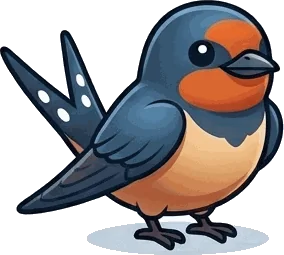
A Barn Swallow sounds like fast, cheerful chatter that never quite stops: a run of liquid, squeaky twitters that a male strings together into a song, with a dry, grating rattle worked into the middle. In flight the birds trade short witt or witt-witt calls, and when a cat or a hawk shows up near the nest the whole colony switches to sharp, loud alarm notes. You hear it low over fields and ponds, and inside barns and under bridges where the mud nests are.
What the song sounds like
The male's song is a long, bubbling warble of twitters, delivered on the wing or from a wire near the nest. Listen for the texture rather than a tune: a stream of quick, liquid notes that suddenly turns into a scratchy, grating rattle, like a fingernail down a comb, and then goes back to twittering. That rattle is the part that separates a Barn Swallow from the other chattering birds over a pond.
Where several pairs nest under one bridge or in one barn, the morning sound is a continuous, layered chatter as birds come and go. They also snap their bills, which adds a dry click if you are close.
The calls: witt-witt and the alarms
The everyday flight call is a short, soft witt, often doubled to witt-witt, given as birds sweep past each other over a field. It is the sound of a flock feeding low over a hayfield or a pond.
Alarm calls are much louder. A ground predator such as a cat near the nest gets a sharp siflitt; a hawk overhead gets a rapid flitt-flitt; and a bird defending its nest can give a loud, two-part splee-plink. When you hear that racket in a barn, look up: the swallows are usually diving at whatever set them off.
When and where you hear it
This is the most widespread swallow on earth, breeding across North America, Europe and Asia and turning up on every continent. The birds that nest in the United States and Canada winter from the Caribbean and Central America down into South America. In the mid-Atlantic they are back around the Chesapeake in early April, and across most of the country the chatter is a sound of late spring and summer. Fall migration is well under way by the middle of August, with flocks moving by day.
Look for them over open ground near water: pastures, hayfields, marshes, ponds and lake shores. The nest, a cup of mud pellets and grass lined with feathers, is stuck to a wall or beam inside a barn, shed or garage, or to the underside of a bridge, dock or wharf. Both parents build it, and a pair raises four or five young at a time, sometimes more. If a building has an open door all summer, there is a fair chance a Barn Swallow is using it.
Because they hunt on the wing in daylight and chatter constantly while they do it, Barn Swallows are one of the easier summer birds to catch by ear in Warble, even when they are only a blur over the grass.
What it looks like
A slim swallow, six to seven inches long, with steel-blue upperparts, a rusty forehead and throat, and underparts that range from deep cinnamon to nearly white. The North American form is redder below than European birds, with a narrow and often broken dark band across the chest. The best mark is the tail: deeply forked, with long, thin outer streamers and a row of white spots you see when the tail is spread. Males have the longest streamers and the glossiest blue; females are a little shorter-tailed and paler below. Young birds in late summer have stubby tails.
Birds that sound similar
 Tree Swallow
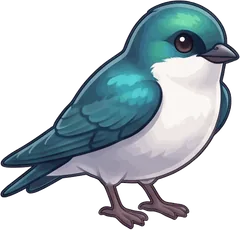
A Tree Swallow's song is a series of clear, liquid twitters with none of the Barn Swallow's grating rattle. Its calls are also cleaner and more whistled. Look for a clean white breast and a tail without streamers.
- ?Cliff Swallow
Cliff Swallows chatter constantly too, but the sound is squeakier and more grating throughout, without the Barn Swallow's smooth twittering runs. Their mud nests are gourd-shaped with a small side entrance, and the tail is short and square.
 Chimney Swift
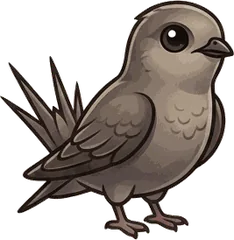
A Chimney Swift's twitter is a rapid series of hard, high, dry chips, all on one note and much faster than a swallow's liquid chatter. Swifts fly on stiff, quivering wings and cannot perch on a wire, only cling to a wall.
Where the Barn Swallow card lives
In Warble the same bird can be an easy card in one state and a prized one in another, because each album ranks its birds by how often people really report them there. The Barn Swallow appears in 49 state albums:
 Heard one? Open Warble, tap the green button while it sings, and the Barn Swallow card flips into your album. Get the app free.
Questions people ask
When do barn swallows arrive and leave?
They arrive in the eastern United States in early to mid spring, around early April in the Chesapeake region, and leave in late summer. Southward migration is already well under way by mid-August, and the birds travel by day in flocks toward Central and South America.
Why are barn swallows flying so low over my lawn?
They are feeding. Barn Swallows catch flying insects in the air and often hunt just above the grass or the water surface, where flies and other small insects are thickest. In bad weather they will even pick insects off the ground.
Do barn swallows come back to the same nest every year?
Barn Swallows often return to the same barn, bridge or shed each spring and will reuse or repair old mud nests there. A nest is often reused for the second brood of the season and repaired again the next year.
How can I tell a barn swallow from a tree swallow by sound?
Listen for the rattle. A Barn Swallow's chatter has a dry, grating buzz in the middle of the song; a Tree Swallow's twitters stay liquid and clear throughout. The Tree Swallow's call is a chirpy chee-weet; the Barn Swallow's is a softer witt-witt.
Sources
- National Audubon Society, Guide to North American Birds: Barn Swallow. www.audubon.org/field-guide/bird/barn-swallow
- Wikipedia: Barn swallow (vocalizations, distribution and the American subspecies). en.wikipedia.org/wiki/Barn_swallow
- Chesapeake Bay Program, Field Guide: Barn Swallow. www.chesapeakebay.net/discover/field-guide/entry/barn-swallow