 Warble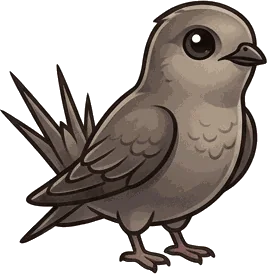
A Chimney Swift sounds like a handful of tiny hard chips being rattled very fast: a rapid, high-pitched twittering, all on one note, dry rather than musical, coming from somewhere overhead. It is usually the first clue that swifts are up there, because the birds themselves are small dark slivers against the sky. Single chips are given too. The sound belongs to summer evenings over towns and cities across the eastern United States, and it gets loud when a flock circles a chimney at dusk.
What the twitter sounds like
Swifts do not sing the way a songbird does. What they have is a chattering twitter, a rapid series of hard, high chips that runs on for a second or two and then breaks off, delivered on the wing and often by several birds at once. Roger Tory Peterson called the bird a cigar with wings, and the voice suits the shape: quick, dry and businesslike, without the liquid notes of a Tree Swallow or the rattling chatter of a Barn Swallow.
Pairs and small groups chitter as they chase each other, and during the breeding season two birds will often glide side by side with their wings raised in a V, calling as they go. Most of the time the sound comes down from well above the rooftops.
Other sounds: the nest and the roost
Inside a chimney a nest full of young makes a loud, raspy raah, raah, raah that carries into the house. Adults disturbed at the nest or roost clap their wings together, which produces a booming or thundering sound in the confined space. At a big roost the combined chittering of hundreds of birds pouring into a chimney at dusk is a sound in its own right.
When and where you hear it
Chimney Swifts breed across the eastern United States and southern Canada and winter in the upper Amazon basin, in eastern Peru and neighboring parts of Ecuador and Brazil. Breeding birds arrive as early as mid-March in the southern states and from late April to mid-May in Canada; in Missouri they show up in April and leave in October. Through the summer you hear them over any town with old brick chimneys, and over open sky above rivers and lakes where insects are thick.
The best show is late summer and fall. Outside the breeding season swifts gather in communal roosts of hundreds or thousands, and near dusk the flock swirls above one big chimney, a school or a church or an old factory, then funnels down into it in a spinning column.
The birds once nested and roosted in hollow trees; now they use chimneys and similar hollow towers almost exclusively. A pair glues a shallow half-saucer of twigs to the inside wall with its own saliva and lays four or five eggs. Swifts feed only in the air, in small flocks, on beetles, flies, true bugs, moths, winged ants and airborne spiders; a pair feeding three young gets through something like 5,000 to 6,000 housefly-sized insects a day. Numbers have fallen steeply across most of the range, enough that the species was listed as Vulnerable in 2018, with pesticides and light pollution among the suspected causes. In Warble the chitter is a summer catch for anyone who lives under one of those chimneys.
What it looks like
A small, dark, cigar-shaped bird, about five inches long with a wingspan of eleven to twelve inches, sooty olive-brown above and grayish brown below with a paler throat. The tail is short and square-tipped, and the long, narrow wings curve back like a crescent or a scimitar. In flight the wingbeats look stiff, quick and shallow, alternating with glides; the wings seem to flap out of step but actually beat together. A swift cannot perch upright. It clings to vertical surfaces with its feet. Compared with a swallow, the bend of the wing sits much closer to the body, so the whole wing reads as a curved blade rather than a triangle.
Birds that sound similar
 Barn Swallow
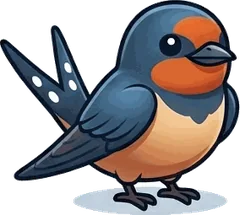
A Barn Swallow's twittering is liquid and varied, with a dry rattle in the song and a soft witt-witt in flight. The swift's chips are harder, higher, faster and all on one pitch.
 Tree Swallow
Tree Swallows give a chirpy, liquid chee-weet and a gurgling song. Nothing a swift says is liquid; it is all dry, ticking chips.
 Purple Martin
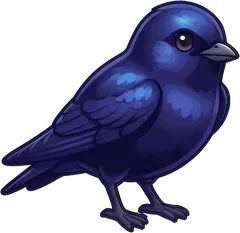
A Purple Martin's low, throaty gurgle and two-note tchew-tchew are much richer than a swift's thin chittering, and martins are far bigger, with broad wings and a forked tail.
Where the Chimney Swift card lives
In Warble the same bird can be an easy card in one state and a prized one in another, because each album ranks its birds by how often people really report them there. The Chimney Swift appears in 35 state albums:
 Heard one? Open Warble, tap the green button while it sings, and the Chimney Swift card flips into your album. Get the app free.
Questions people ask
What are the small birds chattering high over my house at dusk?
Most likely Chimney Swifts, especially in a town east of the Rockies from spring through early fall. Their rapid, dry, high-pitched chips come from birds hunting insects well above the rooftops, and at dusk the calls get louder as the flock heads for a roost chimney.
Why are there birds chirping inside my chimney?
In summer that raspy raah, raah is almost certainly a brood of young Chimney Swifts. The parents built a twig nest glued to the flue wall with saliva. The noise lasts until the young fledge at about four weeks old.
Do Chimney Swifts ever land?
Not the way other birds do. A swift cannot perch upright on a branch or a wire. It clings to vertical surfaces, chimney walls, hollow trees and the like, and otherwise stays airborne while it feeds.
Where do Chimney Swifts go in winter?
To the upper Amazon basin of South America, mainly eastern Peru and nearby parts of Ecuador and Brazil. They leave in the fall and return between mid-March in the South and mid-May in Canada.
Sources
- National Audubon Society, Guide to North American Birds: Chimney Swift. www.audubon.org/field-guide/bird/chimney-swift
- Wikipedia: Chimney swift (vocalizations, flight, nesting, range and conservation). en.wikipedia.org/wiki/Chimney_swift
- Missouri Department of Conservation, Field Guide: Chimney Swift. mdc.mo.gov/discover-nature/field-guide/chimney-swift