 Warble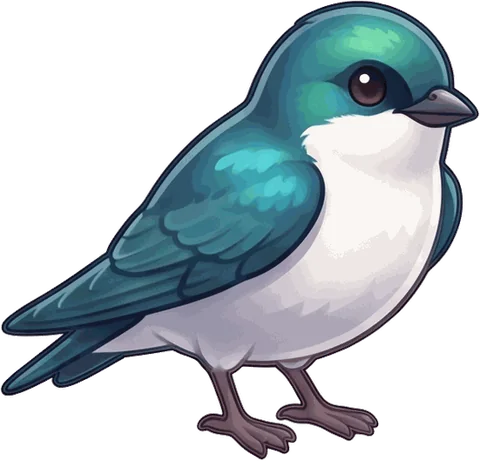
A Tree Swallow sounds like a bubbling stream of liquid chirps and gurgles, cheerful and a little squeaky, given from a nest box, a dead snag or in the air over a pond. The song is built from three kinds of notes, a chirp, a whine and a gurgle, mixed and repeated in different orders, and it often ends with the gurgle given twice. The everyday call is a chirpy one- or two-syllable chee-weet. It is the first swallow voice of the year across most of the country, back over the water while the ice is still going out.
What the song sounds like
Listen for texture rather than melody. A singing male strings together short liquid chirps, a thinner whining note and a low, rolling gurgle, and he can repeat or drop any of the three, so no two runs sound quite the same. The gurgle tends to come last, usually twice, and seems to be aimed at the mate rather than the neighbors.
Everything about the sound is clean and watery. There is no dry rattle in it, which is the quickest way to separate it from a Barn Swallow chattering over the same field, and it is higher and lighter than the throaty warble of a Purple Martin. A line of boxes along a marsh edge keeps up a steady twitter from first light.
The call: a chirpy chee-weet
The call is a chirpy chee-weet or a longer chweet-twit-clweet, one or two syllables with the same liquid quality as the song. You hear it from birds passing overhead in migration and from pairs trading places at the nest. There is also a chattering call males use to advertise a cavity, and a sharper alarm given when a hawk, a cat or a person comes too close to the box.
When and where you hear it
Tree Swallows breed across almost the whole of North America, north to north-central Alaska and the tree line in Canada. They are early. In Missouri the first birds show up in late February and March and spring numbers peak in mid-April, when most other swallows are still on their way. Fall migration starts as early as July and peaks in early autumn, with flocks moving by day. Missouri's last birds are gone by mid-November.
They winter farther north than any other swallow, from California and southwestern Arizona in the west and southeastern Virginia in the east, down the Gulf Coast to the West Indies, Panama and the northwestern coast of South America. The trick is diet: unlike other North American swallows they eat a fair amount of plant food, up to a fifth of the year's intake, mostly bayberries in winter, which carries them through cold snaps that would starve a pure insect-eater. The rest of the year they hunt flying insects low over water and fields.
Look for them in open country near water: marshes, wet meadows, lakes, ponds and reservoirs, anywhere with dead trees or nest boxes and a supply of insects. They nest in old woodpecker and sapsucker holes and take readily to boxes put up for bluebirds. The nest of grass, moss and pine needles is lined with feathers from other birds, gathered mostly by the male and often added after the first eggs are laid. Unlike many aerial insect-eaters the species is doing well, with numbers increasing in many areas, and its twitter is an easy early-spring catch in Warble.
What it looks like
A small swallow, about five to six inches long, with a wingspan of a foot or a little more. Adults are glossy blue-green above, shifting toward greener tones in fall, and clean white below, with a sharp line between the two. The wings and tail are blackish. Females are duller and sometimes have a brown forehead, and young females can keep mostly brown upperparts with a scattering of blue feathers for a year or more. Juveniles are brown above with a faint gray-brown wash on the chest. The bright white underside is the mark that separates them from the dingy Northern Rough-winged Swallow that often shares the same water.
Birds that sound similar
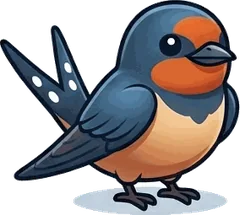 Barn Swallow
The Barn Swallow's chatter has a dry, grating rattle worked into it and a soft witt-witt flight call. Tree Swallow song stays liquid throughout and the call is a chirpier chee-weet.
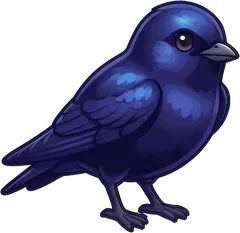 Purple Martin
A Purple Martin's warble is lower, richer and more guttural, with a two-note tchew-tchew call, and the bird is much bigger. The Tree Swallow's twitter is higher, thinner and faster.
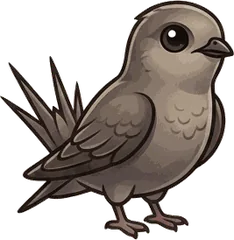 Chimney Swift
A Chimney Swift's call is a rapid run of hard, high, dry chips with no liquid notes at all. Swifts also fly on stiff, quivering, crescent-shaped wings and never land on a wire or a box.
Where the Tree Swallow card lives
In Warble the same bird can be an easy card in one state and a prized one in another, because each album ranks its birds by how often people really report them there. The Tree Swallow appears in 46 state albums:
 Heard one? Open Warble, tap the green button while it sings, and the Tree Swallow card flips into your album. Get the app free.
Questions people ask
When do tree swallows come back in spring?
Earlier than any other swallow. In the middle of the country the first birds appear in late February and March, with spring numbers peaking in mid-April. They can afford it because they eat bayberries and other fruit when a cold spell grounds the insects.
Why are tree swallows using my bluebird box?
Because it is exactly the kind of cavity they nest in. Tree Swallows use old woodpecker holes in dead trees and take to bluebird boxes readily, especially near water. They compete for holes with starlings and House Sparrows as well.
Do tree swallows eat anything besides insects?
Yes, and it sets them apart. Up to about 20 percent of their yearly food is plant matter, mostly bayberries, eaten in fall, winter and early spring when insects are scarce. That is why they can winter along the Gulf and Atlantic coasts and arrive north so early.
Sources
- National Audubon Society, Guide to North American Birds: Tree Swallow. www.audubon.org/field-guide/bird/tree-swallow
- Wikipedia: Tree swallow (song structure, range, diet and nesting). en.wikipedia.org/wiki/Tree_swallow
- Missouri Department of Conservation, Field Guide: Tree Swallow. mdc.mo.gov/discover-nature/field-guide/tree-swallow