 Warble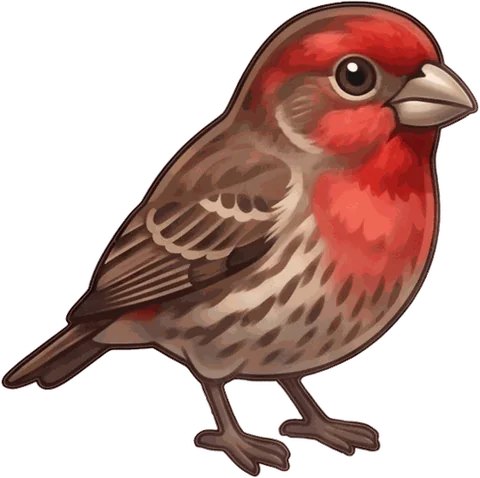
A House Finch sounds like a bird in a hurry to say everything at once: a long, bouncy, jumbled warble of sweet and scratchy notes that runs for a few seconds and usually finishes with a harsh, down-slurred cheer or a buzzy rising zeee. It has the cheerfulness of a canary without the long trills and rolls. Both males and females sing in spring, often from a rooftop, a wire or a TV antenna. The everyday call is a soft, rising two-note queet or tooit, and a flock at a feeder keeps up a constant chirping twitter.
What the song sounds like
The song is an energetic, twittering warble: a fast tumble of high notes that rise, fall and skip around with no obvious pattern, lasting a few seconds and then starting over. Two things mark it as a House Finch. The tone is a little rough and squeaky rather than pure, and the phrase very often ends with an emphatic buzzy note, described as a harsh down-slurred cheer, a zeee or a high wheer. Once you have caught that ending you will hear it from parking lots and porch feeders all spring.
Males sing from high, exposed perches, and unlike most songbirds the females sing too, mostly in spring. Singing runs through the long nesting season, which can begin as early as February and continue into August, with two or three broods. In the West it is one of the most familiar sounds of towns and streamside thickets; in the East it has been the voice of the suburbs for only a couple of generations.
The call: a rising queet
The common call is a soft, rising, two-syllable queet or tooit, and in flight a shorter cheet. Audubon describes the chirp as sounding like a young House Sparrow's, which is exactly why people at a feeder mix the two birds up. The difference is that the finch calls sit on top of an actual song, while the sparrow only ever chirps. Because House Finches feed in flocks for most of the year, you usually hear several at once, a bright, busy chattering from the top of a hedge or a feeder pole.
When and where you hear it
House Finches are now found year-round in almost every part of the United States and most of Mexico, breeding as far north as northern Alberta, with a population of roughly 40 million. They avoid dense forest and open grassland and settle instead in cities, suburbs and farmland with trees and lawns. Originally they were birds of streamside thickets in the arid Southwest, and they still thrive there, but the story of the eastern birds is stranger.
Around 1940 dealers in New York City were selling wild-caught western House Finches as cage birds under the name Hollywood finches. That was illegal under the Migratory Bird Treaty Act, and in 1940, to avoid prosecution, sellers and owners released their birds on Long Island. The escapees took to the suburbs, reached New England and North Carolina by 1971, and kept going west until, within about 50 years, the eastern population met the native western one on the Great Plains. In the 1990s an eye disease, mycoplasmal conjunctivitis, crashed the eastern population; it has since recovered, while western numbers have slipped in many areas.
For most people the House Finch is the first red bird at a new feeder, and the first card in Warble that turns out not to be a cardinal.
What it looks like
A small, slim finch, 5 to 6 inches long with an 8 to 10 inch wingspan, weighing well under an ounce. The male has red on the forehead, eyebrow, throat and upper chest, a brown back and, importantly, brown streaks down the whitish flanks and belly. The red comes from pigments in the berries and fruit he eats, so some males are orange or even yellow instead. The female is plain gray-brown with a blurry streaked breast and no strong face pattern. A Purple Finch male looks dipped in raspberry juice with no dark side streaks, and the female Purple Finch has a bold white eyebrow and dark cheek that the House Finch lacks. House Finches eat seeds, buds and berries and are one of the very few birds that feed their nestlings nothing but plant matter.
Birds that sound similar
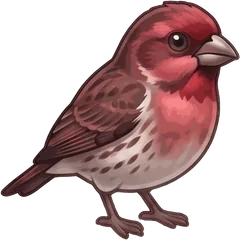 Purple Finch
The Purple Finch's warble is richer and more liquid and does not end in the House Finch's harsh cheer. Its call is a dry, sharp tick or pick, especially in flight, nothing like the finch's rising queet.
- ?Cassin's Finch
A bird of high mountain conifer forests in the West. Its song is flutier and more varied, often with brief imitations of other birds, and its call is a distinctive high pwee-de-lip. House Finches stay at lower elevations.
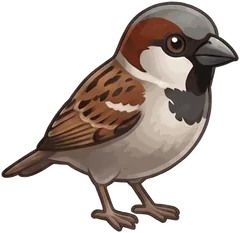 House Sparrow
A House Sparrow's chirp sounds much like a young House Finch and the two share the same feeders. But the sparrow never produces a warbling song; if the chirps break into a tumbling melody, it is the finch.
Where the House Finch card lives
In Warble the same bird can be an easy card in one state and a prized one in another, because each album ranks its birds by how often people really report them there. The House Finch appears in 50 state albums:
 Heard one? Open Warble, tap the green button while it sings, and the House Finch card flips into your album. Get the app free.
Questions people ask
Do female house finches sing?
Yes. Females sing in spring alongside the males, which is unusual among North American songbirds. Their song is the same kind of quick warble, so a singing brown streaky finch is not necessarily a young male.
Why is my house finch orange or yellow instead of red?
The red pigment comes from the berries and fruit the male eats while growing new feathers. A bird that got fewer of those pigments comes out orange, or in rare cases pale yellow. It is the same species, just a different diet.
Are house finches native to the East Coast?
No. They are native to the western United States and Mexico. Birds sold illegally as Hollywood finches in New York were released on Long Island in 1940, and their descendants spread across the entire East and Midwest within a few decades.
How do I tell a house finch from a purple finch by sound?
Listen for the ending and the call. A House Finch usually closes its warble with a harsh, buzzy, down-slurred note and calls with a rising queet. A Purple Finch's warble is smoother without that buzzy finish, and its flight call is a short, dry tick.
Sources
- National Audubon Society, Guide to North American Birds: House Finch. www.audubon.org/field-guide/bird/house-finch
- Wikipedia: House finch (song, Hollywood finches, range, plumage, disease). en.wikipedia.org/wiki/House_finch
- Missouri Department of Conservation, Field Guide: House Finch. mdc.mo.gov/discover-nature/field-guide/house-finch
- National Audubon Society, Guide to North American Birds: Purple Finch. www.audubon.org/field-guide/bird/purple-finch