 Warble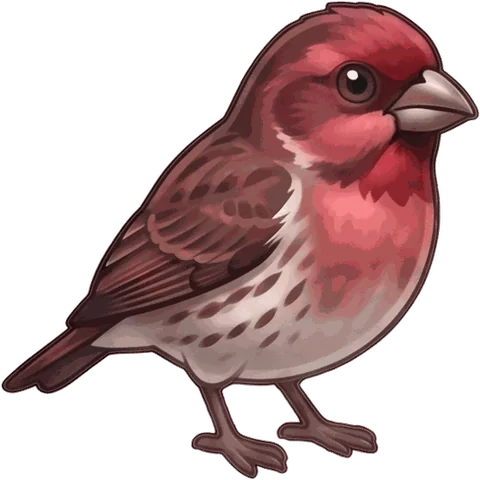
A Purple Finch sounds like a House Finch that took lessons: a rich, fast, bubbling warble of high and low notes that rises and falls without a break and ends cleanly, with none of the harsh zeee a House Finch tacks on. Away from the song, listen for a soft, dry pick from the feeder and a distinctive sharp tick given in flight. Females sing too, sometimes from the nest.
What the song sounds like
The song is a dense, continuous warble, a rapid string of musical notes that climb and drop in an up-and-down cadence for several seconds at a time. It is fuller and rounder than the House Finch song, and it stays musical to the end: no sour buzz, no drawn-out slur. Field guides reach for words like rich, energetic and bubbly, and for once they agree. Males sing from the top of a spruce or a bare branch in the breeding woods; on migration and in winter you may hear a subdued version from a flock working through the trees.
Nesting females sing as well, which is unusual enough among finches to be worth knowing when you hear a warble coming from a brown, streaky bird. If you have both finches at your feeder, the cleanest test is the ending: a House Finch nearly always finishes with a harsh, rising zeee; a Purple Finch does not.
The calls: pick and tick
The everyday call is a soft pick, given from a perch or a feeder, and a short, sharp tick in flight that Audubon singles out as distinctive. Both are drier and flatter than a House Finch's cheerful chirp, which sounds like a young House Sparrow, and quite different from the House Finch's rising two-note too-it. Learn the flight tick and you will pick Purple Finches out of overhead flocks in October before you see a feather.
When and where you hear it
Purple Finches breed in coniferous and mixed forest across Canada and the northern United States, and in oak and streamside woodland along the Pacific coast. They are common in the North and the East and on the West Coast, but scarce in most of the Rocky Mountain region. Northern birds move south in day-flying flocks over a long stretch of fall and again in spring, so their arrival and departure in any one place is gradual rather than sudden.
For most people the Purple Finch is a winter feeder bird. In Missouri it is present from October through April, common on migration and less so through midwinter, when small flocks visit feeders in towns, farms and suburbs, often feeding on the ground beneath them. Numbers vary from year to year. The eastern population has declined over the past century, first after the House Sparrow arrived and more recently, Audubon suggests, from competition with the House Finch, which spread from a 1940 release of caged birds in New York to meet its western kin on the Great Plains within fifty years.
It is the state bird of New Hampshire, adopted in 1957 over a proposed chicken, the New Hampshire Red.
What it looks like
A chunky, short-tailed finch, five and a half to six and a half inches long, with a thick conical bill and a notched tail. The male looks as if he had been dipped headfirst in raspberry juice: the red washes evenly over the head, breast, back and rump, without the sharp brown streaks on the flanks that mark a male House Finch, and it is more purplish than orange-red. The female is brown above and white below with heavy dark streaks, a bold whitish eyebrow and a dark whisker mark, a much stronger face pattern than a female House Finch. Pacific birds are darker and longer-tailed.
Birds that sound similar
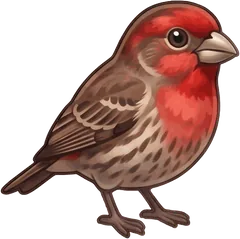 House Finch
The House Finch's song is longer, looser and more jangly, and it usually ends in a harsh rising zeee. Its call is a chirp like a young House Sparrow and a rising two-note too-it. The Purple Finch's warble is richer and ends clean, and its calls are a flat pick and tick.
- ?Orchard Oriole
Audubon describes the Orchard Oriole's rapid musical warble as somewhat like a Purple Finch's but thinner in quality. It is a summer bird of open groves in the Midwest and South, singing when most Purple Finches have gone north.
Where the Purple Finch card lives
In Warble the same bird can be an easy card in one state and a prized one in another, because each album ranks its birds by how often people really report them there. The Purple Finch appears in 11 state albums:
 Heard one? Open Warble, tap the green button while it sings, and the Purple Finch card flips into your album. Get the app free.
Questions people ask
How do I tell a Purple Finch from a House Finch by sound?
Listen for the ending. A House Finch's long, jumbled warble almost always finishes with a harsh, buzzy, rising zeee; a Purple Finch's richer warble rolls up and down and ends without a buzz. Calls differ too: the House Finch chirps and gives a rising two-note too-it, while the Purple Finch says a soft pick and a sharp tick in flight.
Do female Purple Finches sing?
Yes. Nesting females sing, which is uncommon among finches, so a warble from a brown, streaky bird with a bold white eyebrow is not a mistake. The male's song is the one you hear most, delivered from a high perch in breeding season.
When are Purple Finches at feeders?
Mostly from October through April across the central and southern states, with the biggest numbers on migration in fall and spring. How many turn up in a given winter varies; some years bring flocks, others almost none. They eat seeds, buds and berries and come readily to feeders.
Which state has the Purple Finch as its state bird?
New Hampshire, since 1957. The legislature chose it over the New Hampshire Red, a breed of chicken that had also been proposed.
Sources
- National Audubon Society, Guide to North American Birds: Purple Finch. www.audubon.org/field-guide/bird/purple-finch
- Wikipedia: Purple finch (song, plumage, state bird, competition with House Finch). en.wikipedia.org/wiki/Purple_finch
- Missouri Department of Conservation, Field Guide: Purple Finch. mdc.mo.gov/discover-nature/field-guide/purple-finch
- National Audubon Society, Guide to North American Birds: House Finch (lookalike voice and history). www.audubon.org/field-guide/bird/house-finch