 Warble


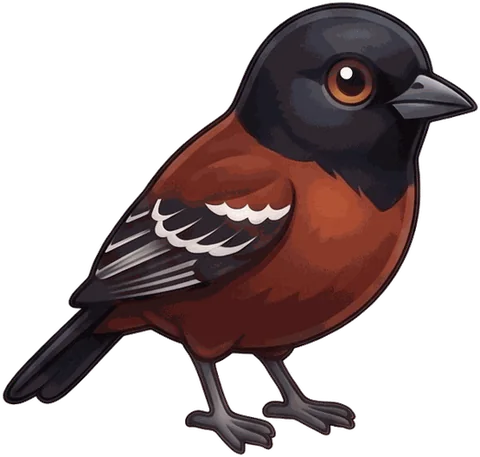
An Orchard Oriole sounds like a songbird in a hurry: a quick, high, sweet warble that tumbles out in a rush, mixed with short chatters, chuckles and rolls, and often ending in a whistle that slurs up or down. It is less repetitive than a robin and faster and more jumbled than the clear whistles of a Baltimore Oriole. Males sing from the upper branches of shade trees, orchards and streamside groves in spring, and the everyday call is a soft chuck.
What the song sounds like: a rushed warble
The song is a rapid run of high, musical notes that seems to spill out faster than the bird can organize it. Inside each burst you hear quick warbled phrases, a few harsh or scratchy interjections, little chuckles and rolls, and, usually near the end, a whistle that slides upward or downward. Each phrase changes from the one before, so the effect is sweet but restless rather than tidy.
Audubon compares it to the warble of a Purple Finch, only less rich in tone, and the Missouri Department of Conservation describes it as more lyrical than a catbird's song and less repetitive than a robin's.
Adult males, including second-year males in their first breeding season, start singing as soon as they reach the breeding grounds, probably to attract a mate. A young male singing alone at the top of a tree can sound especially jumbled and hard to place. In general you will hear an Orchard Oriole well before you see one, because it keeps to the upper parts of trees.
The call: a soft chuck and chatter
Away from the song, males give a soft chuck and a chatter. A string of chucks and chatters is an alarm, and other Orchard Orioles take notice; they also react to alarm calls from Baltimore and Bullock's Orioles. From mid-July to mid-August, listen for a different sound: females and young keep in touch with short whistles held on a single pitch.
When and where you hear it
Orchard Orioles are summer birds of the eastern and central United States, most common in the Midwest and the South. They winter from southern Mexico to Colombia and fly north in spring, many of them straight across the Gulf of Mexico, traveling at night. In Missouri they arrive in late April.
Their summer is short. Fall migration starts very early, with some birds already heading south by late July. In Missouri most have left by the end of August and all are gone by mid-September, so the window for hearing one is short.
Look for semi-open country with scattered deciduous trees: riverside groves, orchards, parks with big shade trees, suburbs, woodland edges, hedgerows in grassland and groves on the prairie. They usually avoid unbroken forest. Audubon notes that clearing eastern woods and planting groves on the prairie may have helped the species. Orchard Orioles are not very territorial, and two pairs may nest in the same tree, sometimes sharing it with an Eastern Kingbird. In Warble it is an uncommon card in Nebraska and a rare or legendary one in most of the other albums that carry it, from Missouri to Virginia.
Summer food is mostly insects, including caterpillars, beetles and grasshoppers, with more fruit and nectar during migration.
What it looks like
A small, slim oriole, about 7 inches long and smaller than a Baltimore Oriole. The adult male is black on the head, back and throat with deep chestnut on the underparts, shoulders and rump, a combination that sets him apart from other orioles. At a glance he can pass for a robin or a towhee until body shape and bill give him away. Females are olive-green above and yellowish below with two white wing bars, without the orange tones of a female Baltimore. A first-year male looks like a female with a black throat patch, and he sings anyway.
The nest is a tightly woven pouch of grass and plant fibers hung from the fork of a branch, usually 10 to 20 feet up and sometimes tucked into Spanish moss. The female does most of the building and incubates a clutch of around four pale bluish, blotched eggs for about two weeks while the male brings her food. Cowbirds lay in Orchard Oriole nests fairly often, at rates recorded as high as 28 percent.
Birds that sound similar
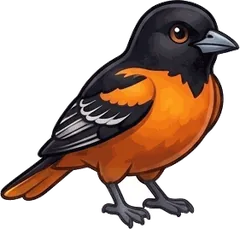 Baltimore Oriole
The two songs are similar, but a Baltimore Oriole sings clear, flute-like whistles, one or two notes at a time, in short, distinct phrases. The Orchard Oriole rushes, packing quick warbles, harsh notes and chatters into each burst.
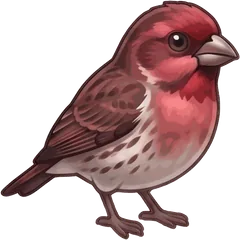 Purple Finch
Audubon likens the Orchard Oriole's song to a Purple Finch's rapid warble, but less rich. Listen for the oriole's chuckles, rolls and the slurred whistle that often closes a phrase.
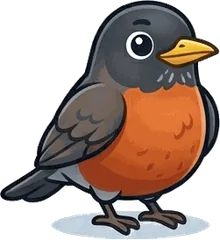 American Robin
Both sing from shade trees in spring. The Orchard Oriole's warble is less repetitive than a robin's song, higher and quicker, and sprinkled with chatters and chuckles.
Where the Orchard Oriole card lives
In Warble the same bird can be an easy card in one state and a prized one in another, because each album ranks its birds by how often people really report them there. The Orchard Oriole appears in 16 state albums:
 Heard one? Open Warble, tap the green button while it sings, and the Orchard Oriole card flips into your album. Get the app free.
Questions people ask
What is the difference between an Orchard Oriole and a Baltimore Oriole song?
The Baltimore sings clear, flute-like whistles in short, separate phrases. The Orchard Oriole's song is faster and higher, a run-together warble with harsh interjections, chuckles and a slurred whistle near the end. The male's color settles it: chestnut and black for Orchard, orange and black for Baltimore.
When do Orchard Orioles leave?
Early. Some head south by late July, and in Missouri most are gone by the end of August and all by mid-September.
Do Orchard Orioles come to feeders?
Sometimes. They drink nectar and some visit hummingbird feeders. Fresh orange halves or jelly can attract them, but skip sugar-free products. Most of their summer diet is still insects.
Why do young male Orchard Orioles look like females?
First-year males are still in a yellow-green plumage like the female's, marked only by a black throat. The black and chestnut comes later, but these young males already sing in their first spring.
Sources
- National Audubon Society, Guide to North American Birds: Orchard Oriole. www.audubon.org/field-guide/bird/orchard-oriole
- Missouri Department of Conservation, Field Guide: Orchard Oriole. mdc.mo.gov/discover-nature/field-guide/orchard-oriole
- Animal Diversity Web (University of Michigan): Icterus spurius. animaldiversity.org/accounts/Icterus_spurius/
- National Audubon Society, Guide to North American Birds: Baltimore Oriole. www.audubon.org/field-guide/bird/baltimore-oriole