 Warble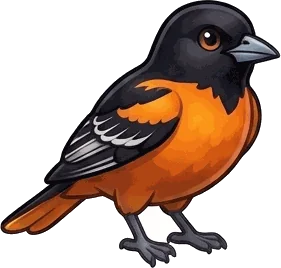
A Baltimore Oriole sounds like someone whistling a short, clear tune from high in a shade tree: a handful of rich, flute-like notes, single or paired, in phrases that stop and start, something like tyew, pyeer, peededoo. Every male has his own version, so no two sound quite alike. Both sexes give a whistled hew-li and a dry, scolding chatter, and females sing a shorter, simpler song near the nest.
What the song sounds like
The song is built from pure, whistled notes with a flute's roundness, given one or two at a time in short, distinct phrases with pauses between. Writers have transcribed the pieces as tyew, pyeer, teer and peededoo, but the exact notes matter less than the quality: loud, clear, unhurried and a little wistful, with none of the run-on warbling of a finch. A bird may repeat one phrase for a while and then change it.
Individual variation is the oriole's trademark. Each male has a distinct song, and a birder who spends a season near one tree learns to recognize that particular bird. He sings through the summer from the canopy, which is where the frustration comes in: the sound is unmistakable and the singer is a moving orange spot behind a wall of leaves. Females sing too, a shorter and less complex song, most often in defense of the area around the nest.
The calls: hew-li and a chatter
The commonest call is a whistled hew-li, two notes, given by both sexes and useful because it is often the first sign an oriole has arrived in spring. Alarm and irritation come out as a rapid, harsh chatter, rattling and unmusical, the sound you hear when a jay or a squirrel comes too near the nest. Nestlings beg loudly, so a hanging nest in late June is easy to find by ear even when it is well hidden.
When and where you hear it
Baltimore Orioles are summer birds of the East, breeding from the Canadian prairies and the Great Lakes to Georgia and the Carolinas, everywhere east of the Great Plains where tall deciduous trees stand with open ground around them: riverside groves, orchards, parks, and the elms, maples and willows of old neighborhoods. Breeding takes place in May and June, and that is when the whistling is loudest, while pairs settle and the female weaves her nest.
They leave early. Many birds head south in July and August, well ahead of most migrants, and by late summer the whistles have stopped even where a few birds linger. Winter is spent from Mexico through Central America to northern South America, often in flowering canopy trees over shade-grown coffee. A few stay along the southern coasts of the United States.
Orioles come to yards for nectar feeders and pieces of fruit, and they hunt caterpillars in the canopy, including the hairy kinds most birds avoid. About 12 million remain, and surveys show declines in recent decades. Where the range meets the western Bullock's Oriole on the Great Plains the two interbreed, which is why from 1973 to 1995 they were lumped as a single species, the Northern Oriole, before research showed the mixing was limited. In the eastern half of the country the song is a May and June catch for Warble players; by August the bird is quiet or gone.
The state bird of Maryland
The name comes from the colors. The male's orange and black matched the coat of arms of the 17th-century Lord Baltimore, whose family founded the colony of Maryland. Maryland made the oriole its state bird in 1947, and the Baltimore Orioles baseball team takes its name and its mascot from the bird.
What it looks like
Seven to eight and a half inches, a bit smaller than a robin, with a straight, sharp bill. The male is flame orange below and on the rump and shoulder, with a black head, back, throat and wings marked by orange and white bars, and orange corners to the black tail. The female is olive-brown to yellow-brown above with darker wings and white wing bars, and dull orange-yellow below, brighter on some birds than others. The nest is the other field mark: a tightly woven pouch of plant fibers, bark strips, grass and any string or yarn on offer, hung 20 to 30 feet up from the drooping tip of a branch. In winter, when the leaves are down, old nests show where to listen the next May.
Birds that sound similar
- ?Bullock's Oriole
Audubon describes the two songs in the same words: flute-like whistled notes in short phrases with much individual variation, plus a rapid chatter. West of the Great Plains assume Bullock's; on the Plains the two interbreed, so look for the male's orange face and larger white wing patch.
- ?Orchard Oriole
The Orchard Oriole's song is a fast, continuous musical warble, closer to a Purple Finch than to the Baltimore's spaced whistles. It is a smaller bird of open groves in the Midwest and South, and it leaves even earlier, some by late July.
Where the Baltimore Oriole card lives
In Warble the same bird can be an easy card in one state and a prized one in another, because each album ranks its birds by how often people really report them there. The Baltimore Oriole appears in 28 state albums:
 Heard one? Open Warble, tap the green button while it sings, and the Baltimore Oriole card flips into your album. Get the app free.
Questions people ask
When do Baltimore Orioles arrive and leave?
They arrive in spring, breed in May and June, and are among the first songbirds to head south: many depart in July and August. By late summer the singing has stopped. They winter from Mexico through Central America to northern South America, with a few along the southern coasts of the United States.
Why is it called the Baltimore Oriole?
The male's orange and black match the colors on the coat of arms of the 17th-century Lord Baltimore, the family behind colonial Maryland. Maryland adopted the bird as its state bird in 1947, and the city's baseball team is named after it.
Do female Baltimore Orioles sing?
Yes. Females sing a shorter, simpler version of the male's whistled song, usually near the nest and often in defense of it, and both sexes give the two-note hew-li call and a harsh chatter.
What do Baltimore Orioles eat at feeders?
Sugar water from a nectar feeder and pieces of fruit. In the trees they eat mostly insects, especially caterpillars, along with berries and nectar from flowers, so a yard with mature deciduous trees helps as much as the feeder does.
Sources
- National Audubon Society, Guide to North American Birds: Baltimore Oriole. www.audubon.org/field-guide/bird/baltimore-oriole
- Wikipedia: Baltimore oriole (song, name, state bird, Northern Oriole split). en.wikipedia.org/wiki/Baltimore_oriole
- Animal Diversity Web: Icterus galbula (vocalizations, nest, range). animaldiversity.org/accounts/Icterus_galbula/
- Wikipedia: List of U.S. state birds (Maryland, 1947). en.wikipedia.org/wiki/List_of_U.S._state_birds