 Warble


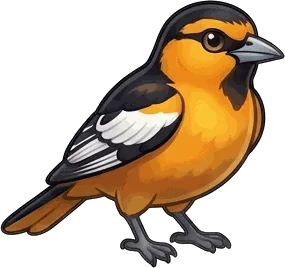
A Bullock's Oriole sounds like a sweet whistler that keeps interrupting itself. The song is a short, fast-changing jumble of flute-like whistles, harsh chattering, squeaks and creaks, sung in brief phrases from high in a cottonwood or willow. The most common call is a dry, rapid chatter, a scolding rattle that birds often give as they take off. Both males and females sing. Listen along western streams, in farmyards and in leafy suburbs from spring through July.
What the song sounds like: whistles with chatter
Each song is short and busy. A few clear whistled notes, single or doubled, come in tight phrases, and then the bird mixes in harsh chattering, squeaks and creaky notes that change from one phrase to the next. Some listeners compare it to a squeaky toy. Individuals vary a lot. An account by Dawson from 1923 writes one version as kip, kit-tick, kit-tick, whew, wheet and a less common one as cut cut cudut whee up chooup, with the final note often blurred.
Both sexes sing. The male's song is the sweeter of the two; the female's is lower in pitch, and she sings most early in the season, even while weaving the nest. The bird singing closest to a nest is often the female, so if the song comes from a dull yellow and gray bird, your ears are fine.
Orioles like to sing from tall streamside trees. The male sings to hold his nesting territory, and when courting he adds a show: he faces the female, stretches up tall, spreads his tail and quivers his half-open wings.
The call: a dry, rattling chatter
The sound most people notice first is the chatter, a dry, rapid rattle that sounds like scolding. Orioles use it to keep a family together, to warn off rivals and as an alarm when a predator comes close. They often chatter as they launch from a branch, so a burst of rattling from a cottonwood followed by a flash of orange is a strong clue.
Quieter notes fill in the gaps: a low single wheet, chet or check, and in flight a rising, nasal wreent or another harsh, chattery rattle. Paired males sometimes give a short cry when they are close to their mate.
When and where you hear it
Bullock's is the most common oriole in the western United States, and of the four orioles usually found in the West it nests the farthest north. Breeding birds range from southern British Columbia, Alberta and Saskatchewan into northern Mexico, and east to the western edges of the Dakotas and Kansas and central Texas. Look in cottonwoods, willows and sycamores along streams and rivers, in ranch yards, along irrigation ditches and in suburbs with enough big shade trees.
Birds return from late March to May, males about two weeks ahead of females, and nesting runs from May into July. The season ends early: many orioles have left northern breeding areas by the end of July, and the southbound movement continues through September, at night, in small loose flocks. Winter is spent in western Mexico, mainly from Sinaloa to Oaxaca, where birds defend flowering Erythrina trees from other birds, especially hummingbirds.
Summer food is mostly insects, caterpillars above all, with fruit making up about two-fifths of the diet: cherries, blackberries, raspberries and figs. Orioles pierce the skin of fruit and lap the juice with a brushy tongue, sip nectar from flowers, including eucalyptus in California, and visit spring feeders stocked with nectar, orange slices or grape jelly. For Warble players in the West, May and June are the best months to catch this card.
The nest is a deep hanging pouch woven from plant fibers, bark strips, grass and hair, usually 10 to 25 feet up at the tip of a drooping branch. The female does most of the weaving, which takes about 15 days.
What it looks like
Between a sparrow and a robin in size, 6.7 to 7.5 inches long, with a sharp, pointed bill. The adult male is bright orange with a black crown, a black line through the eye, a black throat patch, a black back and tail and a large white patch on each wing. Compared with a male Baltimore Oriole, he has an orange face and more white in the wing. Females and young birds are dull yellow on the face, throat and chest, with a gray-brown back, a whitish belly and pale wing bars.
Birds that sound similar
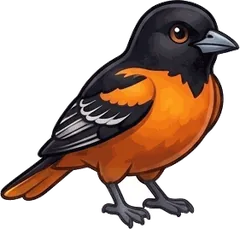 Baltimore Oriole
The Baltimore Oriole sings a short set of sweet, clear whistles, often in pairs. Bullock's songs work in more harsh chatter and squeaks. The two meet and hybridize on the Great Plains, where only a look at the male's face settles it.
- ?Hooded Oriole
Shares California and the Southwest. Its song is a rambling run of whistles, chatters and warbles that can include imitations of other birds, looser than Bullock's short phrases. It favors palm trees, while Bullock's prefers tall cottonwoods and willows.
Where the Bullock's Oriole card lives
In Warble the same bird can be an easy card in one state and a prized one in another, because each album ranks its birds by how often people really report them there. The Bullock's Oriole appears in 6 state albums:
 Heard one? Open Warble, tap the green button while it sings, and the Bullock's Oriole card flips into your album. Get the app free.
Questions people ask
Do female Bullock's Orioles sing?
Yes. Both sexes sing. The female's song is lower and less sweet than the male's, she sings most early in the season, and she has been heard singing while building the nest. The bird singing nearest the nest is often the female.
What is the chattering sound a Bullock's Oriole makes?
That is its main call, a dry, rapid scolding rattle. It keeps families in touch, warns rivals and raises the alarm, and birds often give it as they take off.
Is the Bullock's Oriole the same as the Northern Oriole?
It used to be. For a time Bullock's and Baltimore Orioles were treated as one species, the Northern Oriole. They were split again in 1995, after DNA work and evidence that the zone where they interbreed was not spreading.
When do Bullock's Orioles leave?
Early. Many have left northern breeding areas by the end of July, and the migration south continues through September. They travel at night in small, loose flocks and spend the winter in western Mexico.
Sources
- National Audubon Society, Guide to North American Birds: Bullock's Oriole. www.audubon.org/field-guide/bird/bullocks-oriole
- Animal Diversity Web: Icterus bullockii (song, range, diet, breeding). animaldiversity.org/accounts/Icterus_bullockii/
- Sacramento Audubon Society: Meet the Bullock's Oriole (song, calls, timing). www.sacramentoaudubon.org/kids-corner/meet-the-bullocks-oriole
- Wikipedia: Baltimore oriole (song and calls). en.wikipedia.org/wiki/Baltimore_oriole
- National Audubon Society, Guide to North American Birds: Hooded Oriole. www.audubon.org/field-guide/bird/hooded-oriole