 Warble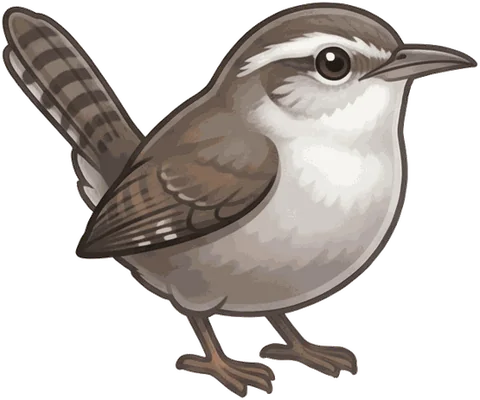
A Bewick's Wren sounds like a Song Sparrow with a wren's energy: a loud, clear, musical song in two or three parts, typically a few introductory notes, a buzz or a higher phrase, and a finishing trill. Audubon calls it the usual bubbly wren warble, also reminiscent of a Song Sparrow, and that is exactly the mix-up most people make. When the bird is bothered it switches to a harsh, buzzing scold. Listen for it in oak scrub, chaparral and brushy yards across the West, with its long tail flicking from side to side.
What the song sounds like
The song is loud and melodious, built from three to five phrases with one or two distinct trills. A typical version opens with a couple of short notes, moves through a buzz or a higher sweet phrase, and ends on a trill, so your ear hears two or three parts. The whole thing has the bubbling, hurried quality of a wren, but the clear whistles and the closing trill are what make people think of a Song Sparrow. The tone is cleaner and more musical than the gurgling jumble of a House Wren.
No two males sound quite the same. Each has a repertoire of between 9 and 22 songs, and he switches among them, sometimes throwing his voice so the song seems to come from somewhere else. Young males do not learn from their fathers; they pick up songs from the neighboring males around the territory they settle on, copying with small mistakes that give each bird its own versions. Eastern and western populations sing differently.
The call: a buzzing scold
Away from the song, an agitated Bewick's Wren gives a harsh, buzzing scold, the sound you hear when you walk too close to a nest box or a cat crosses the yard. Both sexes make short calls while foraging, and the female uses brief sker and swee notes to get her mate's attention. Males sometimes snap their bills in aggression. A buzz followed by a glimpse of a long barred tail flipping sideways is a reliable identification.
When and where you hear it
Today this is a western bird. It is most abundant along the Pacific coast from Baja California north to Washington and southern British Columbia, and it is common through Arizona, New Mexico and Texas, with birds east onto the Plains. It likes dry, brushy places: chaparral and sage scrub, the understory of oak and pine woodland, streamside groves, desert washes and well-planted suburbs. In the drier parts of the Southwest it outnumbers the House Wren.
The story in the East is different. Bewick's Wren once lived east to the Appalachians and north to Ontario and Pennsylvania, and over the last few decades it has disappeared from almost everywhere east of the Mississippi. The leading explanation is the House Wren, which competes for the same cavities and destroys Bewick's nests and eggs; pesticides and the regrowth of forest on old farmland are also blamed. Western populations, meanwhile, are expanding northward.
Western birds stay put all year, though some leave high elevations and the northern edge in winter. The song is loudest in spring, when males sing to claim a territory and pause to chase rivals. Watch the bird forage: it climbs trunks probing bark, hangs upside down under twigs, and flips leaves on the ground, eating beetles, ants, wasps, caterpillars and spiders, plus suet and mealworms at feeders. Nests go in any cavity, from woodpecker holes to nest boxes, mailboxes and tin cans, and the male builds extra dummy nests before the female picks one. In California it is one of the first songs that confuses new Warble players, because the app and the player both have to decide between wren and sparrow.
What it looks like
A slim wren 5 to 6 inches long with a 7 to 9 inch wingspan, weighing about a third of an ounce. It is plain brown above and pale gray below, with a bold white eyebrow and a long tail barred with black and tipped with white corners. The tail is rarely still; the bird flips it from side to side and cocks it up when asserting itself. The bill is long, slender and slightly curved. A Carolina Wren is richer in color and lacks the white tail corners. Audubon named the species in 1827 for his friend Thomas Bewick, the English engraver.
Birds that sound similar
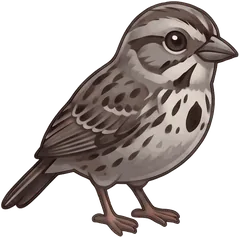 Song Sparrow
The Song Sparrow starts with three short notes and finishes with a varied trill, and the two songs can be very close. The wren's version is thinner and more hurried, and it comes from a bird with a cocked, flicking tail.
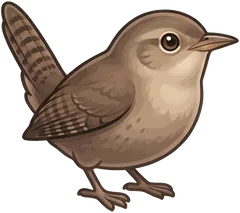 House Wren
A House Wren's song is a gurgling, bubbling rush that rises and then tumbles down with no clear separate parts. Bewick's is slower and more organized, with distinct phrases and a proper trill at the end.
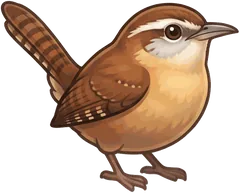 Carolina Wren
Where they overlap in Texas, the Carolina Wren's tea-kettle, tea-kettle, tea-kettle is a louder, rolling repetition of one three-syllable phrase. Bewick's changes phrase within a single song and ends in a trill.
Where the Bewick's Wren card lives
In Warble the same bird can be an easy card in one state and a prized one in another, because each album ranks its birds by how often people really report them there. The Bewick's Wren appears in 9 state albums:
 Heard one? Open Warble, tap the green button while it sings, and the Bewick's Wren card flips into your album. Get the app free.
Questions people ask
How do I tell a Bewick's Wren from a Song Sparrow by sound?
With difficulty, which is why Audubon mentions the resemblance. Both open with a few notes and end with a trill. The wren's song is thinner and more hurried, and it switches versions often. If you can see the singer, a long barred tail flicking sideways settles it.
Why did Bewick's Wren disappear from the eastern United States?
The main suspect is the House Wren, which competes for nesting cavities and destroys Bewick's nests and eggs. Pesticides and the return of forest on former farmland may have contributed. The species is now extremely rare east of the Mississippi.
Do male and female Bewick's Wrens both sing?
The male sings. Females give short calls such as sker and swee to get their mate's attention, and both sexes scold with a harsh buzz.
Who was Bewick?
Thomas Bewick, an English wood engraver and friend of John James Audubon. Audubon named the wren for him in 1827.
Sources
- National Audubon Society, Guide to North American Birds: Bewick's Wren. www.audubon.org/field-guide/bird/bewicks-wren
- Wikipedia: Bewick's wren (song repertoire and learning, eastern decline, measurements, name). en.wikipedia.org/wiki/Bewick%27s_wren
- Animal Diversity Web: Thryomanes bewickii. animaldiversity.org/accounts/Thryomanes_bewickii/
- National Audubon Society, Guide to North American Birds: Song Sparrow. www.audubon.org/field-guide/bird/song-sparrow