 Warble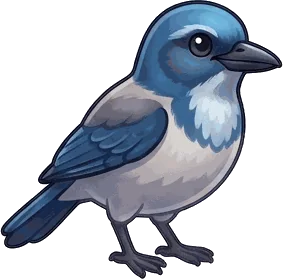
A California Scrub-Jay sounds harsh and a little annoyed. The common call is a loud, throaty, rising jayy? or jree?, often heard as a single upward weep, repeated at intervals from the top of an oak, a fence or a rooftop. In flight the bird gives a long run of check-check-check notes. There is also a buzzy rattle and a low, soft warbled song that the male sings in courtship and that few people ever notice. If a blue and gray bird without a crest is shouting at your cat in a California yard, this is it.
What the song sounds like
Like most jays, the California Scrub-Jay does most of its talking with calls, and the sound people search for is the rising weep. It is a loud, throaty, questioning note, written jayy? or jree?, flat or rising in pitch, with a scratchy, raucous edge. One bird gives it a few times, pauses, and gives it again, and a second bird often answers from the next yard. It carries well across open oak woodland, which is exactly where the bird wants to be heard.
There is a real song, and it is quiet. The male sings a soft sequence of low tones during courtship, a murmured warble that you will only catch if you are close and the bird is not paying attention to you. It bears no resemblance to the harsh public voice.
The most remarkable vocal display is the one nobody wants to witness. When a scrub-jay finds a dead jay, it gives a call that climbs rapidly and repeatedly from low to high pitch, and other jays gather to screech over the body. These loud gatherings can last up to half an hour and have earned the name funerals. The birds stop foraging while they do it, which suggests the racket is a way of sharing news of danger.
The calls: weep, check-check and a rattle
Beyond the rising weep, listen for the flight call, a long, even series of check-check-check-check notes given as the bird crosses an opening with its bouncing flight of quick wingbeats and glides. A dry buzz or rattle turns up in squabbles, and a scream that rises from low to high, given with the bill pointed at the sky, is the territorial threat. Pairs stay on one territory all year, so the same two voices will be scolding your yard in January and in July.
When and where you hear it
This is the scrub-jay of the Pacific slope: from southern British Columbia south through Washington, Oregon and California to Baja California, west of the Sierra Nevada, plus a corner of western Nevada around Reno. Until July 2016 it was lumped with the interior Woodhouse's Scrub-Jay as the Western Scrub-Jay, so older guides and apps may still use that name. The California bird is the brighter, more contrasty of the two, with a strong blue breast band on coastal birds.
Habitat is oak woodland, oak scrub, streamside woods, chaparral, foothill pinyon pine and the edges of mixed evergreen forest, and increasingly the well-wooded suburbs and parks built inside those habitats. They come to feeders. They are year-round residents but will wander in winter, especially after a dry year when the oaks drop few acorns. The range has been creeping north: breeding surveys in the 1970s found none in Washington, and by 2020 they were common around Puget Sound and even into British Columbia. Numbers dipped in California's Central Valley when West Nile virus arrived.
The acorn is the center of the year. From October to February scrub-jays eat mostly acorns, and they bury far more than they eat, in scattered caches across the territory. They remember more than 200 hiding places, along with what is in each one and how fast it will spoil, and they will move a cache if they notice another jay watching them hide it. In spring the diet shifts to insects, especially caterpillars for the young, and in early summer to fruit. Eggs, nestlings, lizards and small rodents round it out.
What it looks like
A slim, long-tailed jay about 11 to 12 inches long with no crest. The head, wings and long, rounded tail are deep blue, the back is a contrasting gray brown, and the underparts are pale gray with a white throat set off by a streaky blue necklace. A thin white eyebrow sits over a dark cheek. The wings are short and rounded and the bird moves through the open in a series of flaps and glides, tail trailing. Its brain is large for its body, and studies of caching have shown it planning for future needs, a talent otherwise known mostly from primates and dolphins.
Birds that sound similar
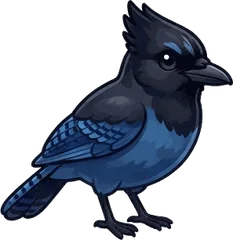 Steller's Jay
The Steller's Jay gives a fast run of identical harsh shack-shack-shack notes, and it lives in conifers. The scrub-jay's weep is a single rising question, given from oaks and yards.
 Blue Jay
A Blue Jay's clear jay, jay scream is longer and more whistled, and the two almost never overlap. The scrub-jay is scratchier and throatier, with a distinct upward inflection.
- ?Woodhouse's Scrub-Jay
The interior species split from the California bird in 2016 and sounds very similar. Range is the practical clue: California west of the Sierra crest, Woodhouse's in the Great Basin and Southwest.
Where the California Scrub-Jay card lives
In Warble the same bird can be an easy card in one state and a prized one in another, because each album ranks its birds by how often people really report them there. The California Scrub-Jay appears in 4 state albums:
 Heard one? Open Warble, tap the green button while it sings, and the California Scrub-Jay card flips into your album. Get the app free.
Questions people ask
Is the California Scrub-Jay the same as the Western Scrub-Jay?
Yes, in part. The Western Scrub-Jay was split into two species in July 2016: the California Scrub-Jay along the Pacific coast and the Woodhouse's Scrub-Jay of the interior West. The California bird is the bluer, more contrasting of the two.
Why do scrub-jays scream when they find a dead bird?
It is a real behavior, often called a jay funeral. A jay that finds a dead scrub-jay gives a rapidly rising call, other jays gather and screech over the body for up to half an hour, and all of them stop feeding. It appears to warn the group that something dangerous is nearby.
Do scrub-jays remember where they bury acorns?
Yes, extremely well. A single bird can track more than 200 caches, remembering what it hid and how quickly each food spoils. If another jay watched it hide something, it will often come back alone and move the cache.
Do California Scrub-Jays migrate?
No. Pairs hold one territory all year and stay together on it. Some birds wander in winter, mainly in dry years when the acorn crop fails, and the species as a whole has been spreading north into Washington and British Columbia.
Sources
- National Audubon Society, Guide to North American Birds: California Scrub-Jay. www.audubon.org/field-guide/bird/california-scrub-jay
- Wikipedia: California scrub jay (range, split from Woodhouse's, caching memory, funerals, northward expansion). en.wikipedia.org/wiki/California_scrub_jay
- Animal Diversity Web: Aphelocoma californica (vocalizations, seasonal diet, territory). animaldiversity.org/accounts/Aphelocoma_californica/